Sunday, January 27, 2008

William Hazlitt about Lord Byron

Lord Byron and Sir Walter Scott are among writers now living the two, who would carry away a majority of suffrages as the greatest geniuses of the age. The former would, perhaps, obtain the preference with the fine gentlemen and ladies (squeamishness apart), the latter with the critics and the vulgar. We shall treat of them in the same connection, partly on account of their distinguished pre-eminence, and partly because they afford a complete contrast to each other. In their poetry, in their prose, in their politics, and in their tempers, no two men can be more unlike.

If Sir Walter Scott may be thought by some to have been


'Born universal heir to all humanity,'

it is plain Lord Byron can set up no such pretension. He is, in a striking degree, the creature of his own will. He holds no communion with his kind, but stands alone without mate or fellow --


'As if a man were author of himself,

And owned no other kin.'


He is like a solitary peak, all access to which is cut off not more by elevation than distance. He is seated on a lofty eminence, 'cloud-capt,' or reflecting the last rays of setting suns, and in his poetical moods reminds us of the fabled Titans, retired to a ridgy steep, playing on their Pan's-pipes, and taking up ordinary men and things in their hands with haughty indifference. He raises his subject to himself, or tramples on it; he neither stoops to, nor loses himself in it. He exists not by sympathy, but by antipathy. He scorns all things, even himself. Nature must come to him to sit for her picture: he does not go to her. She must consult his time, his convenience and his burnout, and wear a sombre or a fantastic garb, or his Lordship turns his back upon her. There is no ease, no unaffected simplicity of manner, no 'golden mean.' All is strained, or petulant in the extreme. His thoughts are sphered and crystalline; his style 'prouder than when blue Iris bends'; his spirit fiery, impatient, wayward, indefatigable. Instead of taking his impressions from without, in entire and almost unimpaired masses, he moulds them according to his own temperament, and heats the materials of his imagination in the furnace of his passions. Lord Byron's verse glows like a flame, consuming every thing in its way; Sir Walter Scott's glides like a river: clear, gentle, harmless. The poetry of the first scorches, that of the last scarcely warms. The light of the one proceeds from an internal source, ensanguined, sullen, fixed; the other reflects the hues of Heaven or the face of nature, glancing, vivid and various.

The productions of the Northern Bard have the rust and the freshness or antiquity about them; those of the Noble Poet cease to startle from their extreme ambition of novelty, both in style and matter. Sir Walter's rhymes are 'silly sooth' --


'And dally with the innocence of thought,

Like the old age' --


his Lordship's Muse spurns the olden time, and affects all the supercilious airs of a modern fine lady and an upstart. The object of the one writer is to restore us to truth and nature: the other chiefly thinks how he shall display his own power, or vent his spleen, or astonish the reader either by starting new subjects and trains of speculation, or by expressing old ones in a more striking and emphatic manner than they have been expressed before. He cares little what it is he says, so that he can say it differently from others. This may account for the charges of plagiarism which have been repeatedly brought against the Noble Poet. If he can borrow an image or sentiment from another, and heighten it by an epithet or an allusion of greater force and beauty than is to be found in the original passage, he thinks he shows his superiority of execution in this in a more marked manner than if the first suggestion had been his own. It is not the value of the observation itself he is solicitous about; but he wishes to shine by contrast -even nature only serves as a foil to set off his style. He therefore takes the thoughts of others (whether contemporaries or not) out of their mouths, and is content to make them his own, to set his stamp upon them, by imparting to them a more meretricious gloss, a higher relief, a greater loftiness of tone, and a characteristic inveteracy of purpose.

Even in those collateral ornaments of modern style, slovenliness, abruptness and eccentricity (as well as in terseness and significance), Lord Byron, when he pleases, defies competition and surpasses all his contemporaries. Whatever he does, he must do in a more decided and daring manner than any one else; he lounges with extravagance, and yawns so as to alarm the reader! Self-will, passion, the love of singularity, a disdain of himself and of others (with a conscious sense that this is among the ways and means of procuring admiration) are the proper categories of his mind: he is a lordly writer, is above his own reputation, and condescends to the Muses with a scornful grace!

Lord Byron, who in his politics is a liberal. in his genius haughty and aristocratic: Walter Scott, who is an aristocrat in principle, is popular in his writings, and is (as it were) servile to nature and to opinion. The genius of Sir Walter is essentially imitative or 'denotes a foregone conclusion': that of Lord Byron is self-dependent or at least requires no aid, is governed by no law but the impulses of its own will. We confess, however much we may admire independence of feeling and erectness of spirit in general or practical questions, yet in works of genius we prefer him who bows to the authority of nature, who appeals to actual objects, to mouldering superstitions, to history, observation and tradition, before him who only consults the pragmatical and restless workings of his own breast, and gives them out as oracles to the world. We, like a writer (whether poet or prose writer) who takes in (or is willing to take in) the range of half the universe in feeling, character, description, much better than we do one who obstinately and invariably shuts himself up in the Bastille of his own ruling passions. In short, we had rather be Sir Walter Scott (meaning thereby the Author of Waverley) than Lord Byron a hundred times over, and for the reason just given, namely, that he casts his descriptions in the mould of nature, ever-varying, never tiresome, always interesting and always instructive, instead of casting them constantly in the mould of his own individual impressions.

He gives us man as he is, or as he was, in almost every variety of situation, action and feeling. Lord Byron makes man after his own image, woman after his own heart; the one is a capricious tyrant, the other a yielding slave; he gives us the misanthrope and the voluptuary by turns; and with these two characters, burning or melting in their own fires, he makes out everlasting centos of himself. He hangs the cloud, the film of his existence over all outward things, sits in the centre of his thoughts, and enjoys dark night, bright day, the glitter and the gloom 'in cell monastic.' We see the mournful pall, the crucifix, the death's-heads, the faded chaplet of flowers, the gleaming tapers, the agonized brow of genius, the wasted form of beauty; but we are still imprisoned in a dungeon; a curtain intercepts our view; we do not breathe freely the air of nature or of our own thoughts. The other admired author draws aside the curtain, and the veil of egotism is rent; and he shows us the crowd of living men and women, the endless groups, the landscape background, the cloud and the rainbow, and enriches our imaginations and relieves one passion by another, and expands and lightens reflection, and takes away that tightness at the breast which arises from thinking or wishing to think that there is nothing in the world out of a man's self!

In this point of view, the Author of Waverley is one of the greatest teachers of morality that ever lived, by emancipating the mind from petty, narrow, and bigoted prejudices: Lord Byron is the greatest pamperer of those prejudices, by seeming to think there is nothing else worth encouraging but the seeds or the full luxuriant growth of dogmatism and self-conceit. In reading the Scotch Novels, we never think about the author, except from a feeling of curiosity respecting our unknown benefactor: in reading Lord Byron's works, he himself is never absent from our minds. The colouring of Lord Byron's style, however rich and dipped in Tyrian dyes, is nevertheless opaque, is in itself an object of delight and wonder: Sir Walter Scott's is perfectly transparent. In studying the one, you seem to gaze at the figures cut in stained glass, which exclude the view beyond, and where the pure light of Heaven is only a means of setting off the gorgeousness of art: in reading the other, you look through a noble window at the clear and varied landscape without. Or to sum up the distinction in one word, Sir Walter Scott is the most dramatic writer now living, and Lord Byron is the least so.

It would be difficult to imagine that the Author of Waverley is in the smallest degree a pedant, as it would be hard to persuade ourselves that the author of Childe Harold and Don Juan is not a coxcomb, though a provoking and sublime one. In this decided preference given to Sir Walter Scott over Lord Byron, we distinctly include the prose-works of the former; for we do not think his poetry alone by any means entitles him to that precedence. Sir Walter in his poetry, though pleasing and natural, is a comparative trifler it is in his anonymous production that he has shown himself for what he is.

Intensity is the great and prominent distinction of Lord Byron's writings. He seldom gets beyond force of style, nor has he produced any regular work or masterly whole. He does not prepare any plan beforehand, nor revise and retouch what he has written with polished accuracy. His only object seems to be to stimulate himself and his readers for the moment -- to keep both alive, to drive away ennui, to substitute a feverish and irritable state of excitement for listless indolence or even calm enjoyment. For this purpose he pitches on any subject at random without much thought or delicacy. He is only impatient to begin, and takes care to adorn and enrich it as he proceeds with 'thoughts that breathe and words that burn.' He composes (as he himself has said) whether he is in the bath, in his study, or on horseback; he writes as habitually as others talk or think; and whether we have the inspiration of the Muse or not, we always find the spirit of the man of genius breathing from his verse. He grapples with his subject, and moves, penetrates and animates it by the electric force of his own feelings. He is often monotonous, extravagant, offensive; but he is never dull or tedious, but when he writes prose.

Lord Byron does not exhibit a new view of nature, or raise insignificant objects into importance by the romantic associations with which he surrounds them, but generally (at least) takes common-place thoughts and events, and endeavours to express them in stronger and statelier language than others. His poetry stands like a Martello tower by the side of his subject. He does not, like Mr. Wordsworth, lift poetry from the ground, or create a sentiment out of nothing. He does not describe a daisy or a periwinkle, but the cedar or the cypress: not 'poor men's cottages, but princes' palaces.' His Childe Harold contains a lofty and impassioned review of the great events of history, of the mighty objects left as wrecks of time; but he dwells chiefly on what is familiar to the mind of every school-boy, has brought out few new traits of feeling or thought, and has done no more than justice to the reader's preconceptions by the sustained force and brilliancy of his style and imagery.

Lord Byron's earlier productions, Lara, the Corsair, etc., were wild and gloomy romances, put into rapid and shining verse. They discover the madness of poetry, together with the inspiration: sullen, moody, capricious, fierce, inexorable: gloating on beauty, thirsting for revenge: hurrying from the extremes of pleasure to pain, but with nothing, permanent, nothing healthy or natural. The gaudy decorations and the morbid sentiments remind one of the flowers strewed over the face of death! In his Childe Harold (as has been just observed) he assumes a lofty and philosophic tone, and 'reasons high of providence, fore-knowledge, will, and fate.' He takes the highest points in the history of the world, and comments on them from a more commanding eminence. He shows us the crumbling monuments of time; he invokes the great names, the mighty spirit of antiquity. The universe is changed into a stately mausoleum: in solemn measures he chaunts a hymn to fame. Lord Byron has strength and elevation enough to fill up the moulds of our classical and time-hallowed recollections, and to rekindle the earliest aspirations of the mind after greatness and true glory with a pen of fire. The names of Tasso, of Ariosto, of Dante, of Cincinnatus, of Caesar, of Scipio, lose nothing of their pomp or their lustre in his hands, and when he begins and continues a strain of panegyric on such subjects, we indeed sit down with him to a banquet of rich praise, brooding over imperishable glories,


'Till Contemplation has her fill.'

Lord Byron seems to cast himself indignantly from 'this bank and shoal of time,' or the frail tottering bark that bears up modern reputation, into the huge sea of ancient renown, and to revel there with untired, outspread plume. Even this in him is spleen; his contempt of his contemporaries makes him turn back to the lustrous past, or project himself forward to the dim future! Lord Byron's tragedies, Faliero, Sardanapalus, etc., are not equal to his other works. They want the essence of the drama. They abound in speeches and descriptions, such as he himself might make either to himself or others, lolling on his couch of a morning, but do not carry the reader out of the poet's mind to the scenes and events recorded. They have neither action, character, nor interest, but are a sort of gossamer tragedies, spun out and glittering, and spreading a flimsy veil over the face of nature. Yet he spins them on. Of all that he has done in this way the Heaven and Earth (the same subject as Mr. Moore's Loves of the Angels) is the best. We prefer it even to Manfred. Manfred is merely himself with a fancy-drapery on. But, in the dramatic fragment published in the Liberal, the space between Heaven and earth, the stage on which his characters have to pass to and fro, seems to fill hi imagination; and the Deluge, which has so finely described, inay be said to have drowned all his own idle humours.

We must say we think little of our author's turn for satire. His 'English Bards and Scotch Reviewers' is dogmatical and insolent, but without refinement or point. He calls people names, and tries to transfix a character with an epithet, which does not stick, because it has no other foundation than his own petulance and spite; or he endeavours to degrade by alluding to some circumstance of external situation. He says of Mr. Wordsworth's poetry, that 'it is his aversion.' That may be: but whose fault is it? This is the satire of a lord, who is accustomed to have all his whims or dislikes taken for gospel, and who cannot be at the pains to do more than signify his contempt or displeasure. If a great man meets with a rebuff which he does not like, he turns on his heel, and this passes for a repartee. The Noble Author says of a celebrated barrister and critic, that he was 'born in a garret sixteen stories high.' The insinuation is not true, or, if it were, it is low. The allusion degrades the person who makes it, not him to whom it is applied. This is also the satire of a person of birth and quality, who measures all merit by external rank, that is, by his own standard. So his Lordship, in a 'Letter to the Editor of my Grandmother's Review,' addresses him fifty times as 'my dear Robarts'; nor is there any other wit in the article. This is surely a mere assumption of superiority from his Lordship's rank, and is the sort of quizzing he might use to a person who came to hire himself as a valet to him at Long's. The waiters might laugh; the public will not. In like manner, in the controversy about Pope, he claps Mr. Bowles on the back with a coarse facetious familiarity, as if he were his chaplain whom he had invited to dine with him, or was about to present to a benefice. The reverend divine might submit to the obligation; but he has no occasion to subscribe to the jest. If it is a jest that Mr. Bowles should be a parson and Lord Byron a peer, the world knew this before; there was no need to write a pamphlet to prove it.

The Don Juan indeed has great power; but its power is owing to the force of the serious writing, and to the contrast between that and the flashy passages with which it interlarded. From the sublime to the ridiculous there is but one step. You laugh and are surprised that any one should turn round and travestie himself: the drollery is in the utter discontinuity of ideas and feelings. He makes virtue serve as a foil to vice; dandyism is (for want of any other) a variety of genius. A classical intoxication is followed by the splashing of sodawater, by frothy effusions of ordinary bile. After the lightning and the hurricane, we are introduced to the interior of the cabin and the contents of the wash-hand basins. The solemn hero of tragedy plays Scrub in the farce. This is 'very tolerable and not to be endured.'

The noble Lord is almost the only writer who has prostituted his talents in this way. He hallows in order to desecrate, takes a pleasure in defacing the images of beauty his hands have wrought, and raises our hopes and our belief in goodness to Heaven only to dash them to the earth again, and break them in pieces the more effectually from the very height they have fallen. Our enthusiasm for genius or virtue is thus turned into a jest by the very person who has kindled it, and who thus fatally quenches the spark of both. It is not that Lord Byron is sometimes serious and sometimes trifling, sometimes profligate and sometimes moral; but when he is most serious and most moral, he is only preparing to mortify the unsuspecting reader by putting a pitiful hoax upon him. This is a most unaccountable anomaly. It is as if the eagle were to build its eyry in a common sewer, or the owl were seen soaring to the mid-day sun. Such a sight might make one laugh, but one would not wish or expect it to occur more than once!

Again, there is no taint in the writings of the Author of Waverley; all is fair and natural and above-board; he never outrages the public mind. He introduces no anomalous character, broaches no staggering opinion. If he goes back to old prejudices and superstitions as a relief to the modern reader, while Lord Byron floats on swelling paradoxes --


'Like proud seas under him';


if the one defers too much to the spirit of antiquity, the other panders to the spirit of the age, goes to the very edge of extreme and licentious speculation, and breaks his neck over it. Grossness and levity are the playthings of his pen. It is a ludicrous circumstance that he should have dedicated his Cain to the worthy Baronet! Did the latter ever acknowledge the obligation? We are not nice, not very nice; but we do not particularly approve those subjects that shine chiefly from their rottenness: nor do we wish to see the Muses drest out in the flounces of a false or questionable philosophy, like Portia and Nerissa in the garb of Doctors of Law. We like metaphysics as well as Lord Byron; but not to see them making flowery speeches, nor dancing a measure in the fetters of verse. We have as good as hinted, that his Lordship's poetry consists mostly of a tissue of superb common-places; even his paradoxes are common-place. They are familiar in the schools: they are only new and striking in his dramas and stanzas by being out of place. In a word, we think that poetry moves best within the circle of nature and received opinion: speculative theory and subtle casuistry are forbidden ground to it.

But Lord Byron often wanders into this ground wantonly, wilfully, and unwarrantably. The only apology we can conceive for the spirit of some of Lord Byron's writings, is the spirit of some of those opposed to him. They would provoke a man to write anything. 'Farthest from them is best.' The extravagance and license of the one seems a proper antidote to the bigotry and narrowness of the other. The first Vision of Judgment was a set-off to the second, though


'None but itself could be its parallel.'


Perhaps the chief cause of most of Lord Byron's errors is, that he is that anomaly in letters and in, society, a Noble Poet. It is a double privilege, almost too much for humanity. He has all the pride of birth and genius. The strength of his imagination leads him to indulge in fantastic opinions; the elevation of his rank sets censure at defiance. He becomes a pampered egotist. He has a seat in the House of Lords, a niche in the Temple of Fame. Every-day mortals, opinions, things are not good enough for him to touch or think of. A mere nobleman is, in his estimation, but 'the tenth transmitter of a foolish face': a mere man of genius is no better than a worm. His Muse is also a lady of quality. The people are not polite enough for him; the Court is not sufficiently intellectual. He hates the one and despises the other. By hating and despising others, he does not learn to be satisfied with himself. A fastidious man soon grows querulous and splenetic. If there is nobody but ourselves to come up to our idea of fancied perfection, we easily get tired of our idol.

When a man is tired of what he is, by a natural perversity he sets up for what he is not. If he is a poet, he pretends to be a metaphysician: if he is a patrician in rank and feeling, he would fain be one of the people. His ruling motive is not the love of the people, but of distinction: not of truth, but of singularity. He patronizes men of letters out of vanity, and deserts them from caprice or from the advice of friends. He embarks in an obnoxious publication to provoke censure, and leaves it to shift for itself for fear of scandal. We do not like Sir Walter's gratuitous servility: we like Lord Byron's preposterous liberalism little better. He may affect the principles of equality, but he resumes his privilege of peerage, upon occasion. His Lordship has made great offers of service to the Greeks -- money and horses. He is at present in Cephalonia, waiting the event!

We had written thus far when news came of the death of Lord Byron, and put an end at once to a strain of somewhat peevish invective, which was intended to meet his eye, not to insult his memory. Had we known that we were writing his epitaph, we must have done it with a different feeling. As it is, we think it better and more like himself, to let what we had written stand, than to take up our leaden shafts, and try to melt them into 'tears of sensibility,' or mould them into dull praise and an affected show of candour. We were not silent during the author's life-time, either for his reproof or encouragement (such as we could give, and he did not disdain to accept) nor can we now turn undertakers' men to fix the glittering plate upon his coffin, or fall into the procession of popular woe. Death cancels every thing but truth, and strips a man of every thing but genius and virtue. It is a sort of natural canonization. It makes the meanest of us sacred; it installs the poet in his immortality, and lifts him to the skies. Death is the great assayer of the sterling ore of talent. At his touch the drossy particles fall off, the irritable, the personal, the gross, and mingle with the dust -- the finer and more ethereal part mounts with the winged spirit to watch over our latest memory, and protect our bones from insult. We consign the least worthy qualities to oblivion, and cherish the nobler and imperishable nature with double pride and fondness.

Nothing could show the real superiority of genius in a more striking point of view than the idle contests and the public indifference about the place of Lord Byron's interment, whether in Westminster Abbey or his own family vault. A king must have a coronation -- a nobleman a funeral-procession. The man is nothing without the pageant. The poet's cemetery is the human mind, in which he sows the seeds of never-ending thought -- his monument is to be found in his works:


'Nothing can cover his high fame but Heaven;

No pyramids set off his memory,

But the eternal substance of his greatness!


Lord Byron is dead: he also died a martyr to his zeal in the cause of freedom, for the last, best hopes of man. Let that be his excuse and his epitaph!


from The Spirit of the Age, William Hazlitt

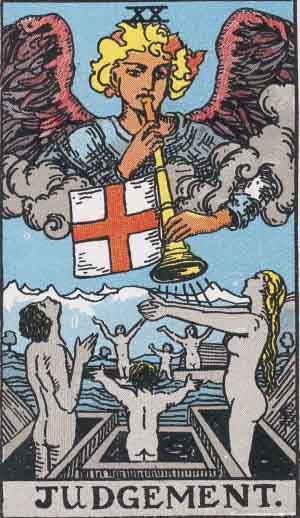
Tarot - Judgement


Basic Card Symbols

Angel, trumpets, graves with people rising from them, often water or an ocean.

Basic Tarot Story

As the Fool leaves the garden of the Sun, he feels that he is near the end of his journey, ready to take a final step. But something is keeping him from doing this, holding him back. He gazes up, hoping to find guidance from the Sun; instead he sees above him a fiery angel, beautiful and terrible.

"You are right," the Angelic figure confirms, "you have only one last step on your journey, one final step to completion. But you cannot take that step until you lay your past to rest." The Fool is perturbed. "Lay it to rest? I thought I'd left it behind, all of it," he says. "There is no way to do that," The Angel observes. "Each step wears down the shoe just a bit, and so shapes the next step you take, and the next and the next. Your past is always under your feet. You cannot hide from it, run from it, or rid yourself of it. But you can call it up, and come to terms with it. Are you willing to do that?"

The Angel hands the Fool a small trumpet. The Fool is hesitant, but he knows that this is a final decision. Either to go forward, or stay where he is. He blows, and the trumpet's song echoes across the sky, its vibrations seeming to crack open the Earth. From under the Fool's feet, memories rise. Images of his innocent youth, challenges, loves, failures, losses, success, disillusionment and wisdom.

For the first time, he does not try to leave them, ignore or forget them, but accepts them. They are, he sees, nothing to fear. They happened, but they are gone now. He, alone, carries them into the present. With that understanding, the memories vanish. Though they remain in his mind, they no longer have any power over him. He is free of them, reborn, and wholly in the present.

Basic Tarot Meaning

With Fire as its ruling element (or Pluto as its ruling planet), Judgement is about rebirth, ressurection. The idea of Judgement day is that the dead rise, their sins are forgiven, and they move onto heaven. The Judgement card is similar, it asks the resurrection to summon the past, forgive it, and let it go. There are wounds from the past that we never let heal, sins we've committed that we refuse to forgive, bad habits we haven't the courage to lose. Judgement advises us to finally face these, recognize that the past is past, and put them to rest, absolutely and irrevocably. This is also a card of healing, quite literally from an accident or illness, as well as a card signaling great transformation, renewal, change.

Thirteen's Observations

Judgement is often a hard card to read; it usually signals just a big change, that involves leaving something old completely behind and stepping into something completely new. Like closing the door on an old job, and opening the door to a new and very different career. But it'is also about making a final decision, to take that plunge into the new career, to forgive your family, to leave an abusive spouse, to make a new life. To heal and renew. A very hard card to read in part because it deals with very hard and final decisions. And it means facing something that most Querent's don't want to face. You can't hide any longer, this card says, all the dead have risen and are out in the open. Face what you have to face, make that decision. Change.

source: http://www.aeclectic.net/tarot/learn/meanings/

Tuesday, January 8, 2008

Winnet and the Raven

"And what if I stay?"
"You will find yourself destroyed by grief. All you know will be around you, and at the same time far from you. Better to find a new place now."
Winnet thought about this, while the raven balanced patiently on her shoulder.
"Will you come with me?"
"I can't, I'm bound here, but take this!" The raven flew down and as far as Winnet could see, started vomiting on the flags. Then he rearranged his feathers and dropped a rough brown peddle into her hand.
"Thank you" said Winnet. "What is it?"
"It's my heart."
"But it's made of stone."
"I know," the raven replied sadly. "You see I chose to stay, oh, a long time ago, and my heart grew thick with sorrow, and finally set. It will remind you."

excerpt from Jeannette Winterson's 'Oranges Are Not The Only Fruit'

Saturday, December 29, 2007

Little Thumb - Charles Perrault

Once upon a time there lived a woodcutter and his wife; they had seven children, all boys. The eldest was but ten years old, and the youngest only seven. People were astonished that the woodcutter had had so many children in such a short time, but his wife was very fond of children, and never had less than two at a time

They were very poor, and their seven children inconvenienced them greatly, because not one of them was able to earn his own way. They were especially concerned, because the youngest was very sickly. He scarcely ever spoke a word, which they considered to be a sign of stupidity, although it was in truth a mark of good sense. He was very little, and when born no bigger than one's thumb, for which reason they called him Little Thumb.

The poor child bore the blame of everything that went wrong in the house. Guilty or not, he was always held to be at fault. He was, notwithstanding, more cunning and had a far greater share of wisdom than all his brothers put together. And although he spoke little, he listened well.

There came a very bad year, and the famine was so great that these poor people decided to rid themselves of their children. One evening, when the children were all in bed and the woodcutter was sitting with his wife at the fire, he said to her, with his heart ready to burst with grief, "You see plainly that we are not able to keep our children, and I cannot see them starve to death before my face. I am resolved to lose them in the woods tomorrow, which may very easily be done; for, while they are busy in tying up the bundles of wood, we can leave them, without their noticing."

"Ah!" cried out his wife; "and can you yourself have the heart to take your children out along with you on purpose to abandon them?"

In vain her husband reminded her of their extreme poverty. She would not consent to it. Yes, she was poor, but she was their mother. However, after having considered what a grief it would be for her to see them perish with hunger, she at last consented, and went to bed in tears.

Little Thumb heard every word that had been spoken; for observing, as he lay in his bed, that they were talking very busily, he got up softly, and hid under his father's stool, in order to hear what they were saying without being seen. He went to bed again, but did not sleep a wink all the rest of the night, thinking about what he had to do. He got up early in the morning, and went to the riverside, where he filled his pockets with small white pebbles, and then returned home.

They all went out, but Little Thumb never told his brothers one syllable of what he knew. They went into a very thick forest, where they could not see one another at ten paces distance. The woodcutter began his work, and the children gathered up the sticks into bundles. Their father and mother, seeing them busy at their work, slipped away from them without being seen, and returned home along a byway through the bushes.

When the children saw they had been left alone, they began to cry as loudly as they could. Little Thumb let them cry, knowing very well how to get home again, for he had dropped the little white pebbles all along the way. Then he said to them, "Don't be afraid, brothers. Father and mother have left us here, but I will lead you home again. Just follow me."

They did so, and he took them home by the very same way they had come into the forest. They dared not go in, but sat down at the door, listening to what their father and mother were saying.

The woodcutter and his wife had just arrived home, when the lord of the manor sent them ten crowns, which he had owed them a long while, and which they never expected. This gave them new life, for the poor people were almost famished. The woodcutter sent his wife immediately to the butcher's. As it had been a long while since they had eaten, she bought three times as much meat as would be needed for two people.

When they had eaten, the woman said, "Alas! Where are our poor children now? They would make a good feast of what we have left here; but it was you, William, who decided to abandon them. I told you that we would be sorry for it. What are they now doing in the forest? Alas, dear God, the wolves have perhaps already eaten them up. You are very inhuman to have abandoned your children in this way."

The woodcutter at last lost his patience, for she repeated it more than twenty times, that they would be sorry for it, and that she was right for having said so. He threatened to beat her if she did not hold her tongue. It was not that the woodcutter was less upset than his wife, but that she was nagging him. He, like many others, was of the opinion that wives should say the right thing, but that they should not do so too often.

She nearly drowned herself in tears, crying out, "Alas! Where are now my children, my poor children?"

She spoke this so very loud that the children, who were at the gate, began to cry out all together, "Here we are! Here we are!"

She immediately ran to open the door, and said, hugging them, "I am so glad to see you, my dear children; you are very hungry and tired. And my poor Peter, you are horribly dirty; come in and let me clean you."

Now, you must know that Peter was her eldest son, whom she loved above all the rest, because he had red hair, as she herself did.

They sat down to supper and ate with a good appetite, which pleased both father and mother. They told them how frightened they had been in the forest, speaking almost always all together. The parents were extremely glad to see their children once more at home, and this joy continued while the ten crowns lasted; but, when the money was all gone, they fell again into their former uneasiness, and decided to abandon them again. This time they resolved to take them much deeper into the forest than before.

Although they tried to talk secretly about it, again they were overheard by Little Thumb, who made plans to get out of this difficulty as well as he had the last time. However, even though he got up very early in the morning to go and pick up some little pebbles, he could not do so, for he found the door securely bolted and locked. Their father gave each of them a piece of bread for their breakfast, and he fancied he might make use of this instead of the pebbles, by throwing it in little bits all along the way; and so he put it into his pocket.

Their father and mother took them into the thickest and most obscure part of the forest, then, slipping away by an obscure path, they left them there. Little Thumb was not concerned, for he thought he could easily find the way again by means of his bread, which he had scattered along the way; but he was very much surprised when he could not find so much as one crumb. The birds had come and had eaten every bit of it up. They were now in great distress, for the farther they went the more lost and bewildered they became.

Night now came on, and there arose a terrible high wind, which made them dreadfully afraid. They fancied they heard on every side of them the howling of wolves coming to eat them up. They scarcely dared to speak or turn their heads. After this, it rained very hard, which drenched them to the skin; their feet slipped at every step they took, and they fell into the mire, getting them muddy all over. Their hands were numb with cold.

Little Thumb climbed to the top of a tree, to see if he could discover anything. Turning his head in every direction, he saw at last a glimmering light, like that of a candle, but a long way from the forest. He came down, but from the ground, he could no longer see it no more, which concerned him greatly. However, after walking for some time with his brothers in the direction where he had seen the light, he perceived it again as he came out of the woods.

They came at last to the house where this candle was, but not without many fearful moments, for every time they walked down into a hollow they lost sight of it. They knocked at the door, and a good woman opened it. She asked them what they wanted.

Little Thumb told her they were poor children who had been lost in the forest, and begged her, for God's sake, to give them lodging.

The woman, seeing that they were good looking children, began to weep, and said to them, "Alas, poor babies, where are you from? Do you know that this house belongs to a cruel ogre who eats up little children?"

"Ah! dear madam," answered Little Thumb (who, as well as his brothers, was trembling all over), "what shall we do? If you refuse to let us sleep here then the wolves of the forest surely will devour us tonight. We would prefer the gentleman to eat us, but perhaps he would take pity upon us, especially if you would beg him to."

The ogre's wife, who believed she could hide them from her husband until morning, let them come in, and had them to warm themselves at a very good fire. There was a whole sheep on the spit, roasting for the ogre's supper.

After they warmed up a little, they heard three or four great raps at the door. This was the ogre, who was come home. Hearing him, she hid them under the bed and opened the door. The ogre immediately asked if supper was ready and the wine drawn, and then sat down at the table. The sheep was still raw and bloody, but he preferred it that way. He sniffed about to the right and left, saying, "I smell fresh meat."

His wife said, "You can smell the calf which I have just now killed and flayed."

"I smell fresh meat, I tell you once more," replied the ogre, looking crossly at his wife, "and there is something here which I do not understand."

As he spoke these words he got up from the table and went directly to the bed. "Ah, hah!" he said. "I see then how you would cheat me, you cursed woman; I don't know why I don't eat you as well. It is fortunate for you that you are tough old carrion. But here is good game, which has luckily arrived just in time to serve to three ogre friends who are coming here to visit in a day or two."

With that he dragged them out from under the bed, one by one. The poor children fell upon their knees, and begged his pardon; but they were dealing with one of the cruelest ogres in the world. Far from having any pity on them, he had already devoured them with his eyes. He told his wife that they would be delicate eating with good savory sauce. He then took a large knife, and, approaching the poor children, sharpened it on a large whetstone which he held in his left hand.

He had already taken hold of one of them when his wife said to him, "Why do it now? Is it not tomorrow soon enough?"

"Hold your chatter," said the ogre; "they will be more tender, if I kill them now."

"But you have so much meat already," replied his wife. "You have no need for more. Here are a calf, two sheep, and half a hog."

"That is true," said the ogre. "Feed them so they don't get too thin, and put them to bed."

The good woman was overjoyed at this, and offered them a good supper, but they were so afraid that they could not eat a bit. As for the ogre, he sat down to drink, being highly pleased that now had something special to treat his friends. He drank a dozen glasses more than ordinary, which went to his head and made him sleepy.

The ogre had seven little daughters. These young ogresses all had very fine complexions, because they ate fresh meat like their father; but they had little gray eyes, quite round, hooked noses, and very long sharp teeth, well spaced from each other. As yet they were not overly mischievous, but they showed great promise for it, for they had already bitten little children in order to suck their blood.

They had been put to bed early, all seven in a large bed, and each of them wearing a crown of gold on her head. The ogre's wife gave the seven little boys a bed just as large and in the same room, then she went to bed to her husband.

Little Thumb, who had observed that the ogre's daughters had crowns of gold upon their heads, and was afraid lest the ogre should change his mind about not killing them, got up about midnight, and, taking his brothers' caps and his own, went very softly and put them on the heads of the seven little ogresses, after having taken off their crowns of gold, which he put on his own head and his brothers', that the ogre might take them for his daughters, and his daughters for the little boys whom he wanted to kill.

All of this happened according to his plan for, the ogre awakened about midnight and, regretting that he had put off until morning that which he might have done tonight, he hastily got out of bed and picked up his large knife. "Let us see," he said, "how our little rogues are doing! We'll not make that mistake a second time!"

He then went, groping all the way, into his daughters' room. He came to the bed where the little boys lay. They were all fast asleep except Little Thumb, who was terribly afraid when he felt the ogre feeling about his head, as he had done about his brothers'. Feeling the golden crowns, the ogre said, "That would have been a terrible mistake. Truly, I did drink too much last night."

Then he went to the bed where the girls lay. Finding the boys' caps on them, he said, "Ah, hah, my merry lads, here you are. Let us get to work." So saying, and without further ado, he cut all seven of his daughters' throats. Well pleased with what he had done, he went to bed again to his wife.

As soon as Little Thumb heard the ogre snore, he wakened his brothers and told them to put on their clothes immediately and to follow him. They stole softly down into the garden, and climbed over the wall. They kept running nearly the whole night, trembling all the while, and not knowing which way they were going.

The ogre, when he awoke, said to his wife, "Go upstairs and dress those young rascals who came here last night."

The ogress was very much surprised at this goodness of her husband, not dreaming how he intended that she should dress them, thinking that he had ordered her to go and put their clothes on them, she went up, and was horribly astonished when she saw her seven daughters with their throats cut and lying in their own blood.

She fainted away, for this is the first expedient almost all women find in such cases. The ogre, fearing his wife would be too long in doing what he had ordered, went up himself to help her. He was no less amazed than his wife at this frightful spectacle.

"What have I done?" he cried. "Those wretches shall soon pay for this!" He threw a pitcher of water on his wife's face, and, having brought her to herself, cried, "Bring me my seven-league boots at once, so that I can catch them."

He went out, and ran this way and that over a vast amount of ground. At last he came to the very road where the poor children were, and not more than a hundred paces from their father's house. They saw the ogre coming, who was stepping from mountain to mountain, and crossing over rivers as easily as if they were little streams. Little Thumb hid himself and his brothers in a nearby hollow rock, all the while keeping watch on the ogre.

The ogre was very tired from his long and fruitless journey (for seven-league boots are very tiring to wear), and decided to take a rest. By chance he sat on the rock where the little boys had hid themselves. He was so tired that he fell asleep, and began to snore so frightfully that the poor children were no less afraid of him than when he had held up his large knife and was about to cut their throats. However, Little Thumb was not as frightened as his brothers were, and told them that they immediately should run away towards home while the ogre was asleep so soundly, and that they should not worry about him. They took his advice, and soon reached home. Little Thumb came up to the ogre, pulled off his boots gently and put them on his own feet. The boots were very long and large, but because they were enchanted, they became big or little to fit the person who was wearing them. So they fit his feet and legs as well as if they had been custom made for him. He immediately went to the ogre's house, where he saw his wife crying bitterly for the loss of her murdered daughters.

"Your husband," said Little Thumb, "is in very great danger. He has been captured by a gang of thieves, who have sworn to kill him if he does not give them all his gold and silver. At the very moment they were holding their daggers to his throat he saw me, and begged me to come and tell you the condition he is in. You should give me everything he has of value, without keeping back anything at all, for otherwise they will kill him without mercy. Because his case is so very urgent, he lent me his boots (you see I have them on), that I might make the more haste and to show you that he himself has sent me to you."

The good woman, being sadly frightened, gave him all she had, for although this ogre ate up little children, he was a good husband. Thus Little Thumb got all the ogre' s money. He returned with it to his father's house, where he was received with great joy.

There are many people who do not agree with this last detail. They claim that Little Thumb never robbed the ogre at all, that he only made off with the seven-league boots, and that with a good conscience, because the ogre's only use of them was to pursue little children. These folks affirm that they are quite sure of this, because they have often drunk and eaten at the woodcutter's house.

These people claim that after taking off the ogre's boots, Little Thumb went to court, where he learned that there was much concern about the outcome of a certain battle and the condition of a certain army, which was two hundred leagues off. They say that he went to the king, and told him that, if he desired it, he would bring him news from the army before night. The king promised him a great sum of money if he could do so. Little Thumb was as good as his word, and returned that very same night with the news. This first feat brought him great fame, and he could then name his own price. Not only did the king pay him very well for carrying his orders to the army, but the ladies of the court paid him handsomely to bring them information about their lovers. Occasionally wives gave him letters for their husbands, but they paid so poorly, that he did not even bother to keep track of the money he made in this branch of his business.

After serving as a messenger for some time and thus acquiring great wealth, he went home to his father, where he was received with inexpressible joy. He made the whole family very comfortable, bought positions for his father and brothers, all the while handsomely looking after himself as well.

Moral:

It is no affliction to have many children, if they all are good looking, courteous, and strong, but if one is sickly or slow-witted, he will be scorned, ridiculed, and despised. However, it is often the little urchin who brings good fortune to the entire family.

Wednesday, December 26, 2007

Lethe

Standing into the cave all she could discern was the dark waters of the lake in front of her. She could sense the coldness of the abyss embracing her, calling her from its depths. She was scared and enchanted at the same time. She knew that if she followed its path the end, her end would be close. Nothing could save her from the claws of the abyss. And yet she wanted so much to fall into the dark waters. It was like this weird feeling a child has when adults tell him not to do things. The more she knew it was forbidden, the more she craved for it.

She had heard tales about people who had followed their impulse and never came back. She really liked hearing their tales. She admired them. When everybody else considered them fools and cowards, she felt they were more like heroes. They were people who were not afraid to fall into the mysterious and unknown waters of the vast lake. Not because they gave up, not because the cave was no longer enough for them but because they finally found the exit and had the guts to go for it.

The moment she found herself in the banks of the Lake of Lethe she knew what her path would be. She knew she was meant to escape, one of the few humans who have tried to. And now she was finally ready. There was no fear, only great anticipation. She unbuttoned her dress, got undressed and naked she approached the cold water. Without hesitating or looking back she dived into the dark lake and was lost forever...

Monday, December 24, 2007

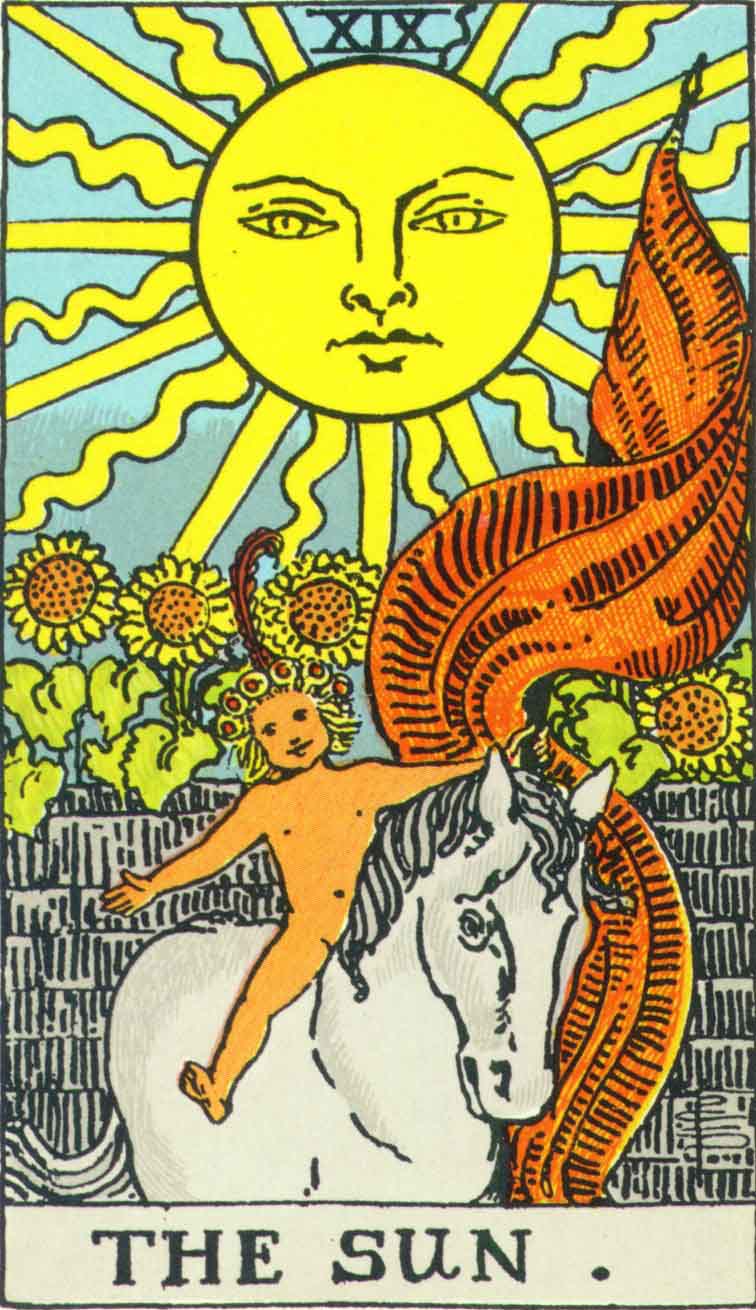
Tarot - The Sun


Basic Card Symbols

The Sun, one or two naked children (a naked little boy, sometimes riding a white pony or a boy & a girl), sunflowers, often a wall, sometimes a banner.

Basic Tarot Story

The Fool wakes at dawn from his long, restless night to find that the wild river has, at last, come to an end, quietly floating him into a serene pool. There is a walled garden around this pond dominated by roses, lilies and splendid, nodding sunflowers. Stepping ashore, he watches the Sun rise overhead, bright and golden. The day is clear. A child's laughter attracts his attention and he sees a little boy ride a small white pony into the garden.

"Come!" says the little boy, leaping off the horse and running up to him. "Come see!" And the child proceeds to take the Fool's hand and enthusiastically point out all manner of things, the busy insects in the grass, the seeds and petals on the sunflowers, the way the light sparkles on the pond. He asks questions of the Fool, simple but profound ones, like "Why is the sky blue?" He sings songs, and plays games with the Fool.

At one point the Fool stops, blinking up at the Sun so large and golden overhead, and he finds himself smiling, wider and brighter than he has in a very long time. Since he started on this spiritual journey, he has been tested and tried, confused and scared, dismayed and amazed. But this is the first time that he has been simply and purely happy. His mind feels illuminated, his soul light and bright as a sunbeam. Like the great Sun itself, this child with his simple questions, games and songs, has helped the Fool see the world and himself anew, to wonder at and appreciate both. "Who are you?" the Fool asks the child at last. The child smiles at this and seems to shine. And then he grows brighter and brighter until he turns into pure sunlight. "I'm You," the boy's voice says throughout the garden, "The new you." And as the words fill the Fool with warmth and energy, he comes to realize that this garden, the sun above, the child, all exist within him. He has just met his own inner light.

Basic Tarot Meaning

The Sun is ruled by...the Sun, of course. This is the light that comes after the long dark night, Apollo to the Moon's Diana. A positive card, it promises the Querent their day in the sun. Glory, gain, triumph, pleasure, truth, success. As the moon symbolized inspiration from the unconscious, from dreams, this card symbolizes discoveries made fully consciousness and wide awake. This is science and math, beautifully constructed music, carefully reasoned philosophy. It is a card of intellect, clarity of mind, and feelings of youthful energy. And, yes, the child/children in this card can be taken literally if other cards in the spread seem to suggest it. Your Querent can be informed that a wanted and most welcome babe will soon be on the way. Likely a boy, or twins.

Thirteen's Observations

I actually have predicted children with this card once, and once only. Most of the time, however, this card, to me, is all about the Apollian ideal. Young, healthy, new, fresh. The brain is working, things that were muddled come clear, everything falls into place, and everything seems to go your way. It's one of those days when it all goes right. Just right. The money you were waiting for arrives and a bonus has been added, the project you've been working on comes out perfectly and you get all the credit. Traffic lights turn green for you, liars come clean and apologize, the garden blooms, the sky is blue, the weather is warm and sweet. As the song goes, "Here comes the Sun...." and absolutely everything is going to be all right.

source: http://www.aeclectic.net/tarot/