Showing posts with label mythology. Show all posts

Friday, June 22, 2007

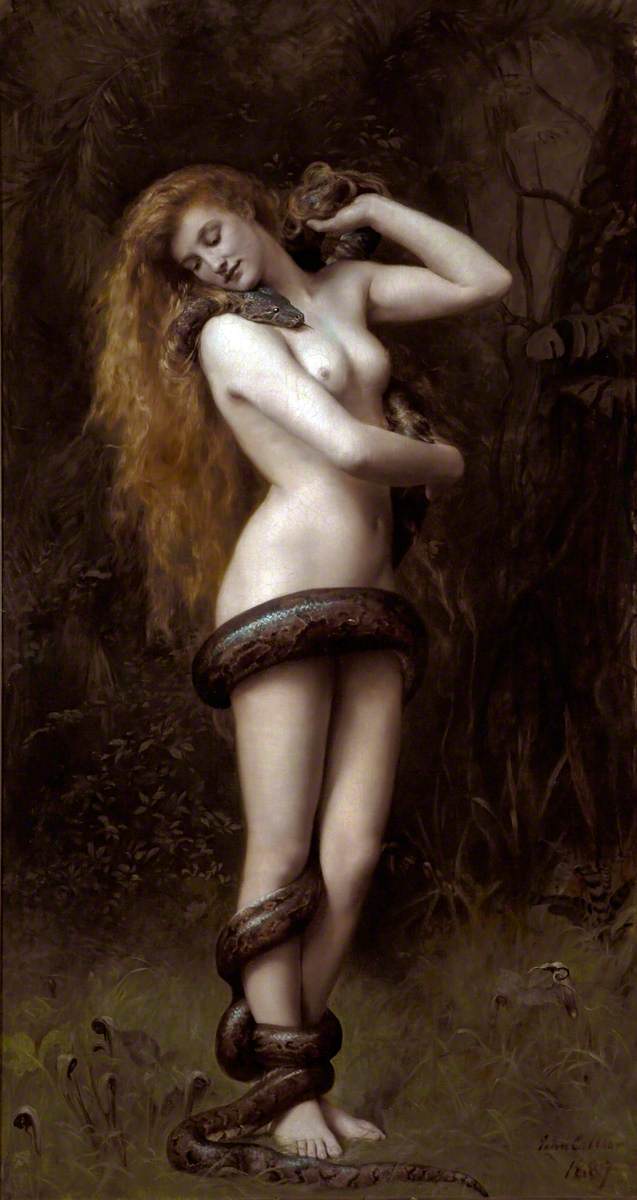
Lilith - The First Woman of Adam

According to Rabbinical mythology, the Talmudists say that Adam had a wife before Eve, whose name was Lilith. Refusing to submit to Adam, she left Paradise for a region of the air. She still haunts the night as a spectre, and is especially hostile to new-born infants. Some superstitious Jews still put in the chamber occupied by their wife four coins, with labels on which the names of Adam and Eve are inscribed, with the words, “Avaunt thee Lilith!” The fable of Lilith was invented to reconcile Genesis i with Genesis ii. Genesis i represents the simultaneous creation of man and woman out of the earth; but Genesis ii represents that Adam was alone, and Eve was made out of a rib, and was given to Adam as a helpmeet for him.

In Eden Bower D G Rosetti says “It was Lilith, the wife of Adam … / Not a drop of her blood was human, / But she was made like a soft sweet woman.” Goethe introduced her in his Faust . The mage is introduced by Mephistopheles to various apparitions on Walpurgis Night in the Hartz Mountains. Presented with a whirling crowd, Faust asks: “Who's that?”; Mephistopheles replies: “Her features closely scan - ‘Tis the first wife of the first man”. “Who, say you?” asks Faust; and the Spirit answers: “Adam's first wife, Lilith. / Beware - beware of her bright hair, / And the strange dress that glitters there: / Many a young man she beguileth, / Smiles winningly on youthful faces, / But woe to him whom she embraces!”.

In Assyrian demonology, a female demon appears, represented as winged, with dishevelled hair. Such demons were banished from Hebrew religion, and hardly appear in the Old Testament except in poetic imagery. But these ‘hairy ones', nocturnal ‘goblins', are exactly like the Arabian jinn . They haunted waste and desert places in fellowship with jackals. There is a Mohammedan story of Bilkis, Queen of Sheba, who married Solomon. She had hair on her ankles and was thus shown to be a jinniyyah by descent. The Arab writers say that Lilith was an evil spirit, the first wife of Adam, and that her children were the jinns or devils. She is said to have had 784 children, as the letters of her name have this numerical value. Her name is found in the Assyrian inscriptions as Li-lit , ‘the black', an ‘evil spirit'. She was said to have stimulated ‘nocturnal impurities', and to have been more especially dangerous to married women at the birth of their first child, upon which occasion the Arabian nurses still throw stones at the foot of the bed to drive her away.

The night devil of Isaiah xxxiv, 14, she was especially feared in Babylonia where a special class of priests, the Ashipu , were employed to ward off the harmful effects of witchcraft. Her designation was originally applied to certain spirits of the northern Semites; it was only later that it was applied to the person of Lilith of the Talmud, the first wife of Adam. She may be equated with the ghoul of pre-Islamic myth and with Ninlil , the Babylonian goddess. A very common practice, constantly found in the Mesopotamian exorcism tablets is that of the use of magic knots. These were tied by the ashipu for the protection of a pregnant woman. A magic knot could be tied by a sorcerer or witch to invoke spirits and to gain power over an enemy. By loosing of the knot the power of an evil spirit was broken. One of these maqla tablets, directed against witchcraft, ends with the words, “Her knot is loosed, her sorcery is brought to naught, and all her charms fill the desert”, where the desert symbolizes the underworld.

Rabbinic literature is full of the doings of Lilith, who bore Adam devils and spirits. Whoever slept alone in a room was likely to be beset by her. The Rabbis believed, too, that a man might have children by allying himself with a demon, and although they might not be visible to human beings, yet when that man was dying they would hover round his bed, to hail him as their father. At the funeral of a bachelor the Jews of Kurdistan cast sand before the coffin to blind the eyes of the unbegotten children of the deceased. Among the Jews in Palestine, Lilith (or the evil eye in general) is averted from the bed by hanging a charm over it consisting of a special cabalistic paper in Hebrew together with a piece of rue, garlic, and a fragment of looking glass. It is said sometimes that women find their best gowns, which they have carefully put away in their bridal chests, have been worn by female spirits during their confinement, because they did not utter the name of God in locking them up. On the first possible Sabbath all the relations assemble in the woman's room and make a hideous noise to drive away the evil spirits.

We may note that Asmodeus was the counterpart of Lilith, as being dangerous to women. Cognate with the concept of Asmodeus is the curious Arab belief in a female demon accompanying every woman, and having as many children as her counterpart. Just as Lilith took the place of Eve, evidently this spirit is intended, in one of her phases (that of bearing children), to do the same for each man. She is very dangerous to pregnant women and newly married people; that is to say, just as Asmodeus becomes jealous of interference with his rights, so does this female spirit admit of no dallying with other women. She is said to destroy the creative power of men and to make women barren, and to her is due epilepsy as the penalty for pouring water over the threshold of the door without naming God, on a Friday, or to quench the fire. She may appear as an owl, a Jewess, a camel, or a black man. There is a story that Solomon once met a singular looking woman and asked her whether she was jinn or human. She answered that she was the female spirit “ … that puts hatred between husband and wife; I make women miscarry; I make them barren; I make men impotent; I make husbands love other men's wives, women other men's husbands; in short, I do all contrary to the happiness of wedded life”. In The Testament of Solomon, one Obizuth is the name of the female spirit that visits women in childbirth, and if she is lucky she strangles the babe.

According to Rabbinical tradition among the Jews, Lilith has her strange story thus related in Jewish legends. “When the blessed God created the first man, whom he formed alone, without a companion, he said, ‘It is not good that the man should be alone': and therefore he created a woman also out of the ground, and named her Lilith. They immediately began to contend with each other for superiority. The man said: ‘It behoves thee to be obedient; I am to rule over thee'. The woman replied: ‘We are on a perfect equality; for we are both formed out of the same earth'. So neither would submit to the other. Lilith, seeing this, uttered the Shem-hamphorash ”, that is, pronounced the name Jehovah , “and instantly flew away through the air. Adam then addressed himself to God, and said: ‘Lord of the universe! The woman whom thou gavest me, has flown away from me'. God immediately dispatched three angels to bring back the fugitive. He said to them: ‘If she consent to return, well; but if not, you are to leave her, after declaring to her that a hundred of her children shall die every day'. These angels then pursued her, and found her in the midst of the sea, in the mighty waters in which the Egyptians were to be afterwards destroyed. They made known to her the divine message, but she refused to return. They threatened, unless she would return, to drown her in the sea. She then said: ‘Let me go; for I was created for no other purpose than to debilitate and destroy young infants; my power over the males will extend to eight days, and over the females to twenty days, after their birth'.

“On hearing this, the angels were proceeding to seize her and carry her back to Adam by force: but Lilith swore by the name of the living God, that she would refrain from doing any injury to infants, wherever or whenever she should find these angels, or their names, or their pictures, on parchment or paper, or on whatever else they might be written or drawn: and she consented to the punishment denounced against her by God, that a hundred of her children should die every day. Hence it is that every day witnesses the death of a hundred young demons of her progeny. And for this reason we write the names of these angels on slips of paper or parchment, and bind them upon infants, that Lilith, on seeing them, may remember her oath, and may abstain from doing our infants any injury”. Another rabbinical writer says: “I have also heard that when the child laughs in its sleep in the night of the Sabbath or of the new moon, the Lilith laughs and toys with it; and that it is proper for the father, or mother, or any one that sees the infant laugh, to tap it on the lips, and say, ‘Hence, begone, cursed Lilith; for thy abode is not here'. This should be done three times, and each repetition should be accompanied with a pat on the mouth. This is of great benefit, because it is in the power of Lilith to destroy children whenever she pleases”.

Lilith warrants special attention, not only as principal female demon, but because, unlike others mentioned, she was conceived to possess human rather than animal form, and also on account of her prominence in the later Jewish literature. According to Rabbinic teaching Lilith was the night demon par excellence . By a mistaken etymology the name was supposed to be derived from the Hebrew word lailah , (‘night'), a derivation favoured by the similarity of the two words, and also by the fact that Lilith was supposed to be specially active at night-time. Modern scholars prefer to associate it with the Sumerian word for ‘wantonness', and explain her as the demoness who inspires lust. However, it is very probable that she is referred to in Psalm 91 where the psalmist says: “Thou shalt not be afraid for the terror by night”.

In the Rabbinic literature Lilith is usually portrayed with long flowing hair, and as possessing wings. She is the queen of the Lilin , which form one of the great classes of demons. It is enjoined that a man should not go out alone at night because an evil spirit, Agrath bath Mahlath , (to be identified with Lilith), together with eighteen myriads of destroying angels, roams about and is permitted to destroy anyone whom she meets. Though specially dangerous to children, the Lilin also attack men. Thus the injunction that a man be forbidden to sleep alone in a house, lest, ignoring this warning, he be seized by Lilith. Formulas for exorcizing Lilith are given. This Jewish conception of Lilith appears to have much in common with the empousa of the Greeks and with the strix and lamia of the Romans. Whilst the name and leading characteristics were clearly derived from the Babylonian demonology, the conception may also have been influenced by Persian ideas.

Alone among the spirits known through Jewish tradition, Lilith retained her position during the Middle Ages, and indeed strengthened it by virtue of the closer definition of her activities. Originally a wind-spirit, derived from the Assyrian lilitu , with long dishevelled hair, and wings, during Talmudic times the confusion of her name with the word for night transformed her into a night spirit who attacks those who sleep alone. Laylah appears also as the angel of night, and of conception. Out of the assimilation to one another of these two concepts grew the view that prevailed during the Middle Ages. Though Lilith and the popularly derived plurals, the lilin , and the liliot , appeared often in nondescript form, merely as another term for demons, as when we are told that the liliot assemble in certain trees, the lilits proper possessed two outstanding characteristics in medieval folklore which gave them distinct personality: they attacked new born children and their mothers, and they seduced men in their sleep. As a result of the legend of Adam's relations with Lilith, although this function was by no means exclusively theirs, the lilits were most frequently singled out as the demons who embrace sleeping men and cause them to have nocturnal emissions which are the seed of a hybrid progeny. It was in her first role, however, that Lilith terrorized medieval Jewry. As the demon whose special prey is lying-in women and their babes, it was found necessary to adopt an extensive series of protective measures against her.

All sorts of means are used to circumvent the malign influences of Lilith and her demons and both men and women appear to be in need of this protection. According to the usual amuletic practice, wearing an amulet inscribed with her name protects against her activities and this practice accounts for the numerous amulets thus found inscribed. Amulets inscribed with the name of Lilith alone can possibly have been worn by men and indeed could be worn by everyone with advantage at all times but those inscribed with the alternative names of Lilith or with the names of the angels sent in pursuit of her, were intended to be of use to women only, particularly near the time of their delivery. The usual custom was to write these charms on pieces of paper and hang them around the mother's bed and even until recent times, the ‘Song of Degrees' (Psalm 121) was thus written and used. Metallic amulets inscribed with this psalm were worn by men as well as women at all times and became an article of decoration. They are extremely common.

Elijah the Prophet, that great performer of miracles, on one occasion encountered Lilith, doubtless secure in the fact that he was himself originally an angel and so immune from her attentions. Elijah's angelic name was Sandalphon , and he is one of the greatest and mightiest of the fiery angelic hosts. He imposed restrictions on Lilith's activities which, after dire threats, she was compelled to accept. The most important of these conditions was that if any of the numerous names of Lilith were inscribed near a childbed, and particularly if the inscription of Psalm 121 was associated with it, Lilith would be compelled to abandon her right to injure that particular mother or her child. In addition, the names of the three angels who were sent to recall her to her wifely duties and whose message she disobeyed were to be equally effective in neutralising her activities.

We have seen that Lilith undoubtedly derives from very ancient sources, appearing as Lilatu , ‘a female demon' in Assyrian literature and earlier still as Lillaku in Sumerian tablets of the story of Gilgamesh in which she was supposed to have lived in a willow tree. A connection between these similarly named demons can scarcely be denied. According to David de Pomis (Venice, 1587 CE) Lilith is a wild animal, or an evil spirit, or, as some say, a bird, which flits about alone at night and fills the air with wailing. Solomon ben Abraham (Salerno, 1160 CE) said that Lilith “grows out of the wind just as the salamander grows from the fire”. Lilith represents the classical example of the succubus in Jewish mythology. The incubus is a spirit which, taking the semblance of a man, has intercourse with mortal women. The succubus is a similar spirit which in the form of a woman behaves in a like manner with mortal men. The Hebrew Lilith was regarded as queen of the succubi by the theologians who spent much time investigating such matters. St Augustine states that “devils do indeed collect human semen, by means of which they are able to produce bodily effects”. St Thomas Aquinas did much to prove that incubi and succubi were demons sent to tamper with frail humanity. But in the 17th century CE Peter Sinistrari made the unorthodox claim that such visitants were not demons but semi-angels who honoured mankind by contact, echoing Gnostic ideas. Many renowned people, including Caesar, Alexander the Great, and Plato, have the distinction of descent from such unnatural unions, which is not impossible when one takes into consideration that Hieronymus relates a story of a young woman who called for help against the attack of an incubus, which, on being pulled from under the bed where it had rushed to hide, proved to be none other than the good Bishop Sylvanus.

The succubus has always been a rarer phenomenon than the incubus. There are far more male than female devils. Pico della Mirandola tells us that he knew an old man of eighty-four years who had slept for half his life with a female devil; and another of seventy, who had enjoyed the same advantages. Sprenger reports that a German magician “had carnal connection with a woman before the very eyes of his wife and friends who were present during this action but were prevented from seeing her form”. Gregory de Tours tells of a holy bishop of Tuvergne, Eparchius, who had also been exposed to the temptations of a demon. He awoke one night with the thought of praying in the church; he arose and left for the church; on arriving he found the basilica resplendent with an infernal light and filled entirely with demons, who committed the most horrible deeds in front of the altar; he saw Satan in women's clothes sitting in the bishop's chair and presiding over these immoral mysteries. “Infamous whore”, he cried, “thou art not satisfied with poisoning all and everything with thy pollutions, thou even defamest God's sacred spots with thy loathsome body”. “Since thou give me the name of whore”, answered the prince of demons, “I shall present you with many instances of it and will make you lust after the body of woman”. Satan disappeared in a cloud of stench but he kept his word and poor Eparchius felt the torments of the fleshly appetites every night until his death. The similar temptations of St Anthony are too well known to need repeating. Despite the saint's advanced and revered age Satan did not disdain from decorating his lonely hermitage with obscene and passionate pictures.

In The Sayings of Rabbi Eliezer , Samael (Satan) is charged with being the one (in the guise of a serpent) who tempted Eve and seduced her. In Jewish tradition Lilith was the bride of Samael. She predated Eve, and had relations with Adam in Paradise. According to Rabbi Eliezer, Lilith bore Adam every day 100 children. The Zohar describes Lilith as “a fiery female who at first cohabited with Adam” but, when Eve was created, “flew to the cities of the sea coast”, where she is “still trying to ensnare mankind”. In the Cabala she is the demon of Friday, and is represented as a naked woman whose body terminates in a serpents tail. The rabbis regard Lilith as the first temptress, as Adam's demon wife, and as the mother of Cain. In Talmudic lore, as also in the Cabala, most demons are mortal, but Lilith will “continue to exist and plague man until the Messianic day, when God will finally extirpate uncleanliness and evil from the face of the earth”. The scholar Scholem says in an article that Lilith and Samael “emanated from beneath the throne of Divine Glory, the legs of which where somewhat shaken by their joint activity”. It is known of course that Samael was once a familiar figure in Heaven, but not that Lilith was up there also, assisting him. Lilith went by a score of names, some of which she revealed to Elijah, when she was forced to do so by the Old Testament prophet. Moses Gaster in his Studies and Texts in Folklore lists some of these: Abeko, Abito, Amizo, Batna, Eilo, Ita, Izorpo, Kea, Kokos, Odam, Partasah, Patrota, Podo, Satrina, Talto . Another listing is given by Hanauer in his Folklore of the Holy Land , namely: Abro, Amiz, Amizu, Avitu, Bituah, Ik, Ils, Kalee, Kakash, Kema, Partashah, Petrota, Pods, Raphi, Satrinah, Thiltho. Other sources provide: Abyzu, Ailo, Alu, Gallu, Gelou, Gilou, Lamassu, Zahriel, Zephonith. The name of the land to which Lilith betook herself in her flight from Paradise is recorded as Zamargad , near the Red Sea, where she set up her abode and mated with the demons who were well known to be living on those shores.

Her principal copulation there was with the archdemon Beelzeboul. The fruit of their union, a nameless male demon, yet writhes, enchained by King Solomon, at the bottom of the Red Sea. Of Lilith's other numberless progeny few are known. Yet obscure texts do name one son and a daughter, Hurnim and Hurmiz respectively. Also, Arabian tradition tells of a lone daughter of Adam who emulated her nefarious practices. This daughter of Adam, Anak , is apparently to be blamed for belief in talismans and other evil practices. This lady, so it is said, was the first “to reduce the demons to serve her by means of charms”. God had given Adam a sprinkling of magic words, just to enable him to control a few spirits, and these words he communicated to Eve. She preserved them quite faithfully until Anak extracted them from her while she slept. It is not stated how this robbery was effected; perhaps the words were impressed in cuneiform characters on clay tablets, or she may have extracted them as did Isis from the great Sun god Ra ; however, once Anak was in possession, she “conjured evil spirits, practised the magical art, pronounced oracles, and gave herself up openly to impiety”. Interestingly, the name of Lilith survives in an ancient curse of Coptic Christian origin. This text on parchment, preserved in the Louvre, is uttered to separate a man from a woman. It comes from the tenth century CE. The utterance, to be written on a blade-shaped parchment goes: “ Tartari, Saro, Ptha, Astabias, Thatha, Eibethatha, Lahkimaia, Kaha, Alaha, Lilith, put hatred and separation, put hatred and separation between Sipa son of Siheu , and Ouarteihla daughter of Cauhare. They must not be able to look at each other's faces, yea, yea!”.

Amulets to protect pregnant women and women in child-bed were as common among the Hebrews as among pagan nations. Wallis Budge gives details in his treatise on amulets. They were written upon parchment, and also upon the door and walls of the chamber wherein the woman lay. And if they were to be really effective, the texts had to be written in ink in which holy incense had been mixed, and even the copyist had to be a man ceremonially pure and a believer. One of the most important and powerful child-bed amulets is contained in the rare Hebrew work generally known as the Sepher Raziel , ‘The Book of Raziel', bequeathed to the faithful by the preceptor angel of Adam himself. This amulet contains figures representative of Adam, Eve and Lilith. Above these are the names of the three angels sent after Lilith, Senoi, Sansenoi, and Semangeloph. There seals are given. The Hebrew text says that the woman will be protected by the name of God from all the evils and calamities which are enumerated therein. This amulet had a double purpose. The three figures of the angels and their names and seals protected the newly born infant and its mother. And the text warded off any and every evil which Lilith might attempt to do to either. Contained in the text are the names of the Seventy Great Angels whose protection is secured by the amulet.

Two other amulets are illustrated in the Book of Raziel. At the four corners are the names of the four rivers of Paradise, Pishon, Gihon, Prath and Hiddekel. Inside two concentric circles is the Hexagram, or so-called ‘Shield of Solomon' and fourteen groups of three letters and the words “Go forth thou and all the people who are in thy train”, and permutations of the initial letters of the Hebrew words for ‘holiness' and ‘deliverance'. Between the circles are the names of Adam, Eve, and Lilith, the three angels, and also that of the angel Khasdiel, with the words: “He hath given his angels charge concerning thee, that they may keep thee in all thy ways. Amen. Selah.” Another amulet is similar, except that the two triangles of the hexagram are arranged base to base. In the inner circle are fourteen groups of three letters which have esoteric significations.

Concerning apotropaic procedures to ward of the influence of Lilith and her cohorts, Gershon Scholem describes an antidemonic rite both ancient and curious. He says that until quite recently, and indeed occasionally to this day, Jewish burials in Jerusalem were often marked by a strange happening. Before the body was lowered into the grave ten men danced round it in a circle, reciting a psalm which in the Jewish tradition has generally been regarded as a defence against demons, i.e. Psalm 91, or another prayer. Then a stone was laid on the bier and the following verse (Genesis xxv, 6) recited: “But unto the sons of the concubines, which Abraham had, Abraham gave gifts, and sent them away”. This strange dance of death was repeated seven times. The rite, which in modern times has been unintelligible to most of the participants, has to do with Cabalistic conceptions about sexual life and the sanctity of the human seed. Here we have an entire myth, the object of which is to mark off the act of generation from other sexual practices, which were interpreted as demonic in nature, and especially from onanism.

According to Talmudic tradition, demons are spirits made in the Friday evening twilight, who, because the Sabbath has intervened, have received no bodies. From this later authorities drew the inference, implicit in the Talmudic sources, that the demons have been looking for bodies ever since, and that this is why they attach themselves to men. This entered into combination with another idea. After the murder of Abel by his brother, Adam decided to have no further dealings with his wife. Thereupon female demons, succubi, came to him and conceived by him; from this union, in which Adam's generative power was misused and misdirected, stem a variety of demons. The Cabalists took up these old conceptions of demonic generation in pollution or other practices. They are systematized in the Zohar, which develops the myth that Lilith, queen of the demons, or the demons of her retinue, do their best to provoke men to sexual acts without benefit of a woman, their aim being to make themselves bodies from the lost seed.

To the Cabalists, the union between man and woman, within its holy limits, was a venerable mystery, as one may judge from the fact that the most classical and widely circulated Cabalistic definition of mystical meditation is to be found in a treatise about the meaning of sexual union in marriage (Joseph Gikatila, c.1300 CE). Abuse of a man's generative powers was held to be a destructive act, through which not the holy, but the ‘other side', obtains progeny. An extreme cult of purity led to the view that every act of impurity, whether conscious or unconscious, engenders demons.

Abraham Saba, an early sixteenth century CE Cabalist who had come to Morocco from Spain, was first to establish a strange connection between this conception and a man's death. All the illegitimate children that a man has begotten with demons in the course of his life appear after his death to take part in the mourning for him and his funeral. For all those spirits that have built their bodies from a drop of his seed regard him as their father. And so, especially on the day of his burial, he must suffer punishment; for while he is being carried to the grave, they swarm around him like bees, crying: “You are our father”, and they complain and lament behind his bier, because they have lost their home and are now being tormented along with the other demons which hover bodiless in the air.

According to others, the demons claim their inheritance on this occasion along with the other sons of the deceased and try to harm the legitimate children. Those who dance seven times round the dead man do so in order to form a sacral circle, which will prevent these unlawful children from approaching the deceased, sullying his corpse, or doing other harm. Hence the verse from Genesis about the ‘sons of the demonic concubines', whom Abraham sent away lest they harm Isaac, his legitimate son. A similar rite, in which the bier is set down on the ground seven times on the way to the cemetery, has the same purpose. Most important of all, the Cabalists strictly forbade the children, and especially the sons of the deceased from escorting him to his last resting place. In his lifetime, it was held, a pious man should expressly forbid ‘all his children' to follow him to the grave; by so doing, he will keep his illegitimate demonic offspring away and, in case any of them should nonetheless get through to his grave, prevent them from endangering his true children, begotten in purity. It is known that some Jews in their lifetime sternly ordered their children not to make the slightest plaint or weep until the dead body in the cemetery had been purified by washing, cleansing, and the cutting of the finger and toenails, because the unclean spirits are thought to have no further part in the body, once it is cleansed. Another noteworthy rite is connected with similar conceptions. Especially in a leap year, the Cabalists fasted on Monday and Thursday of certain weeks in the wintertime, in order to ‘correct', by special prayers and acts of penance, the taint which it is said a man inflicts on his true form by involuntary ejaculation in the night and by masturbation.

But it is not only in unlawful sexual practices that Lilith takes a hand. Even legitimate union between man and wife is endangered by her, for here too she tries to infringe on the domain of Eve. Accordingly, we find widespread observance of a rite recommended by the Zohar, the purpose of which was to keep Lilith away from the marriage bed: “In the hour when the husband enters into union with his wife, he should turn his mind to the holiness of his Lord and say: ‘Veiled in velvet - are you here? / Loosened, loosened be your spell! / Go not in and go not out! / Let there be none of you and nothing of your part! / Turn back, turn back, the ocean rages, / Its waves are calling you. / But I cleave to the holy part, / I am wrapped in the sanctity of the King.' Then for a time he should wrap his head and his wife's head in cloths, and afterwards sprinkle his bed with fresh water”.

The symbolism of erotic demonic activities is encountered down the ages, even by such as the venerable Doctor Dee in his workings with Edward Kelley. On 15 August 1584 CE their first Prague action began with an extraordinary series of alchemical visions. Madimi appeared, in apocalyptic mood: “Woe be to women great with child, for they shall bring forth monsters … Woe unto the Virgins of the Earth, for they shall disdain their virginity, and become concubines for Satan”. According to Cabalistic tradition, quoted by Dion Fortune, Lilith taught wisdom to Adam; and he could not forget her. This writer also quotes another tradition which holds that it was Lilith who performed the office of the Serpent in tempting Adam to eat the forbidden fruit in the Garden of Eden. A rare illustration of this appears in Queen Mary's Psalter (1553 CE). In The Secret Doctrine , Madame Blavatsky regards Lilith as having appeared in the primordial ages, and describes her as “An ethereal shadow … an actual living female monster millions of years ago”. She is linked by the theosophists with the planet Saturn. The importance attached to Lilith in witchcraft is attested by Doreen Valiente, who regarded her as one of the presiding goddesses of the Craft, calling her “the personification of erotic dreams, the suppressed desire for delights”. According to Gerald Gardner there is a tradition of the continuous worship of Lilith to the present time in witchcraft, and that hers is the name sometimes given to the Goddess being personified, in ritual, by the coven Priestess. Leland in his Etruscan-Roman Remains identifies Lilith with Herodias, or Aradia. He notes that she is mentioned in the old Slavonian spells and charms, and therein has twelve daughters, an instance of the witches thirteen perhaps. In Irish tradition Lilith gives her favours especially to ‘celibates, mystics and hermits'. Yeates calls the Sidhe her ‘children'. In Voudoun she is assimilated with the loa Erzulie. Modern magicians have deliberately used the mechanism of intercourse with spirits in their rituals of magica sexualis . The activities of such as Crowley and his adherents are perhaps too well known now from published accounts to warrant any exposition here.

source: white dragon.org.uk
Tuesday, June 19, 2007

Hymn to Osiris

"Homage to thee, Osiris, Lord of eternity, King of the Gods, whose names are manifold, whose forms are holy, thou being of hidden form in the temples, whose Ka is holy. Thou art the governor of Tattu (Busiris), and also the mighty one in Sekhem (Letopolis). Thou art the Lord to whom praises are ascribed in the nome of Ati, thou art the Prince of divine food in Anu. Thou art the Lord who is commemorated in Maati, the Hidden Soul, the Lord of Qerrt (Elephantine), the Ruler supreme in White Wall (Memphis). Thou art the Soul of Ra, his own body, and hast thy place of rest in Henensu (Herakleopolis). Thou art the beneficent one, and art praised in Nart. Thou makest thy soul to be raised up. Thou art the Lord of the Great House in Khemenu (Hermopolis). Thou art the mighty one of victories in Shas-hetep, the Lord of eternity, the Governor of Abydos. The path of his throne is in Ta-tcheser (a part of Abydos). Thy name is established in the mouths of men. Thou art the substance of Two Lands (Egypt). Thou art Tem, the feeder of Kau (Doubles), the Governor of the Companies of the gods. Thou art the beneficent Spirit among the spirits. The god of the Celestial Ocean (Nu) draweth from thee his waters. Thou sendest forth the north wind at eventide, and breath from thy nostrils to the satisfaction of thy heart. Thy heart reneweth its youth, thou producest the.... The stars in the celestial heights are obedient unto thee, and the great doors of the sky open themselves before thee. Thou art he to whom praises are ascribed in the southern heaven, and thanks are given for thee in the northern heaven. The imperishable stars are under thy supervision, and the stars which never set are thy thrones. Offerings appear before thee at the decree of Keb. The Companies of the Gods praise thee, and the gods of the Tuat (Other World) smell the earth in paying homage to thee. The uttermost parts of the earth bow before thee, and the limits of the skies entreat thee with supplications when they see thee. The holy ones are overcome before thee, and all Egypt offereth thanksgiving unto thee when it meeteth Thy Majesty. Thou art a shining Spirit-Body, the governor of Spirit-Bodies; permanent is thy rank, established is thy rule. Thou art the well-doing Sekhem (Power) of the Company of the Gods, gracious is thy face, and beloved by him that seeth it. Thy fear is set in all the lands by reason of thy perfect love, and they cry out to thy name making it the first of names, and all people make offerings to thee. Thou art the lord who art commemorated in heaven and upon earth. Many are the cries which are made to thee at the Uak festival, and with one heart and voice Egypt raiseth cries of joy to thee.

"Thou art the Great Chief, the first among thy brethren, the Prince of the Company of the Gods, the stablisher of Right and Truth throughout the World, the Son who was set on the great throne of his father Keb. Thou art the beloved of thy mother Nut, the mighty one of valour, who overthrew the Sebau-fiend. Thou didst stand up and smite thine enemy, and set thy fear in thine adversary. Thou dost bring the boundaries of the mountains. Thy heart is fixed, thy legs are set firm. Thou art the heir of Keb and of the sovereignty of the Two Lands (Egypt). He (Keb) hath seen his splendours, he hath decreed for him the guidance of the world by thy hand as long as times endure. Thou hast made this earth with thy hand, and the waters, and the winds, and the vegetation, and all the cattle, and all the feathered fowl, and all the fish, and all the creeping things, and all the wild animals therof. The desert is the lawful possession of the son of Nut. The Two Lands (Egypt) are content to crown thee upon the throne of thy father, like Ra.

"Thou rollest up into the horizon, thou hast set light over the darkness, thou sendest forth air from thy plumes, and thou floodest the Two Lands like the Disk at daybreak. Thy crown penetrateth the height of heaven, thou art the companion of the stars, and the guide of every god. Thou art beneficent in decree and speech, the favoured one of the Great Company of the Gods, and the beloved of the Little Company of the Gods.

His sister [Isis] hath protected him, and hath repulsed the fiends, and turned aside calamities (of evil). She uttered the spell with the magical power of her mouth. Her tongue was perfect, and it never halted at a word. Beneficent in command and word was Isis, the woman of magical spells, the advocate of her brother. She sought him untiringly, she wandered round and round about this earth in sorrow, and she alighted not without finding him. She made light with her feathers, she created air with her wings, and she uttered the death wail for her brother. She raised up the inactive members of whose heart was still, she drew from him his essence, she made an heir, she reared the child in loneliness, and the place where he was not known, and he grew in strength and stature, and his hand was mighty in the House of Keb. The Company of the Gods rejoiced, rejoiced, at the coming of Horus, the son of Osiris, whose heart was firm, the triumphant, the son of Isis, the heir of Osiris."

Papurys of Ani
Egyptian Book of the Dead
Translated by E. A. Wallis Budge

Thursday, May 3, 2007

Lilith - the Vampire Mother

Lilith (Hebrew לילית) is a female Mesopotamian demon associated with wind and was thought to be a bearer of disease, illness, and death. The figure of Lilith first appeared in a class of wind and storm demons or spirits as Lilitu, in Sumeria, circe 3000 B.C. Many scholars place the origin of the phonetic name "Lilith" at somewhere around 700 B.C. Lilith appears as a night demon in the Talmud and Midrash and as a screech owl in the King James version of the Bible.

In Mesopotamian mythology

Kiskil-lilla

The mention of a she-demon that is usually identified with Lilith is ki-sikil-lil-la-ke4, a female being in the Sumerian prologue to the Gilgamesh epic. Ki-sikil-lil-la-ke is sometimes translated as Lila's maiden, companion, his beloved or maid. Akin to this, Ki-sikil-ud-da-ka-ra means "the maiden who has stolen the light" or " the maiden who has seized the light". Texts describe Lillake as the "gladdener of all hearts" and "maiden who screeches constantly".

The name of the male companion Lila, is likewise known from this period. The father of Gilgamesh was named as Lilu (= Lila) on the Sumerian king's list. Lila (Lilu, Lillu) is one of four storm demons of the incubi-succubae class. Little is known about the nature of Lila. It is said of him that he attempts to disturb or seduce women in their sleep by night, while Lilitu appears to men in their erotic dreams.

Kramer translates:

a dragon had built its nest at the foot of the tree
the Zu-bird was raising its young in the crown,
and the demon Lilith had built her house in the middle.
[…]
Then the Zu-bird flew into the mountains with its young,
while Lilith, petrified with fear, tore down her house and fled into the wilderness
Wolkenstein translates the same passage:
a serpent who could not be charmed made its nest in the roots of the tree,
The Anzu bird set his young in the branches of the tree,
And the dark maid Lilith built her home in the trunk.
Some scholars dispute identification with Lilith. However, most sources consider it definitive. The Anchor Bible Dictionary (Lowell K. Handy) states the following on the subject:
"Two sources of information previously used to define Lilith are both suspect. Kramer translated ki-sikil-lil-la-ke4 as 'Lilith', in a Sumerian Gilgamesh fragment. The text relates an incident where this female takes up lodging in a tree trunk which has a Zu-bird perched in the branches and a snake living in the roots. This text was used to interpret a sculpture of a woman with bird talons for feet as being a depiction of Lilith. From the beginning this interpretation was questioned so that after some debate neither the female in the story, nor the figure are assumed to be Lilith." (Vol. 4, p. 324)
The Burney relief

The Gilgamesh passage quoted above has in turn been applied by some to the Burney relief (Norman Colville collection), which dates to roughly 1950 BC and is a sculpture of a woman who has bird talons and is flanked by owls.

The key to this identification lies in the bird talons and the owls. While the relief may depict the demon Kisikil-lilla-ke of the Gilgamesh passage or a goddess, identification with Lilitu is more tenuous and likely influenced by the "screech owl" translation of the KJV. Most scholars accept it to actually be Inanna or her underworld sister Ereshkigal. However, the real identity of this figure remains inconclusive. A very similar relief dating to roughly the same period is preserved in the Louvre (AO 6501).

Mesopotamian Lilitu

Around 3000 BC, Lilitu/Lilith's first appearance was that in a class of spirits called Lilitu. Here, Lilith was not thought of as a central figure. The Lilitu were said to prey upon children, women in childbirth, and women and were winged spirits with bird feet. Early incantations against the Lilitu associates them with Zu birds (An eagle or type of bird of prey.), lions, storms, and disease. This begins the figure known as Lilith, a disease bearing spirit whose presence was feared to bring illness, death, and terrors by night. Early portrayals of lilitu are known as having Zu bird talons for feet and wings. The name Lilitu/Lilith stood for multiple spirits as well as a single being.

Lilith's epithet was "the beautiful maiden". She had no milk in her breasts and was unable to bear children. She was believed to be a harlot and vampire that would chose lovers and never let them go, but without giving them any real satisfaction.

Lilu, a similar male demon, was one of the four demons that belonged a vampire or incubus-succubi class. The other three were Lilitu, the she-demon, Ardat lili (Lilith's handmaid), who visited men by night and bore them children, and Irdu lili, who was the male counterpart to Ardat lili and would visit women by night and beget children by them. These demons were orginally storm demons. However, because of popular mistaken etymology they became to be regarded as night demons.

Sumerian accounts began to depict Lilitu as the handmaiden of Inanna, particularly presiding over fertility rites. "In older Sumerian texts...it says that Inanna — who corresponds to the Babylonian Ishtar — has sent the beautiful, seductive, and unmarried prostitute Lilitu out into the streets and fields in order to lead men astray". Furthermore, she governs a class of succubi and is called "strangler," a common title in later Lilith stories.

Identical to the Babylo-Sumerian Lilitu, the Akkadian Ardat-Lili presided over temple prostitution. Ardat is derived from "ardatu", a title of prostitutes and young unmarried women, meaning "Maiden". Like Lilith, Ardat Lili was a figure of disease and uncleanliness. One magical text tells of how Ardat Lili had come to 'seize' a sick man.

Akin to the Sumerian and Akkadian accounts, the Babylonians' texts depict Lilitu as the servant of the mother goddess Ishtar. Presiding over sexuality, prostitution, and fertility. However, like her counterparts she is still quite vicious and devouring. Some Babylonian texts mention her as the chief prostitute to Ishtar's temple. While others state that La-bar-tu, the Assyrian counterpart, Lamashtu, as the handmaiden to Inanna/Ishtar.

A similar related Mesopotamian demon, Lamashtu, also contributed to the evolution of the Lilitu myth. Lamashtu was a demon thought to harm children and women during childbirth. This demon was described as having bird talons for feet, having a lioness head and is often depicted as a fearsome creature with wild animals. In further fashion of Lilith, she also had statues, amulets, and incantations against her.

From Arslan Tash (Aleppo National Museum), a site in modern day Syria, comes the "Lilith Prophylactic". Lilith is pictured as a sphinx like creature devouring a child. Similar to the medieval period's amulets to ward off the demon Lilith, this inscribed plaque features an Phoenician-Canaanite dialect incantation against winged night demons called "Lili".
O, Flyer in a dark chamber, Go away at once, O Lili!
These lines are part of a incantation to protect women in childbirth. T.H. Gaster's translation wields Lilith as the demon mentioned in this incantation.

Related myths

A figure often compared to Lilith is the Greek Lamia. Said to be a daughter of the goddess Hecate or turned into a monster by the jealous Hera, she has a cannibalistic appetite for children, and is often blamed for kidnapping them. Lamia has a role akin to Lilith in that, she too, is said to have a powerful, dangerous, sexual appetite for men.

Lamia is described as appearing from the torso up as a woman and serpentine from the torso down. She presides over vampiric, blood-sucking Lamiai, (similar to succubi in Medieval myths) and is said to give birth to the horrible demoness Empusae, a creature compared to lilim.

Lilith in the Bible

The Book of Isaiah 34:14, describing the desolation of Edom, is the only occurrence of Lilith in the Hebrew Bible:
Hebrew (ISO 259): pagšu ṣiyyim et-ʾiyyim w-saʿir ʿal-rēʿhu yiqra ʾakšam hirgiʿah lilit u-maṣʾah lah manoḫ
morpho-syntactic analysis: "yelpers meet-[perfect] howlers; hairy-ones cry-[imperfect] to fellow. liyliyth reposes-[perfect], acquires-[perfect] resting-place."
KJV: "The wild beasts of the desert shall also meet with the wild beasts of the island, and the satyr shall cry to his fellow; the screech owl also shall rest there, and find for herself a place of rest."
Schrader (Jahrbuch für Protestantische Theologie, 1. 128) and Levy (ZDMG 9. 470, 484) suggest that Lilith was a goddess of the night, known also by the Jewish exiles in Babylon. Evidence for Lilith being a goddess rather than a demon is lacking. Isaiah dates to the 6th century BC, and the presence of Jews in Babylon would coincide with the attested references to the Līlītu in Babylonian demonology.

The Septuagint translates onokentauros, apparently for lack of a better word, since also the saʿir "satyrs" earlier in the verse are translated with daimon onokentauros. The "wild beasts of the island and the desert" are omitted altogether, and the "crying to his fellow" is also done by the daimon onokentauros.

In Horace (De Arte Poetica liber, 340), Hieronymus of Cardia translated Lilith as Lamia, a witch who steals children, similar to the Breton Korrigan, in Greek mythology described as a Libyan queen who mated with Zeus. After Zeus abandoned Lamia, Hera stole Lamia's children, and Lamia took revenge by stealing other women's children.

The screech owl translation of the KJV is without precedent, and apparently together with the "owl" (yanšup, probably a water bird) in 34:11, and the "great owl" (qippoz, properly a snake,) of 34:15 an attempt to render the eerie atmosphere of the passage by choosing suitable animals for difficult to translate Hebrew words. It should be noted that this particular species of owl is associated with the vampiric Strix of Roman legend.

Later translations include:
  • night-owl (Young, 1898)
  • night monster (ASV 1901, NASB 1995)
  • night hag (RSV 1947)
  • night creature (NIV 1978, NKJV 1982, NLT 1996)
  • nightjar (New World Translation, 1984)
  • vampires (Moffatt Translation, 1922).
Jewish tradition

A Hebrew tradition exists in which an amulet is inscribed with the names of three angels (Senoy, Sansenoy, and Semangelof) and placed around the neck of newborn boys in order to protect them from the lilin until their circumcision. There is also a Hebrew tradition to wait three years before a boy's hair is cut so as to attempt to trick Lilith into thinking the child is a girl so that the boy's life may be spared.

Dead Sea scrolls

The appearance of Lilith in the Dead Sea Scrolls is somewhat more contentious, with one indisputable reference in the Song for a Sage (4Q510-511), and a promising additional allusion found by A. Baumgarten in The Seductress (4Q184). The first and irrefutable Lilith reference in the Song occurs in 4Q510, fragment 1:
"And I, the Instructor, proclaim His glorious splendour so as to frighten and to te[rrify] all the spirits of the destroying angels, spirits of the bastards, demons, Lilith, howlers, and [desert dwellers…] and those which fall upon men without warning to lead them astray from a spirit of understanding and to make their heart and their […] desolate during the present dominion of wickedness and predetermined time of humiliations for the sons of lig[ht], by the guilt of the ages of [those] smitten by iniquity – not for eternal destruction, [bu]t for an era of humiliation for transgression."
Akin to Isaiah 34:14, this liturgical text both cautions against the presence of supernatural malevolence and assumes familiarity with Lilith; distinct from the biblical text, however, this passage does not function under any socio-political agenda, but instead serves in the same capacity as An Exorcism (4Q560) and Songs to Disperse Demons (11Q11) insomuch that it comprises incantations – comparable to the Arslan Tash relief examined above – used to "help protect the faithful against the power of these spirits." The text is thus, to a community "deeply involved in the realm of demonology," an exorcism hymn.

Another text discovered at Qumran, conventionally associated with the Book of Proverbs, credibly also appropriates the Lilith tradition in its description of a precarious, winsome woman – The Seductress (4Q184). The ancient poem – dated to the first century BCE but plausibly much older – describes a dangerous woman and consequently warns against encounters with her. Customarily, the woman depicted in this text is equated to the "strange woman" of Proverbs 2 and 5, and for good reason; the parallels are instantly recognizable:
"Her house sinks down to death, And her course leads to the shades. All who go to her cannot return And find again the paths of life." (Proverbs 2:18-19)
"Her gates are gates of death, and from the entrance of the house she sets out towards Sheol. None of those who enter there will ever return, and all who possess her will descend to the Pit." (4Q184)
However, what this association does not take into account are additional descriptions of the "Seductress" from Qumran that cannot be found attributed to the "strange woman" of Proverbs; namely, her horns and her wings: "a multitude of sins is in her wings." The woman illustrated in Proverbs is without question a prostitute, or at the very least the representation of one, and the sort of individual with whom that text’s community would have been familiar. The "Seductress" of the Qumran text, conversely, could not possibly have represented an existent social threat given the constraints of this particular ascetic community. Instead, the Qumran text utilizes the imagery of Proverbs to explicate a much broader, supernatural threat – the threat of the demoness Lilith.

Folk tradition

The Alphabet of Ben Sira is considered to be the oldest form of the story of Lilith as Adam's first wife. Whether or not this certain tradition is older is not known. Scholars tend to date Ben Sira between 8th and 10th centuries. Its real author is anonymous, but it is falsely attributed to the sage Ben Sira. The amulets used against Lilith that were thought to derive from this tradition are in fact, dated as being much older. While the concept of Eve having a predecessor is not exclusive to Ben Sira or new and can be found in Genesis Rabbah, the idea that this predecessor was Lilith is. According to Gershom Scholem the author of the Zohar, R. Moses de Leon, was aware of the the folk tradition of Lilith, as well another story, possibly older, that may be conflicting.

The idea that Adam had a wife prior to Eve may have developed from an interpretation of the Book of Genesis and its dual creation accounts; while Genesis 2:22 describes God's creation of Eve from Adam's rib, an earlier passage, 1:27, already indicates that a woman had been made: "So God created man in his own image, in the image of God created he him; male and female created he them." The text places Lilith's creation after God's words in Genesis 2:18 that "it is not good for man to be alone". He forms Lilith out of the clay from which he made Adam, but the two bicker. Lilith claims that since she and Adam were created in the same way, they were equal, and she refuses to "lie below" him:
After God created Adam, who was alone, He said, 'It is not good for man to be alone.' He then created a woman for Adam, from the earth, as He had created Adam himself, and called her Lilith. Adam and Lilith immediately began to fight. She said, 'I will not lie below,' and he said, 'I will not lie beneath you, but only on top. For you are fit only to be in the bottom position, while I am to be the superior one.' Lilith responded, 'We are equal to each other inasmuch as we were both created from the earth.' But they would not listen to one another. When Lilith saw this, she pronounced the Ineffable Name and flew away into the air. (In this act, Lilith becomes unique in that she is not touched by "original sin", having left the garden before Eve came into existence. Lilith also reveals herself to be powerful in her own right by knowing the name of God).
Adam stood in prayer before his Creator: 'Sovereign of the universe!' he said, 'the woman you gave me has run away.' At once, the Holy One, blessed be He, sent these three angels Senoy, Sansenoy, and Semangelof, to bring her back.
"Said the Holy One to Adam, 'If she agrees to come back, what is made is good. If not, she must permit one hundred of her children to die every day.' The angels left God and pursued Lilith, whom they overtook in the midst of the sea, in the mighty waters wherein the Egyptians were destined to drown. They told her God's word, but she did not wish to return. The angels said, 'We shall drown you in the sea.'
"'Leave me!' she said. 'I was created only to cause sickness to infants. If the infant is male, I have dominion over him for eight days after his birth, and if female, for twenty days.'
"When the angels heard Lilith's words, they insisted she go back. But she swore to them by the name of the living and eternal God: 'Whenever I see you or your names or your forms in an amulet, I will have no power over that infant.' She also agreed to have one hundred of her children die every day. Accordingly, every day one hundred demons perish, and for the same reason, we write the angels names on the amulets of young children. When Lilith sees their names, she remembers her oath, and the child recovers."
The background and purpose of The Alphabet of Ben-Sira is unclear. It is a collection of stories about heroes of the Bible and Talmud, it may have been a collection of folk-tales, a refutation of Christian, Karaite, or other separatist movements; its content seems so offensive to contemporary Jews that it was even suggested that it could be an anti-Jewish satire, although, in any case, the text was accepted by the Jewish mystics of medieval Germany.

The Alphabet of Ben-Sira is the earliest surviving source of the story, and the conception that Lilith was Adam's first wife became only widely known with the 17th century Lexicon Talmudicum of Johannes Buxtorf.

An Armenian writer Avetik Isahakyan describes Lilit (not Lilith) as Adam's first wife. But here God created Lilit from fire and Adam from soil. Lilit didn't like how Adam smells like soil. In the end she escapes with the Satan in the shape of snake. And only after that God created Eva from Adam's bone, so that she would always be with him. "But though Adam's lips said Eve, but his soul always echoed Lilith."

In the folk tradition that arose in the early middle ages Lilith, a dominate female demon, became identified with Asmodeus, King of Demons, as his queen. Asmodeus was already well known by this time because of the legends about him in the Talmud. Thus, the merging of Lilith and Asmodeus was inevitable. The fecund myth of Lilith grew to include legends about another world and by some accounts this other world existed side by side with this one, Yenne Velt is Yiddish for this described "Other World". In this case Asmodeus and Lilith were believed to procreate demonic offspring endlessly and spread chaos at every turn. Many disasters were blamed on both of them, causing wine to turn into vineger, men to be impotent, women unable to give birth, and it was Lilith who was blamed for the loss of infant life. The presence of Lilith and her cohorts were considered very real at this time.

Two primary characteristics are seen in these legends about Lilith: Lilith as the incarnation of lust, causing men to be led astray, and Lilith as a child killing witch, who stangles helpless neonates. These two aspects of the Lilith legend seemed to have evolved separately, in there is hardly a tale were Lilith emcompasses both roles. But the aspect of the witchlike role that Lilith plays broadens her archetype of the destructive side of witchcraft. Such stories are commonly found among Jewish folklore.

One story tells of how a daughter of Lilith dwelling in a mirror came to possess a narcissistic young girl. (Schwartz) A wife had bought a mirror and hung it in a room of her daughter. The mirror had been hung in a den of demons and a daughter of Lilith resided in it. Whenever the mirror was moved from the haunted house the demoness within went with it. The girl spent a lot of time gazing at herself in the mirror, each time drawing closer and closer into Lilith's web. The daughter of Lilith watched the young girl's every movement. Biding her time, one day Lilith's daughter slipped out and possessed the girl, through the eyes. Seizing control of the girl, Lilith's daughter dominated the girl's every move. Driven by the evil of Lilith's daughter's wishes and desires, the girl became promiscuous and ran around with many men. (Schwartz)

It is said that every mirror is a passage into the Otherworld and leads to Lilith's cave. The cave that Lilith went to after she had abandoned Adam and Eden for all time and the same cave that Lilith took up demon lovers in. From these unholy unions, Lilith birthed multitudes of demons, who flocked from that cave and infested the world. When these demons want to return they simply enter the nearest mirror, that is why Lilith makes her home in every mirror.(ibid)

Lilith in the Romantic period

During the Romantic period (1789 - 1832) Lilith's image began to change dramatically. Goethe and John Keats are two early Romantic authors that were credited to being the first to be influential in the shifting of the image of Lilith and to bring her legend into a larger, more mainstream audience. Later, during the Pre-Raphaelites period, Dante Gabriel Rossetti was famously responsible for bringing a new interpretation of Lilith's identity, image, and myth, where she was adapted by feminists as a modern heroine. A primary consideration for Romantics was the favouring of innovation against traditional forms and styles.

Lilith in Faust

In the earliest Romantic work, Johann Wolfgang von Goethe's 1808 work Faust Part I, Lilith makes another literary appearance, one that has been seen in nearly 600 years since the Zohar. This appearance is quite significant when compared to the ancient works, as Lilith begins to take on a new dimension and a more positive role.

The legends about Dr. Faustus may have begun about 1540. In most versions are his quests for forbidden and often hidden knowledge. During a "Walpurgis" Night scene of Faust by Goethe, Lilith makes one appearance:
Faust:
Who's that there?

Mephistopheles:
Take a good look.
Lilith.

Faust:
Lilith? Who is that?

Mephistopheles:
Adam's wife, his first. Beware of her.
Her beauty's one boast is her dangerous hair.
When Lilith winds it tight around young men
She doesn't soon let go of them again.

(1992 Greenberg translation, lines 4206–4211)
With her "ensnaring" sexuality, Goethe draws upon ancient legends of Lilith which associate her with Adam. Perhaps, more importantly, is the identifying marker of Lilith, her long, ensnaring hair, an image recounted in more familiar ancient tales. This image is the first "modern" literary mention of Lilith and continues to dominate throughout the nineteenth century.

After Mephistopheles offers this warning to Faust, he then, quite ironically, encourages Faust to dance with "the Pretty Witch". Lilith and Faust engage in a short conversation, where Lilith recounts the days spent in Eden.
Faust: [dancing with the young witch]
A lovely dream I dreamt one day
I saw a green-leaved apple tree,
Two apples swayed upon a stem,
So tempting! I climbed up for them.

The Pretty Witch:
Ever since the days of Eden
Apples have been man's desire.
How overjoyed I am to think, sir,
Apples grow, too, in my garden.

(1992 Greenberg translation, lines 4216 – 4223)
Here Goethe chooses to elaborate on the Eden scene, focusing on the popular Lilith's identity as the first wife of Adam rather than a child-killing and disease-bearing demon.

This brief mention is important, as it marks Lilith's debut in modern literature. Additionally, her character being for the most part is unnecessary, this establishes that Goethe's intentions and reason in invoking her image and associations may differ. It also suggests familiarity with the figure of Lilith. This text heavily influenced the later Romantic art and literature of Lilith and how she is often portrayed and continues to dominate representations throughout the 19th century.

Keats, Lilith, and "Lamia"

In Keats's poem: "Lamia" (1819), the two tales of Lamia and Lilith begin to assimilate and forge a connection.

The title female character is never referred to as Lilith, but the similarities between the two are too prominent to be overlooked. An enchantress and she-demon, Lamia is the archetypal Romantic representation of what Lilith will become. She is never branded as "immoral" or "evil" by Keats. The reader is invited to feel Lamia's pain under her unfortunate circumstances. This sparks the beginning of the transformation of Lilith and Lamia. While both are associated with wickedness, these inherently negative aspects are redefined in a way to make it look unimportant.

The poem begins with Lamia stuck in a serpent's body. It never states how she became that way, but the poem hints that she had a previous human existence. She appeals to Hermes: I was a woman, let me have once more / A woman's shape, and charming as before. / I love a youth of Corinth - O the bliss! / Give me my woman's form, and place me where he is" (I.117-120). The poem continues with Lamia's falling in love with a traveller named Menippus Lycius (whose name is an epithet of the god Apollo.)

"Lamia" introduces the dual sexual nature of Lilith: virgin but also seductress. The paradox is first introduced in these lines: "A virgin purest lipp'd, yet in the lore / Of love deep learned to the red heart's core" (I.189-190). This contradiction is also present in founding texts, some of which that claim Lilith gives birth to children in the hundreds each day, while she, likewise, murders hundreds of children.

The most important aspect of Keats's Lilith-themed poem is that of her association with excess. Her words are spoken as if "through bubbling honey," her song is "too sweet," and she herself is described as "bitter-sweet" (I.64, 299, 59). Within the poem, Lycius himself is driven to comment on this excess, professing that Lamia's mere presence invokes "a hundred thirsts." Lycius further proclaims that he will die without Lamia and that her memory alone is enough to kill (ln. 269-270).

The characterization of Lamia bears great similarities to the figure of Lilith; many other facets are omitted on purpose, such as the night terror aspect. Although she remains a seductress, her intentions are not considered immoral nor condemned. As the Norton Anthology introduction to the poem states: "Lamia is an enchantress, a liar, and a calculating expert in amour; but she apparently intends no harm, is genuinely in love, and is very beautiful" (797).

Goethe simply ignores her negative aspects, Keats altogether rewrites Lilith's original identity. Even the serpent, a symbol in popular Western lore denoted with evil and a cult animal of Lilith's, is shed in the body of the poem. From this "evil" evolves a beautiful and sensuous womanly figure. Many scholars of Romantic literature further associate the unnamed figure in another Keats poem, "La Belle Dame Sans Merci", to that of Lilith. Akin to Lamia, the figure of the poem is a beautiful seductress associated with death.

Lilith in literature

  • Lilith is a book containing the character Lilith by the author George Macdonald, who in turn heavily influenced C.S. Lewis.
  • George Bernard Shaw has Lilith make a grand speech expressing some of his philosophy at the end of his play As Far as Thought Can Reach, part of his five-part series Back to Methuselah (1921). C.S. Lewis referred to this as "nonsense" in his essay "The Weight of Glory".
  • In C.S. Lewis's The Lion, the Witch and the Wardrobe, the central antagonist, the White Witch, is said to be a descendant of Lilith.
  • In Piers Anthony's Incarnations of Immortality series Lilith is a demon of Hell.
  • Lilith is the main antagonist in the book Resurrection by Steve Alten.
  • Lilith is a character in the novel Coldheart Canyon: A Hollywood Ghost Story by Clive Barker, published in 2001.
  • Lilith is the name of a main character in Octavia E. Butler's trilogy, Xenogenesis. The trilogy draws upon much of the Lilith mythology.
  • In his 1924 novel The Magic Mountain, German author Thomas Mann makes antagonist Lodovico Settembrini refer to main character Hans Castorp's romantic interest, Clawdia Chauchat as Lilith.
  • The reference in the above-mentioned literary work is again a quote from Johann Wolfgang von Goethe's Faust I, in which Lilith appears among the witches on Walpurgisnacht.
  • Lilith is an antagonistic character in the play "The Love Song of J. Robert Oppenheimer." In this play the character of Lilith exists in Oppenheimer's mind and never touches the ground.
  • Song of Lilith is a published poem written by Joy Kogawa as an interpertation of Lilith's flight from the Garden of Eden and the aftermath.
  • Lilith is also a prominant figure in the book series "The Nightside" by Simon Green. Once again she is displayed as Adam's first wife, who laid with the devil and created demons. Her character is hinted at for the first three books, but her character does not show up until book four, "Hex and the City".
  • Lilith is the name of the vampire queen in the Nora Roberts "Circle" trilogy, released in 2006.
  • Lilith in World of Darkness is said to have had a hand in the creation of Daemons, Werewolfs, and Fae's. As well as being a supernatural 'Ascended' human or mage herself. She is also believed to be a second generation Vampire granting her immortality after her romance with Caine, the original Vampire. These things would make her the most powerful being in existence in the World of Darkness Universe, Book of Nod.
source: Wikipedia

Friday, April 13, 2007

Agartha

There is allegedly a civilization of people living in the center of the Earth in a place called Agartha. Agartha is one of the most common names cited for the society of underground dwellers Agharta, its capital city, Shambhala. The source for this information is The Smoky God the biography of a Norwegian sailor named Olaf Jansen. Agartha - Secrets of the Subterranean Cities by Willis Emerson, explains how Jansen's sloop sailed through an entrance to the Earth's interior at the North Pole. For two years he lived with the inhabitants of the Agharta network of colonies who, Emerson writes, were a full 12 feet tall and whose world was lit by a "smoky" central sun. Shamballa the Lesser, one of the colonies, was also the seat of government for the network. While Shamballa the Lesser is an inner continent, its satellite colonies are smaller enclosed ecosystems located just beneath the Earth' s crust or discreetly within mountains."

The many cataclysms and wars taking place on the surface drove these people underground, according to Secrets: Consider the lengthy Atlantean-Lemurian war and the power of thermonuclear weaponry that eventually sank and destroyed these two highly advanced civilizations. The Sahara, the Gobi, the Australian Outback and the deserts of the U.S. are but a few examples of the devastation that resulted. The sub-cities were created as refuges for the people and as safe havens for sacred records, teachings and technologies that were cherished by these ancient cultures.

Alleged entrances to Agartha: Some are planetary grid points - indwells and outwells of energy.

- Kentucky Mommoth Cave, in south-central Kentucky, US.
- Manaus, Brazil
- Mato Grosso, Brazil - City of Posid
- Igua Falls, border or Brazil and Argentina
- Mount Epomeo, Italy
- Himalayan Mountains, Tibet - the entrance to the underground city of Shonshe is allegedly guarded by Hindu monks
- Mongolia - the underground city of Shingwa allegedly exists beneath the border of Mongolia and China
- Rama, India - beneath this surface city is a long lost subterranean city, they say, also named Rama
- Great Pyramid of Giza
- King Solomon's Mines
- North and South Poles
- Mount Shasta, California - the Agharthean city of Telos allegedly exists within and beneath this mountain
- Dero Caves - Atlantean link

The Hollow Earth Theory

Underground civilizations link with the 'Hollow Earth Theory'. There are supposedly races that exist in subterranean cities beneath planet Earth. Very often, these dwellers of the world beneath are more technologically advanced than we on the surface. Some believe that UFOs are not from other planets, but are manufactured by strange beings in the interior of the Earth.

In the late 17th century, British astronomer Edmund Halley proposed that Earth consists of four concentric spheres and "also suggested that the interior of the Earth was populated with life and lit by a luminous atmosphere. He thought the aurora borealis, or northern lights, was caused by the escape of this gas through a thin crust at the poles."

In the early 19th century, an eccentric veteran of the war of 1812 John Symmes promoted the idea of interior concentric spheres so widely that the alleged opening to the inner world was named "Symmes Hole."

Jules Verne wrote Journey to the Center of the Earth in 1864 and Edgar Rice Burroughs (1875-1950), the creator of Martian adventures and Tarzan of the Apes, also wrote novels set in the hollow earth. Legends often ignite the imagination of fiction writers and fiction often ignites the imagination of the pseudoscientist.

In 1869, Cyrus Reed Teed, an herbalist and self-proclaimed alchemist, had a vision of a woman who told him that we are living on the inside of the hollow Earth. For nearly forty years, Teed promoted his idea in pamphlets and speeches. He even founded a cult called the Koreshans (Koresh is the Hebrew equivalent of Cyrus).

In 1906, William Reed published The Phantom of the Poles in which he claimed that nobody had found the north or south poles because they don't exist. Instead, the poles are entrances to the hollow Earth.

In 1913, Marshall B. Gardner privately published Journey to the Earth's Interior in which he rejected the notion of concentric spheres but swore that inside the hollow earth was a sun 600 miles in diameter. Gardner, too, claimed that there were huge holes a thousand mile wide at the poles.

In the 1940s, Ray Palmer, co-founder of FATE, Flying Saucers from Other Worlds, Search, The Hidden World, and many other pulp publications, teamed up with Richard Shaver to create the Shaver Mystery, a legend of a world of hollow earth people and an advanced civilization. Shaver even claimed to have dwelled with the inner Earth people.

According to Richard Toronto, the FBI blamed Palmer and Shaver for concocting "flying saucer hysteria" in 1947, making them the true founding fathers of modern UFOlogy.

Admiral Byrd

In 1964, Raymond W. Bernard, an esotericist and leader of the Rosicrucians published The Hollow Earth - The Greatest Geographical Discovery in History Made by Admiral Richard E. Byrd in the Mysterious Land Beyond the Poles - The True Origin of the Flying Saucers.

Admiral Richard E. Byrd of the United States Navy flew to the North Pole in 1926 and over the South Pole in 1929.

In his diary, he tells of entering the hollow interior of the earth, along with others and traveling 17 miles over mountains, lakes, rivers, green vegetation, and animal life. He tells of seeing tremendous animals --resembling the mammoths of antiquity moving --through the brush. He eventually found cities and a thriving civilization. The external temperature was 74 degress F.

His airplane was greeted by flying machines of a type he had never seen before. They escorted him to a safe landing area where he was graciously greeted by emissaries from Agartha. After resting, he and his crew, were taken to meet the king and queen of Agartha. They told him that he had been allowed to enter Agartha because of his high moral and ethical character. They went on to say that they worried about the safety of planet due to he bombs and other testing done above the surface by goverments. After the visit Byrd and his crew were guided back to the surface of the planet.

In January of 1956 Admiral Byrd led an expedition to the South Pole. On that expedition he and his crew penetrated down 2,300 miles into the center of the earth. Admiral Byrd stated that the North and South Poles are only two of many openings into the center of the Earth. He wrote about seeing a sun below the Earth.

- The Hollow Earth - Dr. Raymond Bernard tells stories about people who have entered the inner earth and what has happened to them. It mentions a photograph published in 1960 in the Globe and Mail in Toronto, Canada which shows a beautiful valley with lush hills. An aviator claimed that he had taken the picture while flying into the North Pole.

Bernard also authored Flying Saucers from the Earth's Interior. His real name was Walter Seigmeister. In his Letters from Nowhere, Bernard claims to have been in contact with great mystics in secret ashrams and with Grand Lamas in Tibet. He was, in short, another Gurdjieff. Dr. Bernard "died of pneumonia on September 10, 1965, while searching the tunnel openings to the interior of the Earth, in South America." Bernard seems to have accepted every legend ever associated with the hollow Earth idea, including the notions that the Eskimos originated within the Earth and an advanced civilization dwells within even now, revving up their UFOs for occasional forays into thin air. Bernard even accepts without question Shaver's claim that he learned the secret of relativity before Einstein from the Hollow Earth people.

Admiral Byrd actually referred to Antarctica as "The Land of Everlasting Mystery". He once wrote: "I'd like to see that land beyond the (North) Pole. That area beyond the Pole is the Center of the Great Unknown."

Nazi Link

The belief in a hollow Earth had some adherents in Nazi Germany. There is even a legend which says that Hitler and his chief advisers escaped the last days of the Third Reich by going through the opening at the South Pole.

Some of Hitler's top advisors - perhaps even Hitler himself - believed that the Earth was hollow; and there was at least one expedition by the Nazi military to exploit that belief for strategic advantage during the war.

As with all such stories, it's often difficult to sort out facts, exaggerations, and outright fabrications. But it's anintriguing tale, and one that requires a little background.

The "inverted Earth" theory, claims that we - our civilization - actually exists on the inside of the globe. We are held fast to the ground not by gravity, but by centrifugal force as the Earth rotates. The stars, so goes the theory, are twinkling chunks of ice suspended high in the air, and the illusion of day and night is caused by a rotating central sun that is half brilliant, half dark. Cyrus Teed, an alchemist from Utica, N.Y., was one of the first people to popularize this idea. So obsessed was he with the idea that he founded a religion based on it, changed his name to Koresh, and established a commune for Koreshanity in Chicago in 1888. In Germany, independently of the Koreshans, another group also was founded that adhered to the inverted Earth idea, and it was this concept that was accepted by some segments of the Nazi hierarchy.

The scenario told at the beginning of this article accepts one hollow Earth theory, while the facts seem to show that some Nazis actually believed in the other.

Hitler's Nazis were convinced that they were destined to rule the world, and they came to this warped conclusion through the acceptance of many occult beliefs and practices, including astrology, the prophecies of Nostradamus, and the hollow/inverted Earth theory.

Because they suspected that our surface is on the interior of a concave Earth, Hitler sent an expedition, including Dr. Heinz Fischer and powerful telescopic cameras, to the Baltic island of Rugen to spy on the British fleet. Fischer did so not by aiming his cameras across the waters, but by pointing them up to peer across the atmosphere to the Atlantic Ocean. The expedition was a failure, of course. Fischer's cameras saw nothing but sky, and the British fleet remained safe.

There's the legend... that Hitler and many of his Nazi minions escaped Germany in the closing days of World War II and fled to Antarctica where at the South Pole they had discovered an entrance to the Earth's interior. According to the Hollow Earth Research Society in Ontario, Canada, they are still there. After the war, the organization claims, the Allies discovered that more than 2,000 scientists from Germany and Italy had vanished, along with almost a million people, to the land beyond the South Pole. This story gets more complicated with Nazi-designed UFOs, Nazi collaboration with the people who live in the center of the Earth, and the explanation for "Aryan-looking" UFO pilots.

Buddhist Theory

It is believed to be a race of supermen and superwomen who occasionally come to the surface to oversee the development of the human race. It is also believed that this subterranean world has millions of inhabitants and many cities, its capital being Shambhala. Ancient philosophy states that Agartha was first colonized thousands of years ago when a holy man lead a tribe to the underground. The people have scientific knowledge and expertice far beyond that of the people who live on the surface of the planet.

India

The Ramayana one of the most famous texts of India, tells the story of the great avatar, Rama. It describes Rama as "an emissary from Agartha" who arrived on an air vehicle.

In India there is an ancient belief, still held by some, in a subterranean race of serpent people who dwell in the cities Patala and Bhogavati. According to the legend, they wage war on the kingdom of Agharta. "The Nagas," according to "The Deep Dwellers," "are described as a very advanced race or species, with a highly-developed technology. They also harbor a disdain for human beings, whom they are said to abduct, torture, interbreed with and even to eat."

The Entrances. While the entrance to Bhogavati is somewhere in the Himalayas, believers assert that Patala can be entered through the Well of Sheshna in Benares, India. Says William Michael Mott in "The Deep Dwellers": "According to herpetologist and author Sherman A. Minton, as stated in his book Venomous Reptiles, this entrance is very real, with forty steps which descend into a circular depression, to terminate at a closed stone door which is covered in bas-relief cobras.

In Tibet, there is a major mystical shrine also called 'Patala,' which is said by the people there to sit atop an ancient cavern and tunnel system, which reaches throughout the Asian continent and possibly beyond. The Nagas also have an affinity with water, and the entrances to their underground palaces are often said to be hidden at the bottom of wells, deep lakes and rivers."

The Old Ones - The Beings. In an article entitled "The Hollow Earth: Myth or Reality" for Atlantis Rising, Brad Steiger writes of the legends of "the Old Ones," an ancient race that populated the surface world millions of years ago and then moved underground. "The Old Ones, an immensely intelligent and scientifically advanced race," Steiger writes, "have chosen to structure their own environment under the surface of the planet and manufacture all their necessities.

The Old Ones are hominid, extremely long-lived, and pre-date Homo sapiens by more than a million years. The Old Ones generally remain aloof from the surface peoples, but from time to time, they have been known to offer constructive criticism; and it has been said, they often kidnap human children to tutor and rear as their own."

The Elder Race - The Beings. One of the most controversial tales of inner Earth dwellers is the so-called "Shaver Mystery." In 1945, Amazing Stories magazine under the editorship of Ray Palmer ran a story told by Richard Shaver, who claimed he had recently been the guest of what remained of an underground civilization. Although few really believed the story, any many suspect that Shaver may actually have been psychotic, Shaver always averred that his story was true.

He contended that the Elder Race, or Titans, came to this planet from another solar system in our prehistoric past. After a while of living on the surface, they realized our sun was causing them to age prematurely, so they escaped underground, building huge subterranean complexes in which to live. Eventually, they decided to seek a new home on a new planet, evacuating the Earth and leaving behind their underground cities populated by mutated beings: the evil Dero - detrimental robots - and the good Tero - integrated robots. It was these beings that Shaver claimed to have met.

The Entrance. Despite the enormous popularity of the Shaver Mystery in Amazing Stories - Palmer milked it for all it was worth, and then some - the location of the entrance to this underground world was never divulged.

Pop Culture References

  • Agharta, a manga.
  • Agharta: The Hollow Earth, a computer game.
  • A Miles Davis album.
  • The Diabolical Tales film series (2005) features evil villains who rise from the ancient underground civilization of Agartha.
  • This mythical city is also mentioned in Foucault's Pendulum, a book by Umberto Eco.
  • An avant-garde jazz club in Prague.
  • The anime OVA Voices of a Distant Star features a fictional planet in the Sirius star system called Agharta; its human-like civilization is notable for its semi-underground cities and structures.
  • The video game Final Fantasy IV contains a city named Agart connected to an underground "world" populated by dwarves and full of lava flows--a clear reference to Agartha.
  • Another video game, simply named "Agartha", was being developped for the Sega Dreamcast game console in 2001. The project was however cancelled.
  • A song by Afrika Bambaataa & Westbam is titled Agharta (The City of Shamballa)
  • Sky Captain and the World of Tomorrow (2004) Central characters wake up in the mythical Shangri-la after experiencing an explosion in Nepal.
  • In the Japanese horror movie Marebito (2004), Agharta is discussed along with other Hollow Earth theory.
sources:

Thursday, April 12, 2007

Shambhala

Shambhala

In Tibetan Buddhist tradition, Shambhala (or Shambala) is a mystical kingdom hidden somewhere beyond the snow peaks of the Himalayas. It is mentioned in various ancient texts including the Kalachakra and the ancient texts of the Zhang Zhung culture which pre-dated Tibetan Buddhism in western Tibet. The Bon scriptures speak of a closely-related land called Olmolungring.

Shambhala in the Buddhist Kalachakra Teachings

Kalachakra Mandala
The Wheel of Time

Buddha prophecized that all who received the Kalachakra empowerment would take rebirth in its mandala of consciousness.

The Kingdom of Shambhala takes a central place in the Kalachakra teachings. Shambhala (Tib. bde 'byung) is a Sanskrit term meaning place of peace/tranquility/happiness. Shakyamuni Buddha is said to have taught the Kalachakra tantra on request of King Suchandra, also the teachings are said to be preserved there. Shambhala is said to be a society where all the inhabitants are enlightened, centered around a capital city called Kalapa. War and injustice are said to be unknown there, and it is said to be peopled by beautiful women and men dwelling in magnificent abodes.

Shambhala is ruled over by the Kulika or Kalki (Tib. Ridgen) King, a benevolent monarch who upholds the integrity of the Kalachakra tantra. Religious scholars believe that this figure developed out of the myth of the Hindu conqueror Kalki, a similar personage. The Kalachakra prophesizes that when the world declines into war and greed, and all is lost, the twenty fifty Kalika king will emerge from Shambhala with a huge army to vanquish the corrupt world rulers and usher in a worldwide Golden Age. Some scholars put this date at 2424 AD.

As with many concepts in Vajrayana Buddhism, the idea of Shambhala is said to have an 'outer,' 'inner,' and 'secret' meaning. The outer meaning understands Shambhala to exist as a physical place, although only individuals with the appropriate karma can reach it and experience it as such. There are various ideas about where this society is located, but it is often placed in central Asia, north of Tibet. The inner and secret meanings refer to more subtle understandings of what Shambhala represents, and are generally passed on orally.

Western Fascination with Shambhala

During the nineteenth century, Theosophical Society founder H.P. Blavatsky alluded to the Shambhala myth, giving it currency for Western occult enthusiasts. Later esoteric writers further emphasized and elaborated on the concept of a hidden land inhabited by a hidden mystic brotherhood whose members labor for the good of humanity.

The myths of Shambhala were part of the inspiration for the tale of Shangri-La told in the popular book Lost Horizon, and thus some people even refer to Shambhala improperly as if it were a Shangri-La. Shambhala's location and nature remains a subject of much dispute, and several traditions have arisen as to where it is, or will be, including those that emphasize it as a non-physical realm that one can approach only through the mind.

Ancient Zhang Zhung texts identify Shambhala with the Sutlej Valley in Himachal Pradesh. Mongolians identify Shambala with certain valleys of southern Siberia. Beginning in the 1960s, various occult writers have sought to explain the evil of Nazism by suggesting Adolf Hitler tapped into the malevolent forces of Shambhala when he sent Ahnenerbe researchers to Tibet to measure Tibetan skulls as part of his master race justifications.Also known that Josef Stalin organized an expedition to find Shambala.

Western Esoteric Traditions

Madame Blavatsky, who claimed to be in contact with a Great White Lodge of Himalayan Adepts, mentions Shambhala in several places without giving it especially great emphasis. (The Mahatmas, we are told, are also active around Shigatse and Luxor.) Blavatsky's Shambhala, like the headquarters of the Great White Lodge, is a physical location on our earth, albeit one which can only be penetrated by a worthy aspirant.

Later esoteric writers like Alice Bailey (the Arcane School) and the Roerichs (Agni Yoga) do emphasize Shambhala. Bailey transformed it into a kind of extradimensional or spiritual reality. The Roerichs see its existence as both spiritual and physical.

Related "hidden land" speculations surrounding the underground kingdom of Agartha led some early twentieth-century occultists to view Shambhala as a source of rather negative manipulation by an evil (or amoral) conspiracy. Nevertheless, the predominant theme is one of light and hope, as evidenced by James Redfield's and Chogyam Trungpa Rinpoche's respective books by that name.

In Neo-Nazi mysticism, Shambhala is sometimes supposed to be the place to which Adolf Hitler fled after the fall of the Third Reich. Hitler was known to have an interest in the myth of Shambhala and in "eastern mysticism" generally, from which he appropriated the swastika.

source: crystalinks.com

our next trip will be to the lost place of Agartha... Stay tuned!

Wednesday, April 11, 2007

Scandinavian Mythology


Introduction

Scandinavian Mythology, pre-Christian religious beliefs of the Scandinavian people. The Scandinavian legends and myths about ancient heroes, gods, and the creation and destruction of the universe developed out of the original common mythology of the Germanic peoples and constitute the primary source of knowledge about ancient German mythology. Because Scandinavian mythology was transmitted and altered by medieval Christian historians, the original pagan religious beliefs, attitudes, and practices cannot be determined with certainty. Clearly, however, Scandinavian mythology developed slowly, and the relative importance of different gods and heroes varied at different times and places. Thus, the cult of Odin, chief of the gods, may have spread from western Germany to Scandinavia not long before the myths were recorded; minor gods—including Ull, the fertility god Njord, and Heimdall—may represent older deities who lost strength and popularity as Odin became more important. Odin, a god of war, was also associated with learning, wisdom, poetry, and magic.

Most information about Scandinavian mythology is preserved in the Old Norse literature (see Icelandic Literature; Norwegian Literature), in the Eddas and later sagas; other material appears in commentaries by the Danish historian Saxo Grammaticus and the German writer Adam of Bremen (flourished about 1075). Fragments of legends are sometimes preserved in old inscriptions and in later folklore.

Gods and Heroes

Besides Odin, the major deities of Scandinavian mythology were his wife, Frigg, goddess of the home; Thor, god of thunder, who protected humans and the other gods from the giants and who was especially popular among the Scandinavian peasantry; Frey, a god of prosperity; and Freya, sister of Frey, a fertility goddess. Other, lesser gods were Balder, Hermod, Tyr, Bragi, and Forseti; Idun, Nanna, and Sif were among the goddesses. The principle of evil among the gods was represented by the trickster Loki. Many of these deities do not seem to have had special functions; they merely appear as characters in legendary tales.

Many ancient mythological heroes, some of whom may have been derived from real persons, were believed to be descendants of the gods; among them were Sigurd the Dragon-slayer; Helgi Thrice-Born, Harald Wartooth, Hadding, Starkad, and the Valkyries. The Valkyries, a band of warrior-maidens that included Svava and Brunhild, served Odin as choosers of slain warriors, who were taken to reside in Valhalla. There the warriors would spend their days fighting and nights feasting until Ragnarok, the day of the final world battle, in which the old gods would perish and a new reign of peace and love would be instituted. Ordinary individuals were received after death by the goddess Hel in a cheerless underground world.

Scandinavian mythology included dwarves; elves; and the Norns, who distributed fates to mortals. The ancient Scandinavians also believed in personal spirits, such as the fylgja and the hamingja, which in some respects resembled the Christian idea of the soul. The gods were originally conceived as a confederation of two formerly warring divine tribes, the Aesir and the Vanir. Odin was originally the leader of the Aesir, which consisted of at least 12 gods. Together all the gods lived in Asgard.

Creation Myth

The Eddic poem Völuspá (Prophecy of the Seeress) portrays a period of primeval chaos, followed by the creation of giants and gods and, finally, of humankind. Ginnungagap was the yawning void, Jotunheim the home of the giants, Niflheim the region of cold, and Muspellsheim the realm of heat. The great world-tree, Yggdrasil, reached through all time and space, but it was perpetually under attack from Nidhogg, the evil serpent. The fountain of Mimir, source of hidden wisdom, lay under one of the roots of the tree.

Religious Rituals

The Scandinavian gods were served by a class of priest-chieftains called godar. Worship was originally conducted outdoors, under guardian trees, near sacred wells, or within sacred arrangements of stones. Later, wooden temples were used, with altars and with carved representations of the gods. The most important temple was at Old Uppsala, Sweden, where animals and even human beings were sacrificed.

source: msn encarta