She wore white
Hoping to preserve her innocence
Like a peach canned in a jar
Imbuing the room with its wild aroma upon unscrewing
She wore red
Tearing through life
Wanting to be noticed
If only for an instant
She wore blue
On those days when the rain is relentless
And the drip drip sound
Echoes the emptiness of her heart
She wore the colors of life in all their splendor and variety
She wore life itself grafted to her skin
And with each breath
She came closer to her death
(This poem of an unknown poet was published in the Greek magazine "Μοτέρ", issue 15. It's one of a kind, so I thought it would be fantastic to share it with you. Hope you like it!)
Showing posts with label introducing. Show all posts
Showing posts with label introducing. Show all posts
Saturday, March 21, 2009
White

Monday, June 16, 2008
Introducing The Twilight Saga by Stephenie Meyer
"As Shakespeare knew, love burns high when thwarted by obstacles. In Twilight, an exquisite fantasy by Stephenie Meyer, readers discover a pair of lovers who are supremely star-crossed. Bella adores beautiful Edward, and he returns her love. But Edward is having a hard time controlling the blood lust she arouses in him, because—he’s a vampire. At any moment, the intensity of their passion could drive him to kill her, and he agonizes over the danger. But, Bella would rather be dead than part from Edward, so she risks her life to stay near him, and the novel burns with the erotic tension of their dangerous and necessarily chaste relationship.”
— Amazon.com
— Amazon.com

This is the review of the first novel of The Twilight Saga by Stephenie Meyer as I found it in Amazon.com. It is about a new vampire series that has become very popular amongst teenagers and adults. I admit that the theme of the saga has intrigued my interest although I haven't yet read any novel of the series. I have ordered the first novel from Amazon.com and I expect it to come in the next days. Then I intend also to come back with a review of the first novel and I hope that it will inspire me to read the following novels of the saga. In the meantime, I have to inform you that the novels were so successful that a movie is also about to come. It is expected on December 12, 2008 starring Kirsten Stewart and Robert Pattinson (he was the one who played Cedric Diggory in Harry Potter and the Goblet of Fire). I am looking forward to watch this new vampire movie as well and I do hope that it will respect the vampire myth as it was renovated and vitalized by the mother of the modern vampires, Anne Rice.
For those who might be interested in finding more information about The Twilight Saga you can visit the official page of the author Stephenie Meyer: http://www.stepheniemeyer.com/ and the official page of the movie: http://twilightthemovie.com/

Saturday, October 6, 2007
Sirenia - a Gothic Metal band
"SIRENIA sounds like a mixture of gothic metal and rock with classical influences, as well as black and death metal elements. Their sounds have a solid base in the powerful drums and bass which are arranged in a very dynamic and progressive way and supported by powerful rhythm guitars, dressed with atmospheric keyboards and spiced with melancholic violins and 12-string guitars. The Vocal styles are varied and are made up by growls, screams, female vocals, clean male vocals, choirs, whispers and samples. The songs are very intense and the atmosphere changes frequently. The lyrics are based on reflections on life, death, love, hate, paranoia, anxiety and mental decline in general."
History:
"Sirenia came together in early 2001, when Morten Veland parted ways with his former band Tristania, due to musical disagreements and personal differences. He was however at this point full of ideas and more than ready to set them free. He invested a lot in new equipment and spent much time in his home studio composing."
Members:
- Morten Veland - Programming, Growling, Clean Vocals, Guitar, Bass, Keyboards
- Monika Pedersen - Female Vocals
- Jonathan A. Perez - Drums
- Bjørnar Landa - Guitar
- At Sixes and Sevens (2002)
- An Elixir for Existence (2004)
- Nine Destinies and a Downfall (2007)
There’s a light and a darkened road
There’s a night and a fading hope
There was a dream that once was mine
But now it seems it has passed with time
Sail away my little sister
Sail away to the other side
Sail away my little sister
Sail away far into the night
Where times seems much better
Than this void called life
There’s a voice inside my head
There was a hope, now now long since dead
It’s all a wonder, will I abide
I hear you calling from the other side
information: Sirenia Official Site
Tuesday, June 19, 2007
The Man Behind the Cthulhu Mythos

Howard Phillips Lovecraft, American poet and author of macabre short novels, was born on 20 August 1890 in Providence, Rhode Island. He came from distinguished British ancestry on both sides of his family. His mother made him wear his hair long until the age of six and treated him like a girl. His father was Winfield Scott Lovecraft a travelling salesman, who went mad, probably from syphilis and died when his son was five. At the time of his birth Lovecraft's family was quite well-to-do, most of the wealth derived from the extensive business interests of Lovecraft's maternal grandfather, Whipple Van Buren Phillips. This prosperity, however, was not to last. At the death of Whipple Phillips in 1904 his fortune was squandered and the Lovecrafts were forced to move out of their Victorian home into cramped quarters at 598 Angell Street. Lovecraft was devastated by the loss of his birthplace, and apparently contemplated suicide, as he took long bicycle rides and looked wistfully at the watery depths of the Barrington River. But the thrill of learning banished those thoughts. Lovecraft suffered from terrifying nightly disturbances and nightmares which lasted until his own death. This deeply personal material also marked his stories.
Lovecraft was a precocious youth: he was reciting poetry at age two, reading at age three, and writing at age six or seven. His earliest enthusiasm was for the Arabian Nights, which he read by the age of five; it was at this time that he adapted the pseudonym of “Abdul Alhazred,” who later became the author of the mythical Necronomicon. The next year, however, his Arabian interests were eclipsed by the discovery of Greek mythology, gleaned through Bulfinch’s Age of Fable and through children’s versions of the Iliad and Odyssey. But Lovecraft had by this time already discovered weird fiction, and his interest in the weird was fostered by his grandfather, who entertained Lovecraft with off-the-cuff weird tales in the Gothic mode.
Lovecraft grew up as a fringe member of the conservative New England aristocracy, and was educated at local schools. He was somewhat lonely and suffered from frequent illnesses, many of them apparently psychological. His attendance at the Slater Avenue School was sporadic, and he was often kept away from school by his overprotective mother, but Lovecraft was soaking up much information through independent reading. At about the age of eight he discovered science, first chemistry, then astronomy. During this time he found the works of Edgar Allan Poe, who had visited several times the library in Province, and whose model inspired Lovecraft in his literary aspirations. He also read works by Ambrose Bierce, Arthur Machen, Algernon Blackwood, M.R. James, and Lord Dunsany (1878-1957), who inspired him to write the short novel The dream-quest of unknown Kadath (1926).
Lovecraft later believed that Hellenism and astronomy were the two central influences of his early years, the latter especially because it led directly to his "cosmic" philosophy wherein mankind and the world are but a flyspeck amidst the vortices of infinite space. Lovecraft’s first appearance in print occurred in 1906, when he wrote a letter on an astronomical matter to The Providence Sunday Journal. Shortly thereafter he began writing a monthly astronomy column for The Pawtuxet Valley Gleaner, a rural paper; he later wrote columns for The Providence Tribune (1906-08) and The Providence Evening News (1914-18), as well as The Asheville (N.C.) Gazette-News (1915). It was in the amateur world that Lovecraft recommenced the writing of fiction, which he had abandoned in 1908. W. Paul Cook and others, noting the promise shown in such early tales as The Beast in the Cave (1905) and The Alchemist (1908), urged Lovecraft to pick up his fictional pen again. This Lovecraft did, writing The Tomb and Dagon in quick succession in the summer of 1917. Thereafter Lovecraft kept up a steady if sparse flow of fiction, although until at least 1922 poetry and essays were still his dominant mode of literary expression. Lovecraft also became involved in an ever-increasing network of correspondence with friends and associates, and he eventually became one of the greatest and most prolific letter-writers of the century. L. Sprague de Camp has claimed in Lovecraft: A Biography (1975) that the author wrote over 1000,000 letters. At the age of 27 he was still at home, writing gloomy tales. He was eventually offered the job of editor at the magazine Weird Tales, but he turned the offer down.
Lovecraft was virtually unknown most of his career as a writer. His posthumous fame, particularly in America and France, rests on his Cthulhu Mythos stories that lead him to become a cult figure in the genre of horror fiction. He is considered the most original American writer of weird fiction subsequent to Edgar Allan Poe. Lovecraft's imaginary town in his tales, Arkham, was based on his home town of Providence. He never wrote (or, rather, sold) enough fiction to be a professional writer; instead, his income was provided by an ever-dwindling family inheritance and by the dreary task of literary revision and ghost-writing. This work ran the gamut from textbooks to poetry to novels to articles; but on occasion Lovecraft attracted revision clients who wished to write horror tales, and his "revisions" of the works of such tyros as Hazel Heald, Zealia Bishop, Adolphe de Castro, and others are often tantamount to original composition.
Lovecraft's mother died in 1921, when the author was 31. Mrs. Lovecraft, her frail constitution destroyed by the death of her husband under peculiar circumstances and pathologically overprotective of her only child, died in a sanitarium; the immediate cause of death, however, was a badly managed gall bladder operation. Lovecraft continued to live with his two aunts. His marriage in 1924 with Sonia Greene, who was seven years his senior, lasted only until 1926.
Lovecraft's fiction turned from the nostalgic -- The Shunned House (1924), set in Providence -- to the bitter: He and The Horror at Red Hook (1925) laid bare his feelings about New York, and the ending of the former tale encapsulates his yearning to return to the tranquil and familiar world of New England.
His later works show that he was beginning to outgrow from the genre of horror in the direction of science fiction - among others The Colour Out of Space and The Shadow Out of Time from his mature period were first published in science fiction magazines.
Most of Lovecraft's short stories appeared in the magazine Weird Tales, beginning in 1923. His works from the early phase include The Tomb, The Statement of Randolph Carter, Rats in the Wall, The Shunned House, From Beyond, and Cool Air, all written with more or less conventional scenarios. Lovecraft often used the first-person narrator, who is a scientist or scholar. The narrator witnesses horrors that contradict his beliefs, and going gradually insane he must face his destiny.
After two years in New York, where Lovecraft was horrified with its oppressive size, the hordes of "aliens" at every corner, its emphasis on speed, money, and commercialism, he returned to Providence on April 17, 1926, where he spent with his aunts the rest of his life. The last ten years of his life were the time of his greatest flowering, both as a writer and as a human being. He nurtured the careers of many young writers (August Derleth, Donald Wandrei, Robert Bloch, Fritz Leiber); he became concerned with political and economic issues, as the Great Depression led him to support Roosevelt and become a moderate socialist; and he continued absorbing knowledge on a wide array of subjects, from philosophy to the New England heritage, evoking its topography, history and society. This mature period produced such stories as The Colour Out of Space, The Dunwich Horror, The Shadow over Innsmouth, The Thing on the Doorstep, The Dreams in the Witch House. Many of Lovecraft's tales utilize a pseudo-mythical framework, termed the Cthulhu Mythos. His best-known work in the series is The call of Cthulhu (1928), where he created his basic myth of the Elder Race. It once dominated the Earth, but largely destroyed itself. Its members now lie sleeping somewhere under the sea or underground. In this cosmic scheme of things, humans were reduced to a position of hapless victims, who are not important for the incomprehensible forces.
His later stories, increasingly lengthy and complex, became difficult to sell, and he was forced to support himself largely through the “revision” or ghost-writing of stories, poetry, and nonfictions works. In 1936 the suicide of Robert E. Howard, one of his closest correspondents, left him confused and saddened. By this time the illness that would cause his own death – cancer of the intestine – had already progressed so far that little could be done to treat it and he died from a combination of cancer Bright's disease on March 15, 1937 at the Jane Brown Memorial Hospital in Providence. He was buried in the family plot in the Swan Point Cemetery. Lovecraft's friends August Derleth and Donald Wandrei set up in 1939 a publishing house for his work, Arkham House, and the author's books have remained in print ever since. Only recently has a separate marker been erected on his grave, the funds contributed by many of his posthumous admirers; the stone reads: "I am Providence".
source: booksfactory.com
Monday, May 21, 2007
Astral projection: Visiting the higher planes
Astral Projection: Doorway to a New Dimension
Are you ready to explore other dimensions of human existence? Jerry Gross explains where astral projection - or out-of-body experience - can take us, and the amazing world that awaits us there.
The concept of astral projection has been around for a long time, but until today, it has been hidden from most of humanity. Now, with the aid of astral projection, new levels of knowledge and power enable us to discover the answer to Man's eternal question about life in the physical body. Death takes on a new meaning as we begin to realize that it is only a transition to another dimension, or place of existence. By learning to astral project, we can learn many things about ourselves, and unlearn many things that were previously thought to be true. This leads us to the realization that our physical bodies are only a part of our entire selves, and there is more to our existence than meets the eye!
In our limited awareness, the reality we live and breathe on earth, with its beautiful landscapes, mountains, rivers, streams, animals and insects, can be compared with the petals on a flower. What we see is not the whole flower, but only a part. This is because man has lost touch with the use of his own mind. He concludes, erroneously, that the physical world is the only reality there is. He believes that his life as an individual has only to do with the flesh body of himself, and concludes that the physical world is solid and real because his senses tell him it "feels" solid and real. The mind has abilities that go beyond the five senses of the physical world. The petal of the flower that we now experience is the material world or physical plane of existence. It has a specific vibration, just as all creatures on this level vibrate at the same rate. Because of this, regardless of where we go on this level, all things take on the appearance of being solid, material objects. Just as the colors of the rainbow show the effects of the different vibrations of light, and the melodies on the piano show the effect of the different notes, so, too, does the entire universe contain various octaves, or rates of vibration. These universal harmonics comprise the different levels of existence.
So the earth plane we live on is only one of many dimensions. There are other spheres that we describe as being above or below us. Actually, they are not really above or below us, but rather at all times around us, permeating all things. Astral projection allows us to discover that the people and objects existing on these other realms can be just as solid and real as any object on the earth terrain. And if we happened to be in another level, looking back "down" into this region, we would view an earth that was not solid. Right now, at every instant, we are living, coexisting with, and walking through people and objects of another dimension! When a person astral projects, he or she can see these other frontiers.
Our Astral Bodies
When we were born into this physical world, we were provided with a physical body to carry out our duties. Astral projection allows us to project "out of the body" and into the next plane of existence, which is the astral plane. When we do this, we are in another body, which is called the "astral body." We already possess this astral body, just as all other people, animals, creatures and everything on earth possess an astral body.
The astral body has some amazing properties. Unlike the physical body, which is held down by gravity, the astral body can overcome this limitation by the effort of thought alone. While out of the body, we can not only walk around as if in the physical, but also soar above the trees, or go out into space. Another property of the astral body is that it cannot be injured. One of the greatest fears while on earth is pain or injury. While out of the body, this normal human reaction can be unlearned, because there is absolutely nothing that will cause damage to the astral body! In the next dimension, fire, knives, guns, falling from great heights, electrical shocks, disease, wild animals or being run over by a steam roller can do no harm. Many people receive lessons about this in their dreams. Watch for them, because you'll discover that you always survive - don't you?
In this next level of existence, which all of us can visit, there are many familiar things, such as cars, trains, planes, and highways. Everything that is on this earth right now comes from the astral plane. Many people get this backwards. They think the astral dimension was molded from earth. The truth is, the earth was fashioned from the ideas and discoveries which originated on the astral.
When we are out of the body, communication is accomplished by thought. Another word for this is telepathy. In other words, it is not necessary to move our lips in order to be heard, although we can do this if we wish. Sometimes, when we hear what we think is just a thought, this could actually be someone communicating to us from the astral.
This next plane of existence has been sought after, researched, and argued about by philosophers and religious people from time immemorial. Until now, it has remained elusive and has evaded discovery to all but the most diligent. The individual who looks within instead of without, who looks to correct his own imperfections, and who treats others as he wishes to be treated will have the door of discovery swing wide open for him.
Conquering Our Fears
When we begin to explore this, we must first overcome the obstacle of fear, which will present itself in many forms. The fear of death, pain, injury, the unknown, evil, devils, hell and Satan may loom up before us. We must conquer our own fears head on, and they will rapidly disappear.
We are mental creators, and out of the ether of the next dimension, we can create that which we wish around us. If we are convinced a devil is out there to trick or deceive us, and if we have already pictured in our minds what this devil looks like and what he plans on doing, we should really not be surprised when our worst fears are confirmed. The devils we create become real and solid in the next dimension because we created them.
We are mental creators, and out of the ether of the next dimension, we can create that which we wish around us.
In the astral plane, we can meet those we love, or that which we fear. If we have no fear, we won't meet fear. It's as simple as that. So we can save ourselves trouble by putting nonsense like that out of our mind. Remember there is nothing that can harm us while we are out of our bodies. This teaching of fear has held people in mental bondage long enough! Its exposure is sure to cause a fury in those who have become trapped in the habit of their own thinking. We must release ourselves from the death grip of fear and set ourselves free.
In the astral plane, we can also visit our loved ones who have passed on before us. We can then ask them face-to-face how they like their new surroundings. We can see schools and universities, and may even find ourselves in a classroom, listening to a lecture.
This is also where we can discover the history of the world, and the history of our lives. The "Hall of Records" contains our present lives as well as our past. In it, are recorded our accomplishments and our failures. We can meet our spiritual teachers - which the churches have termed our "guardian angels" - and we can ask them for advice and guidance on our problems.
The astral plane is a vast dimension of existence, and contains life in abundance. It does not operate by the very same laws of the earth plane, and so many things that are quite impossible on earth, are quite commonplace in the astral. Mind over matter is common. Colors are more beautiful, and we may experience endless fascination with new and exciting things that there are to see and discover.
The astral plane is a vast dimension of existence, and contains life in abundance. It does not operate by the very same laws of the earth plane, and so many things that are quite impossible on earth, are quite commonplace in the astral.
For many centuries, the teachings of certain churches have been that some things are mysteries and are not to be questioned. Eve eating from the tree of knowledge and the subsequent expulsion from the Garden of Eden was sighted as proof. This erroneous interpretation was made by those who were ignorant, or by those who wanted to keep the masses of people in subjugation. Man's redemption in the final analysis will come from his knowledge of himself and his love of his neighbor, not from his ignorance.
Tapping the Subconscious
The astral plane contains many things that are not on earth at this time. Some of them may appear in the future on earth, and some are from the earth's past. Many different types of animals that have become extinct on earth exist in the astral. Remember, there is no death.
Astral projection enables us to use the part of our mind that has been dormant or sleeping. We can wake up this part and put it to work. It is called the subconscious, and it can be used to give us the knowledge we need to find out more about ourselves, our purpose on earth, and our relationship with God. Most people think of their mind as only that portion they recognize as their conscious mind, or waking mind. It has been said that the mind is 10 percent conscious, and 90 percent subconscious. We can learn to expand this 10 percent.
Everyone goes to the astral plane at night while they are asleep. Think of this! Astral projection takes place without a person even being aware of it! As strange and hard to believe as this sounds, it is true. To begin exploring astral projection, pay attention to your dreams each night. Eventually, you will come to the realization that you were in the astral plane, but did not realize it.
When we take the first step, of allowing for the possibility of multiple dimensions and astral projection as realities, we can then focus on ways to understand, explore, and actually experience these things. In doing so, we can open the door to an amazing and expansive existence that was heretofore beyond our wildest imagination!
written by Jerry Gross
source: paranormal.about.com
Saturday, May 19, 2007
H.P. Lovecraft and Paranormal

Was the most influential horror writer of the 20th century a believer in the paranormal? DANIEL HARMS examines the evidence.
Mention of the name Howard Phillips Lovecraft might elicit nothing more than a noncommittal shrug from most people, but for fans of the macabre he is still a revered figure, held in awe for his unique literary visions of cosmic horror.
Lovecraft spent most of his life (1890-1937) in Providence, Rhode Island. The last son of a once-wealthy family, he devoted his life to literature, soon finding that his strengths lay in tales of the uncanny. These stories attracted a small following among the readers of Weird Tales and other pulp magazines, and his correspondents included a formidable roster of early horror writers. Since his early death, the popularity of his work has grown – in ways he could never have imagined – inspiring countless stories and novels, films, cartoons, games and even cuddly toys.
His tales have continued to compel readers because of their convincing melding of fact and fantasy and their evocation of a world both phantasmagoric and believable at the same time. The stories serve as a loosely constructed chronicle of the "Old Ones," alien creatures from other worlds and other dimensions. The Old Ones include the mindless chaos Azathoth; the Black Goat of the Woods, Shub-Niggurath; and Cthulhu, a winged squid-like god who lives in a sunken city in the Pacific. Once, in the planet’s distant past, the Old Ones lived on Earth, but eventually they fell into an æons-long sleep. Their worshippers, including the fish-men known as the "deep ones," and the crustacean-like fungi from the planet Yuggoth (Pluto) are still awake and sometimes menace humanity. Books such as the infamous Necronomicon of Abdul Alhazred hold the Old Ones’ lore, and cults around the world work their rituals in the hope that their masters will return to rule again.
Given the power of his vision, many have speculated on just how much Lovecraft knew about the occult. Some occultists hail him as the prophet of a new Dark Age, claiming that his fiction bears genuine traces of ancient knowledge and re-emerging archetypes from the depths of our collective unconscious. Yet, all too often, their conclusions are based on guesswork, rather than the evidence of his own writing. Fortunately for us, he had perhaps one of the best-documented lives in literary history, writing approximately 100,000 letters over his 46 years. Through these letters, and other newly discovered sources, a glimpse into the reality of Lovecraft’s occult lore is finally possible.
Lovecraft as Debunker
To begin with, it’s clear that Lovecraft himself had no belief whatsoever in the occult. As a youth, he had come to doubt the Christian faith of his family, and explored the beliefs of the Greeks, Muslims, Egyptians, and Hindus. None of these satisfied him, and he turned to atheism and scepticism as the only possible alternatives. In 1925, he wrote to his friend Clark Ashton Smith, saying: "I am, indeed, an absolute materialist so far as actual belief goes; with not a shred of credence in any form of supernaturalism – religion, spiritualism, transcendentalism, metempsychosis, or immortality". Anyone who wrote to him asking if the gods and occult tomes mentioned in his stories were real would receive a polite letter stating his disbelief in such notions.
He was not merely a passive believer in a philosophy of scepticism, but a passionate missionary for his creed. He wrote letters to local newspapers attacking claims of the Hollow Earth and astrology. These letters may contain more vitriol than reasoned critique, but they nonetheless make their points effectively and entertainingly. Such debates also raged in his letters, for he kept a wide circle of friends with widely differing perspectives from his own. If he were alive today, Lovecraft would probably be a strong supporter of CSICOP.
Lovecraft’s scepticism was so vehement that, at one point, it almost brought him a book deal. The celebrated stage magician Harry Houdini was known as a debunker of spiritualists and quacks. Lovecraft revised a fictionalised account of one of Houdini’s adventures, in which the conjuror escapes bandits and far worse things in the tunnels beneath the Great Pyramids ("Imprisoned with the Pharaohs"). Houdini was happy with the rewrite, and the two exchanged letters discussing future collaborations. Along with Providence author C M Eddy, they decided to write a book called The Cancer of Superstition, which they thought would strike a final blow against credulity. Houdini’s death in 1926 put an end to the project; if what survives is anything to go by, it was no great loss, the authors’ names being the book’s most interesting feature.
Nevertheless, Lovecraft was at least somewhat familiar with the literature of occultism, especially in his later years. At the time of his death, his library contained such works as Lewis Spence’s Encyclopædia of Occultism, Sir Walter Scott’s Letters on Demonology and Witchcraft, Camille Flammarion’s Haunted Houses, and a variety of works on ghosts, folklore, and mythology. This was not the end of the matter, as Lovecraft also borrowed a number of occult works – as well as Charles Fort’s Book of the Damned and New Lands – from libraries and his friends, most notably Herman C Koenig of New York City. (Interestingly, Lovecraft actually mentions Fort by name in a couple of stories.). Lovecraft, then, was hardly an authority on matters esoteric and uncanny, but he had some basic knowledge that he incorporated into his tales.
New England folklore
To understand Lovecraft’s writing, we must first understand New England. The work is permeated with a love of the old lanes, ancient houses, winding alleys, and sunset skylines of this region. He travelled across the eastern United States and lived (unhappily) for a time in New York City, yet he always returned to Providence and New England. He conducted a good deal of research into the area’s folktales, coming across a number of legends that worked their way into his fiction.
The prize of his library was an old edition of Cotton Mather’s Magnalia Christi Americana. Mather (1663-1728) was a noted New England minister, whose writings encouraged the belief in witchcraft and indirectly led to the Salem witch-trials. Mather devotes one section of the book to the witch-trials, and another to miraculous and supernatural events – witch-findings, ghosts, supernatural warnings, and examples of poltergeist phenomena.
One of Mather’s sermons, reprinted in Magnalia, tells of the punishments God inflicted upon sinners. One prominent figure in the sermon is a young man with a distinctive blemish in his eye, who commits bestiality. His sin is exposed when a farm animal gives birth to an abomination bearing the same mark. The man confesses what he has done, and the local authorities have him executed.
When Lovecraft visited Salem in 1923, its old houses and quaint squares gave him a wonderful thrill. There, in the Charter Street Burying Ground, he found a willow growing around a shattered gravestone, with a crumbling old house beyond it. This house, which still stands, was once the home of Nathaniel Hawthorne’s fiancée, and served as the inspiration for that author’s "Dr. Grimshawe’s Secret". The house made a deep impression on Lovecraft, who was also aware of the strand of folklore concerning New England families who kept ill or deformed relatives hidden in the attic. Weaving these elements together with Mather’s account, he created "The Unnamable".
In the story, two men sit in a cemetery and discuss whether anything can be "unnameable." Joel Manton asserts that nothing can bear such a label, save in a cheap horror story, but the narrator insists that such a thing can indeed exist, and alludes to Mather’s story. In this version, the half-human monstrosity grows into a beast that terrorises the countryside, attacking people on the roads and slaying the parson and his family. The townsfolk lock the monster in the attic of its father’s house, where it dies. The narrator ends his demonstration by stating that he found the creature’s bones and buried them – in the grave on which the two men are sitting. As this revelation is made, the monster reappears and attacks the unfortunate pair.
The Salem witch-trials of 1692 form a common motif in Lovecraft’s fiction. While he didn’t believe in witches, he was fascinated with what he saw as the morbidity of the Puritan lifestyle and the executions that had happened only a short train-ride away from 20th century Providence. While he never wrote a story centring on the witch trials, Lovecraft mingled them with other occult beliefs to create his own literary version of such events.
"Pickman’s Model" is the story of Richard Upton Pickman, a gifted painter from an old Salem family, one of whose ancestors was hanged during the witch-trials. Pickman’s paintings are of undeniable genius, but are so morbid that all the local artists ostracise him. Stinging with this rejection, Pickman brings his friend Thurber to a secret apartment in Boston’s North End, where he shows him a hideous series of paintings suggesting that the witches dealt with corpse-eating monsters that burrow beneath cemeteries and cities. In the end, it is revealed that they have more than a little to do with Pickman’s own dark heritage…
In "The Dreams in the Witch-House", a witch named Keziah Mason is imprisoned in the Salem jail, but escapes the authorities by drawing a curious design in blood on the wall of her cell. Such a magical diagram is a common motif in supernatural fiction, but Mason’s mastery of space and time is not due to any knowledge of ‘magic’ in the traditional sense. Rather, she enters other dimensions through her use of advanced mathematics and geometry, and creeps back to our world centuries later to find converts and sacrifices. She decides that a young mathematics student would be the perfect acolyte, and uses her powers and those of her familiar – the rat-like Brown Jenkin – to draw him into her sorcery. As fantasy author Fritz Leiber pointed out, this was one of the first uses of the mathematical concept of hyperspace in fiction.
The Vampires of Providence
Lovecraft’s "The Shunned House" may not be his most famous tale, but it contains one of the most striking uses of folklore in a horror story. He did not take any aspect of the story from just one source, but mixed and matched various elements to fit his own ends.
"The Shunned House" tells of a building on Benefit Street in Providence noted for the ill health of its tenants. When the narrator’s investigation begins, the house is abandoned. As a child, he visits the house, noting its air of desolation and a curious, anthropomorphic patch of phosphorescent mould in the basement. Going back through its history, he discovers tales of illness and creeping insanity engulfing its inhabitants, dating back to the time of the first builders. Invalids die shrieking about monsters, while some mutter in French, a language of which they have no knowledge. Later, it is revealed that the house was built on the site of the Roulet family graveyard – which nobody troubled to move when Benefit Street was straightened. The narrator informs his uncle, a historian, of these strange findings, and the two visit the house with scientific instruments – not to mention flame-throwers! – to put the horror to rest. Yet, the spirit that resides in the house is not easily defeated.
If the ‘Shunned House’ really existed, one might expect it to be a dark and forbidding dwelling, whispered about in local folklore. Yet the house which is most likely to have inspired the tale is nothing of the sort; now painted yellow, its cellar doors still open directly onto the sidewalk, and part of the overgrown yard is now a community garden. Lovecraft mentions in his letters that the house had a foreboding air, and that his aunt once lived there for a short time in the early 1920s.
Some scholars have sought the tale’s inspiration in local legends of the vampire. While the word conjures up images of castles perched high in the mountains of Transylvania, similar sources lay closer to home. As recently as a century ago, some Rhode Islanders believed in these monsters. In 1892, a wasting disease, now thought to be tuberculosis, struck the Brown family of Exeter. The locals became convinced that the dead family members fed off the living in spirit form, dragging their brothers and sisters with them to the grave. Digging up one of the daughters, Mercy Brown, they found her body fresh and seeping blood. The family burned the young woman’s heart to ashes and fed them to her brother, in an unsuccessful attempt to cure him. Christopher Rondina’s book The Vampire-Hunter’s Guide to New England details a number of such legends circulating in the rural areas of Rhode Island.
Oddly enough, however, these legends played virtually no role in the construction of Lovecraft’s tale – in fact, he dismisses them in a single sentence, one paraphrasing a book of folklore in his own collection, Charles M. Skinner’s Myths and Legends of Our Own Land (1896). A further perusal of this work uncovers a more likely source for Lovecraft’s story. Skinner writes of a house on Green Street in Schenectady, New York, said to have a patch of mould on the floor shaped like a body. Other parts of the story – the illness of the tenants, the unearthed and forgotten body beneath – may also be found in this story. It is unlikely that Lovecraft tried to find this house during his brief trips to upstate New York, but that did not stop the legend from influencing his work.
What, then, accounts for the sinister nature of the occupant of the forgotten tomb? Lovecraft incorporated a legend from John Fiske’s Myths and Myth-Makers (1872), regarding an event near the French town of Caude in 1598, when a group of men saw two wolves devouring the body of a boy. Chasing them, they found a man coated in blood and gore hiding in the woods. He was revealed to be one Jacques Roulet, who claimed to use a salve to change his shape to that of a wolf. He was convicted of murder but, before he could be executed, the government intervened and locked him in an asylum. In his story, Lovecraft suggests that the same Roulets had come to the New World and taken up residence in Providence, with sinister results.
Lovecraft’s genius, then, was to find inspiration and material aplenty in occult, folkloric and historical sources and to use them – with, as we have seen, no belief in the possibility of their reality – as the raw material for tales of an entirely different nature. When we finally meet the terror at the house on Benefit Street, it is much worse than any werewolf or vampire could be.
Lovecraft and the Western Esoteric Tradition
Black magic and forbidden books have been staples of European folklore for centuries, and Lovecraft makes extensive use of them in his works: immortal wizards plot revenge against their foes, magical keys open gates to other dimensions, and a book called the Necronomicon foretells the doom of humanity at the hands (or tentacles) of the Old Ones. These elements of Lovecraft’s fiction have led to plenty of speculation that he was a practising wizard, or at least had a deep knowledge of the magical lore of past ages. In fact, his knowledge of Western esotericism was pretty spotty for most of his career.
His story "The Horror at Red Hook" was his first attempt to use genuine magical lore as the basis for a story. "Red Hook" tells of a policeman’s fight against a sinister cult based in Brooklyn’s seedy Red Hook district. The cult – which mixes such diverse belief systems as Kurdish Yezidism, Tibetan shamanism, and Nestorian Christianity – meets in an old church used as a dance hall and worships demons such as Astaroth and Lilith. The tale is a jumble of occult lore, with good reason – he took most of his information, including a chant to the Greek goddess Hecate, from the Encyclopedia Britannica’s articles on magic and demonology, hardly a very esoteric source!
If nothing else, "Red Hook" made Lovecraft realise how little he knew about magic. He asked his correspondents for suggestions for his reading list. "Are there any good translations of any mediæval necromancers for raising spirits, invoking Lucifer, & all that sort of thing?" he asks in a letter to Clark Ashton Smith. By the end of his life, Lovecraft had read several works on magic, though most of them were sensationalistic works of a second-hand nature. These included Arthur Edward Waite’s Book of Black Magic and of Pacts, Lewis Spence’s Encyclopædia of Occultism, Sax Rohmer’s Romance of Sorcery, and The Mysteries of Magic by Eliphas Levi (Alphonse Constant).
The latter served Lovecraft well when he came to write The Case of Charles Dexter Ward. Ward is a young scholar and historian who discovers that an ancestor, Joseph Curwen, while apparently a prominent and respectable merchant, was also a wizard with a library full of works on alchemy and mysticism. In 1771, a group made up of Providence’s most distinguished citizens attacked Curwen’s farmhouse and did away with him. During the raid, Curwen chanted two spells lifted straight from Levi’s The Mysteries of Magic. Nonetheless, when it came to the final incantation that resurrects the dead, Lovecraft could not find one suitable, so he wrote one in his own "R’lyehian" language.
As time went on, Lovecraft largely abandoned the trappings of magic and adopted a language more congenial to his temperament – that of science. In a letter written near the end of his life, he revealed that he found the language of esotericism "flat, childish, pompous, and unconvincing", and expressed his belief that a writer could make up occult books just as terrifying as any that actually existed. History has proven him right; his arch piece of literary invention, the Necronomicon, has inspired a tremendous number of ‘hoax’ versions, none of which match the power of Lovecraft’s vision.
Mysterious Contacts
Even as Lovecraft sought his terrors in the realm of science, his fame was already spreading among occultists. While he did not share their views, he was nonetheless a polite correspondent who answered their questions and presented his opinions without judgement. So, who were these occult figures? Or, given the rumours that still circulate, who weren’t they?
A great deal of nonsense has appeared about Lovecraft’s connection to the notorious magician Aleister Crowley (1875-1947), coiner of the term "magick" – pronounced may-jick – to distinguish his own "sex-magic" from conjuring parlour-tricks. Some authors say that the two men met, while others claim that Lovecraft’s wife Sonia Greene dated Crowley before marrying Lovecraft. None of this is true. Lovecraft had heard of Crowley, but had little information outside the newspapers of the day and such fictional caricatures as appeared in H Russell Wakefield’s "He Cometh and He Passeth By". He never corresponded with Crowley or read any of his work, and found him to be, if anything, "rather over-advertised". Lovecraft’s "The Thing on the Doorstep" refers to an English cult leader – but this seems to be the extent of Crowley’s influence on the Providence author.
Others have insisted that Lovecraft knew members of the Hermetic Order of the Golden Dawn, an occult fraternity founded in 1877 and whose membership included Arthur Machen and Algernon Blackwood, two authors whom Lovecraft admired greatly. He never wrote to either of these men, though – he resisted "fawning on the great". Further, no Golden Dawn-specific terminology turns up anywhere in his writings.
One person Lovecraft may have met was the science fiction writer and founder of the Church of Scientology, L Ron Hubbard. The two men did write for the pulps at the same time, and both even attended a Fiction Guild dinner in June 1936. In a letter to Robert Bloch (author of Psycho), Lovecraft mentions Hubbard’s name, but finds himself unable to remember meeting the gentleman. Of course, Hubbard did not found his Dianetics movement until well after Lovecraft was dead, and no researchers have found any Hubbard-Lovecraft letters.
This doesn’t mean that Lovecraft didn’t correspond with occultists. One of his pen pals was descended from a Salem witch, and sent him gruesome pieces of folklore that she hoped he would use in his stories (he never did). Another, a gentleman from Iowa named Olson, claimed he held the secret to immortality. His beliefs, as quoted in a letter from Lovecraft’s friend and fellow author Robert E Howard (of Conan the Barbarian fame), included a mixture of Hindu and Buddhist philosophy with physics and other curious tenets, such as the belief that Jesus was a vampire. Howard thought this was odd, if acceptable, but became most incensed when Olson asked him to send on a chain letter.
Nor should we forget E Hoffman Price, a prolific pulp author from New Orleans. Price was not only a soldier and renowned traveller, but described himself as a Theosophist and Buddhist and sometimes cast horoscopes for money. When Lovecraft travelled to Louisiana, Howard informed Price, and the two men spent the next 36 hours together. Later, Lovecraft collaborated with Hoffman on "Through the Gates of the Silver Key", in which Randolph Carter, Lovecraft’s hero and literary alter ego, goes through a mystical initiation in his search for ultimate meaning.
Perhaps the most famous of Lovecraft’s occult correspondents was William Lumley (1880-1960), a night watchman from Buffalo, New York. Before settling down, Lumley had been a sailor who heard strange tales in Port Said and other distant lands. Lumley told Lovecraft of his meetings with Eastern masters – including one who apparently visited him for a short time in Buffalo – and spectral figures in the haunted valleys and houses of western New York. Despite his scepticism, Lovecraft humoured his friend, and the two struck up a lively correspondence which lasted until Lovecraft’s death. When Lumley wrote a story called "The Diary of Alonzo Typer", about a haunted house near Attica, Lovecraft revised it for him. Lumley’s first draft has since been published and closely resembles a real-life journal of a paranormal investigation. Could Lumley have been describing an actual experience? Most of his papers have vanished, so there is no way of knowing.
Lovecraft and Theosophy
In the late 19th century, a Russian émigrée named Madame Helena Petrovna Blavatsky electrified the West. Blavatsky founded Theosophy, meaning roughly "divine knowledge", in 1875. Blavatsky’s "Masters" showed her the Book of Dzyan, a volume existing on the astral plane and written on palm leaves. With the help of the wisdom of Dzyan, the Theosophical Society set out to uncover the truths behind science, religion, and psychic phenomena. Previous civilisations on the lost continents of Lemuria and Atlantis had destroyed themselves due to lack of spiritual purity, but the Theosophists hoped through their researches to move humanity into the next stage of its spiritual evolution, and thereby bring the world to an age of brotherhood. Despite its high-minded claims, scandal rocked the group, and by the 1920s it was a pale shadow of its former self.
Lovecraft skirted the edges of Theosophical literature for over 10 years. In 1926, he read W Scott-Elliot’s Story of Atlantis and the Lost Lemuria. This work is a description of the geography and culture of the lost continents, with notes on their former inhabitants. Shortly after reading this work, Lovecraft penned one of his most celebrated tales, "The Call of Cthulhu". The story tells of a worldwide psychic disturbance in which authors and poets have strange dreams of an underwater city in the Pacific. While some groups – including the Theosophists – consider this to be a good omen, one student of ethnology pieces together the truth: the dreams do not come from a kindly-disposed spiritual lord, but from an alien monstrosity whose return will destroy all of humanity.
Lovecraft’s friend E Hoffman Price notes in his memoirs how unimpressed he was with Lovecraft’s understanding of Theosophy. Perhaps if Lovecraft had read more of the stuff, many of the key concepts within Theosophical texts would have resonated with his own fictional creations. After all, the Theosophists discussed Lemuria, Atlantis, and the Imperishable Sacred Land to the far north (all of which were now lost), and a similar lore concerning lost continents was not unique to "The Call of Cthulhu", but turns up throughout Lovecraft’s œuvre, for instance in "The Temple" and "Out of the Aeons" (written with Hazel Heald). Another important Eastern concept dear to the Theospophists – reincarnation – serves as the theme for a number of Lovecraft stories, including The Case of Charles Dexter Ward, as mentioned opposite (p38). Finally, we should not neglect the fact that Blavatsky and Lovecraft had, in effect, the same goal – the reconciliation of myth and ancient knowledge with modern science. The difference, of course, is that Lovecraft attempted a fictional synthesis, while Blavatsky created a new philosophy centred on this notion.
Some commentators, among them Colin Wilson, have asked whether Blavatsky’s Book of Dzyan could be the inspiration for the Necronomicon. Lovecraft’s letters, though, tell a different story. He didn’t hear of the Book of Dzyan until E Hoffman Price told him about it in 1933. Price’s account of the phantasmal book intrigued him, and it actually appears alongside the Necronomicon in his later works, including "The Diary of Alonzo Typer" and "The Haunter of the Dark".
So did Lovecraft ever read Blavatsky’s work? As it turns out, he might have done. In November 1936, Californian science fantasy author Henry Kuttner sent one of Blavatsky’s works – either Isis Unveiled or The Secret Doctrine – to Providence. Lovecraft thanked his friend, mentioning that he’d always meant to read Blavatsky, but had never got around to it. He died four months later; if he had finally grappled with Blavatsky’s literary efforts, his thoughts on them were lost forever.
The Master’s Legacy
Lovecraft’s death brought his writer friends out en masse to offer their condolences. It was this outpouring of grief that kick-started Lovecraft fandom. Weird Tales, which had never given Lovecraft a cover illustration during his life, frantically reprinted his old stories and searched for new ones. August Derleth and Donald Wandrei, two of Lovecraft’s friends, founded Arkham House to publish his works in book form. The first Arkham House edition, The Outsider and Others, commands prices of up to $3,000 today. A rather unexpected side effect of all this attention was the adoption of Lovecraftian concepts into occult practice.
Modern occultists may be surprised to know that Lovecraft’s influence first made itself felt among the believers in the Hollow Earth and underground cities. Morris Doreal, head of the Brotherhood of the White Temple, referred to a "Yog Sog-Thoth, the gateway to the cycle below" in his Interpretations on the Emerald Tablets, published in 1948. Others discovered Lovecraft indirectly, through the stories of August Derleth, who in his own additions to the ‘Cthulhu Mythos’, as it came to be known, turned Lovecraft’s essentially amoral creations into the evil "Great Old Ones", who are opposed by the protective "Elder Gods." The book Agartha, written by Buddhist monk Robert Ernst Dickhoff in 1951, mentions both groups of beings, plus Lovecraft’s mountain of "Kadath". Richard Shaver, a Pennsylvania welder and long-time Weird Tales reader, used very similar imagery in his writing about the underground "deros" who inflict suffering upon mankind and the "teros" who oppose them.
Lovecraft’s ideas slowly made their way into other sections of the occult community. John Keel’s concept of "windows" – areas in which extra-dimensional beings might appear – is similar to Lovecraft’s notion that a place or object might serve as a focus for influences from Outside. Robert M Price and Charles Garofalo point out how Lovecraft anticipated von Däniken’s theory of "ancient astronauts" by several decades. I’m not suggesting Lovecraft directly inspired Keel or von Däniken, yet their ‘real’ ideas follow an intriguingly parallel course to the ‘fictional’ ones of the man from Providence.
Rumours of strange sects practising Lovecraftian magic have been with us for years, but two works published in 1972 brought them to a broader audience. Anton LaVey’s The Satanic Rituals included ceremonies by Michael Aquino to call Lovecraft’s gods Shub-Niggurath and Cthulhu into consciousness. LaVey and Aquino maintained that these rituals were merely psychodrama, a fact seemingly lost on many of those who practise them. A hemisphere away, Kenneth Grant published The Magical Revival, which hailed Lovecraft as a contemporary of Crowley who echoed his prophecies of a new æon. While occultists have never been averse to creating their own traditions, the embrace of an admittedly fictional pantheon started a firestorm of controversy that has never died down.
Despite this uncertainty, Lovecraftian magic is here to stay. Erik Davis’s article in the now-defunct magazine Gnosis provided much insight into its practitioners, but failed to capture its broad appeal. For example, I have talked with members of the Miskatonic Alchemical Expedition, a group of spiritual seekers who once met at a farmhouse near West Danby in upstate New York. There, they took hallucinogens and sought visions bringing contact with a wide variety of god-forms – including Lovecraft’s Old Ones. Black Moon Publishing, associated with Cincinnati’s Bate Cabal, provides photocopies of a staggering collection of Lovecraftian conjurations, rituals, Tarot decks, and theoretical speculation. As Lovecraft makes his resurgence in popular culture, it is likely that more people will practice magic based on his fiction.
Perhaps the most widespread and broadly appealing strand in this factitious magical tradition – and perhaps its creator’s most enduring legacy – is that madness-inducing book of eldritch lore, the Necronomicon. Since 1940, numerous attempts were made to write the book Lovecraft had invented. The most commercially successful of these were the Simon Necronomicon (1977), which emerged from the New York occult community, and George Hay’s Necronomicon: The Book of Dead Names (1978), published by Neville Spearman and later by Skoob Books. Having examined their beliefs for many years, I have to say that those who believe in the reality of such books are sincere – not to mention more numerous than most commentators have realised.
So the cult of Cthulhu lives. It may be that some day, Howard Phillips Lovecraft himself will be forgotten, while the devotees of his Old Ones "bellow and prance and slay around idol-capped monoliths in lonely places," as he puts it in "The Call of Cthulhu".
I hope this will not be the case, and that Lovecraft’s unique literary gifts will be remembered alongside his creations.
source: Fortean Times

Tuesday, May 15, 2007
Edgar Allan Poe (The Man Behind the Tales)
Edgar Allan Poe (January 19, 1809 – October 7, 1849) was an American poet, short story writer, playwright, editor, critic, essayist and one of the leaders of the American Romantic Movement. Best known for his tales of the macabre and mystery, Poe was one of the early American practitioners of the short story and a progenitor of detective fiction and crime fiction. He is also credited with contributing to the emergent science fiction genre. Poe died at the age of 40. The cause of his death is undetermined and has been attributed to alcohol, drugs, cholera, rabies, suicide (although likely to be mistaken with his suicide attempt in the previous year), tuberculosis, heart disease, brain congestion and other agents.
Life and career
Early life
Poe was born Edgar Poe to a Scots-Irish family in Boston, Massachusetts, on January 19, 1809, the son of actress Elizabeth Arnold Hopkins Poe and actor David Poe, Jr. The second of three children, his elder brother was William Henry Leonard Poe, and younger sister, Rosalie Poe. His father abandoned their family in 1810. His mother died a year later from "consumption". Poe was then taken into the home of John Allan, a successful Scottish merchant in Richmond, Virginia who dealt in a variety of goods including tobacco, cloths, wheat, tombstones, and slaves. Although his middle name is often misspelled as "Allen" (even in encyclopedias), it is actually "Allan," which he had chosen as a sign of respect towards this family, though he was never formally adopted.
The Allan family baptised young Edgar as Episcopalian in 1812 and John Allan alternatively spoiled and aggressively disciplined his foster son. The family, which included Allan's wife Frances Valentine Allan, traveled to England in 1815, and Edgar sailed with them. He attended the Grammar School in Irvine, Scotland (where John Allan was born) for a short period in 1815, before rejoining the family in London in 1816. He studied at a boarding school in Chelsea until the summer of 1817. He was then entered at Reverend John Bransby’s Manor House School at Stoke Newington, then a suburb four miles north of London. Bransby is mentioned by name as a character in "William Wilson."
Poe moved back with the Allans to Richmond, Virginia in 1820. In 1825, John Allan's friend and business benefactor William Galt, said to be the wealthiest man in Richmond, died and left Allan several acres of real estate. The inheritance was estimated at three quarters of a million dollars. By the summer of 1825, Allan celebrated his expansive wealth by purchasing a two-story brick home named "Moldavia." Poe may have become engaged to Sarah Elmira Royster before he registered at the one-year old University of Virginia in February 1826 with the intent to study languages. The University, in its infancy, was established on the ideals of its founder Thomas Jefferson. It had strict rules against gambling, horses, guns, tobacco and alcohol; these rules were generally ignored. Jefferson had enacted a system of student self-government, allowing students to choose their own studies, make their own arrangements for boarding, and to report all wrongdoing to the faculty. The unique system was still in chaos and there was a high drop-out rate. During his time there, Poe lost touch with Royster and also became estranged from his foster father over gambling debts. Poe claimed that Allan had not given him sufficient money to register for classes, purchase texts, and procure and furnish a dormitory. Allan did send additional money and clothes, but Poe's debts increased. Poe gave up on the University after a year and, not feeling welcome in Richmond, especially when he learned of his sweetheart Royster having married Alexander Shelton, he traveled to Boston in April 1827, sustaining himself with odd jobs as a clerk and newspaper writer. At some point, he was using the name Henry Le Rennett as a pseudonym.
Military career
Reduced to destitution, Poe enlisted in the United States Army as a private, using the name "Edgar A. Perry" and claiming he was 22 years old (he was 18) on May 26, 1827. He first served at Fort Independence in Boston Harbor for five dollars a month. That same year, he released his first book, a 40-page collection of poetry, Tamerlane and Other Poems attributed only as "by a Bostonian." Only 50 copies were printed, and the book received virtually no attention. Poe's regiment was posted to Fort Moultrie in Charleston, South Carolina and traveled by ship on the brig Waltham on November 8, 1827. Poe was promoted to "artificer," an officer who prepared shells for artillery, and had his monthly pay doubled. After serving for two years and attaining the rank of sergeant major for artillery (the highest rank a noncommissioned officer can achieve), Poe sought to end his five-year enlistment early. He revealed his real name and his circumstances to his commanding officer, Lieutenant Howard, who would only allow discharged if Poe reconciled with John Allan. Howard wrote a letter to Allan, but he was unsympathetic. Several months passed and pleas to Allan were ignored; Allan may not have written to Poe even to make him aware of his foster mother's illness. Frances Allan died on February 28, 1829 and Poe visited the day after her burial. Perhaps softened by his wife's death, John Allan agreed to support Poe's attempt to be discharged in order to receive an appointment to the United States Military Academy at West Point.
Poe finally was discharged on April 15, 1829 after securing a replacement to finish his enlisted term for him. Before entering West Point, Poe moved to Baltimore, Maryland to stay with his widowed aunt, Maria Clemm, her daughter, Poe's first cousin, Virginia Eliza Clemm, and his brother Henry. Meanwhile, Poe published his second book, Al Aaraaf, Tamerlane and Minor Poems in Baltimore in 1829.
Poe traveled to West Point, and took his oath on July 1, 1830. John Allan married a second time. The marriage, and bitter quarrels with Poe over the children born to Allan out of affairs, led to the foster father finally disowning Poe. Poe decided to leave West Point by purposely getting court-martialed. On February 8, 1831, he was tried for gross neglect of duty and disobedience of orders for refusing to attend formations, classes, or church. Poe tactically plead not guilty to induce dismissal, knowing he would be found guilty. He left for New York in February 1831, and released a third volume of poems, simply titled Poems. The book was financed with help from his fellow cadets at West Point, many of whom donated 75 cents to the cause, raising a total of $170. They may have been expecting verses similar to the satirical ones Poe had been writing about commanding officers. Printed by Elam Bliss of New York, it was labeled as "Second Edition" and included a page saying, "To the U.S. Corps of Cadets this volume is respectfully dedicated." The book once again reprinted the long poems "Tamerlane" and "Al Aaraaf" but also six previously unpublished poems including early versions of "To Helen," "Israfel" and "The City in the Sea."
Publishing career
He returned to Baltimore, to his aunt, brother and cousin, in March 1831. Henry died from tuberculosis in August 1831. Poe turned his attention to prose, and placed a few stories with a Philadelphia publication. He also began work on his only drama, Politian. The Saturday Visitor, a Baltimore paper, awarded a prize in October 1833 to his The Manuscript Found in a Bottle. The story brought him to the attention of John P. Kennedy, a Baltimorian of considerable means. He helped Poe place some of his stories, and also introduced him to Thomas W. White, editor of the Southern Literary Messenger in Richmond. Poe became assistant editor of the periodical in July 1835. Within a few weeks, he was discharged after being found drunk repeatedly. Returning to Baltimore, he secretly married Virginia, his cousin, on September 22, 1835. She was 13 at the time.
Reinstated by White after promising good behavior, Poe went back to Richmond with Virginia and her mother, and remained at the paper until January 1837. During this period, its circulation increased from 700 to 3500. He published several poems, book reviews, criticism, and stories in the paper. On May 16, 1836, he entered into marriage in Richmond with Virginia Clemm, this time in public.
The Narrative of Arthur Gordon Pym was published and widely reviewed in 1838. In the summer of 1839, Poe became assistant editor of Burton's Gentleman's Magazine. He published a large number of articles, stories, and reviews, enhancing the reputation as a trenchant critic that he had established at the Southern Literary Messenger. Also in 1839, the collection Tales of the Grotesque and Arabesque was published in two volumes. Though not a financial success, it was a milestone in the history of American literature, collecting such classic Poe tales as "The Fall of the House of Usher", "MS. Found in a Bottle", "Berenice", "Ligeia" and "William Wilson". Poe left Burton's after about a year and found a position as assistant at Graham's Magazine.
The evening of January 20, 1842, Virginia broke a blood vessel while singing and playing the piano. Blood began to rush forth from her mouth. It was the first sign of consumption, now more commonly known as tuberculosis. She only partially recovered. Poe began to drink more heavily under the stress of Virginia's illness. He left Graham's and attempted to find a new position, for a time angling for a government post. He returned to New York, where he worked briefly at the Evening Mirror before becoming editor of the Broadway Journal. There he became involved in a noisy public feud with Henry Wadsworth Longfellow. On January 29, 1845, his poem "The Raven" appeared in the Evening Mirror and became a popular sensation.
The Broadway Journal failed in 1846. Poe moved to a cottage in the Fordham section of The Bronx, New York. He loved the Jesuits at Fordham University and frequently strolled about its campus conversing with both students and faculty. Fordham University's bell tower even inspired him to write "The Bells." The Poe Cottage is on the southeast corner of the Grand Concourse and Kingsbridge Road, and is open to the public. Virginia died there on January 30, 1847.
Increasingly unstable after his wife's death, Poe attempted to court the poet Sarah Helen Whitman, who lived in Providence, Rhode Island. Their engagement failed, purportedly because of Poe's drinking and erratic behavior; however there is also strong evidence that Miss Whitman's mother intervened and did much to derail their relationship. He then returned to Richmond and resumed a relationship with a childhood sweetheart, Sarah Elmira Royster.
Death
On October 3, 1849, Poe was found on the streets of Baltimore delirious and "in great distress, and... in need of immediate assistance," according to the friend who found him, Dr. E. Snodgrass. He was taken to the Washington College Hospital, where he died early on the morning of October 7. Poe was never coherent long enough to explain how he came to be in his dire condition, and, oddly, was wearing clothes that were not his own. Poe is said to have repeatedly called out the name "Reynolds" on the night before his death. Some sources say Poe's final words were "Lord help my poor soul". Poe suffered from bouts of depression and madness, and he may have attempted suicide in 1848.
Poe finally died on Sunday, October 7, 1849 at 5:00 in the morning. The precise cause of Poe's death is disputed and has aroused great controversy.
source: wikipedia

Saturday, May 12, 2007
Ann Radcliffe
Ann Radcliffe was the most popular writer of her day and almost universally admired. Contemporary critics called her the mighty enchantress and the Shakespeare of romance-writers. Her popularity continued through the nineteenth century; for Keats, she was Mother Radcliffe, and for Scott, the first poetess of romantic fiction
Little was or is known about Radcliffe's life, so not surprisingly apocryphal stories sprang up about her: it was reported that she had gone mad as a result of her dreadful imagination and been confined to an asylum, that she had been captured as a spy in Paris, or that she ate rare pork chops before retiring to stimulate nightmares for her novels; several times she was falsely rumored to be dead. She seems to have been happily married and to have been fortunate in having a husband who encouraged her to write. There is no explanation for why, at the age of thirty-two, the most popular writer of her times stopped publishing; there is of course much speculation by her biographers and by literary critics. In 1833, years after her death, her husband published some of her poems and a historical romance, Gaston de Blondville; it is not clear that she intended to publish these works. Gaston de Blondville is of interest because it is her only novel that does not explain away the supernatural happenings and because it contains, apparently as a preface, her thoughts on the sublime and Gothic fiction, "On the Supernatural in Poetry".
Radcliffe and sensibility
More recent critics of of Radcliffe have demurred from the earlier perception of her as the high priestess of sensibility and of her novels as an affirmation of the value of sensibility; what Radcliffe is really doing, they suggest, is pointing out the dangers of excessive sensibility. Many of the heroine's problems and distresses arise from her acute sensibility, particularly when it yields to imagination; she must learn to use reason to guide her sensibility. In The Mysteries of Udolpho, the heroine's dying father warns her of the dangers of excessively exercising her sensibility:
Above all, my dear Emily... do not indulge in the pride of fine feeling, the romantic error of amiable minds. Those who really possess sensibility ought early to be taught that it is a dangerous quality, which is continually extracting the excess of misery or delight from every surrounding circumstance. And since, in our passage through this world, painful circumstances occur more frequently than pleasing ones, and since our sense of evil is, I fear, more acute than our sense of good, we become the victims of our feelings, unless we can in some degree command them.The heroine must learn to respond to the seemingly inexplicable with reason, not yield to the emotionalism of sensibility: "mystery ... by exciting awe and curiousity, reduced the mind to a state of sensibility, which rendered it more liable to the influence of superstition in general" (The Mysteries of Udolpho).
Characters
Her villains, like Montoni in The Mysteries of Udolpho and Schedoni in The Italian, contributed to the development of the Byronic characters and are her most striking characters. Otherwise, her characters lack individuality, for the most part; the reader cares about them because they are embroiled in thrilling situations, not because they are interesting or compelling in themselves. Because of the lack of individuality, some critics have suggested that her novels do not bear rereading.Ellen Moers sees in Radcliffe's heroines an expression of literary feminism which she calls heroinism. (Literary feminism and feminism are not the same, and she is certainly not calling Radcliffe a feminist.) Heroinism takes many forms, such as the intellectual or thinking heroine, the passionate or woman-in-love heroine, and the traveling heroine. Radcliffe's heroines fall into the category of the traveling heroine, "who moves, who acts, who copes with vicissitude and adventure." Threatened and beset, the heroine is forced to flee her home or her refuge; her flight allows her to experience exciting adventures. Her traveling also occurs within doors, where she explores corridors, vaults, abandoned wings, locked rooms in the castle or abbey or the caves under them. Moers notes, "It was only indoors, in Mrs. Radcliffe's day, that the heroine of a novel could travel brave and free, and stay respectable." And Julia, in A Sicilian Romance, is concerned about the proprieties, as are Radcliffe's other heroines. Moers suggests, furthermore, that Radcliffe's propensity for sending her heroines traveling, whether indoors or outdoors, makes the Gothic novel a female equivalent of the male picaresque novel.
It is not just her heroines who travel; the heroine's pursuers, the heroes, and other main characters (like Madame de Menon) also travel. All this movement gives Radcliffe repeated opportunities to describe scenery, which is generally sublime or romantic, and its influence on the character.
Scenery, the sublime, and obscurity
For most contemporary readers, the charm and much of the originality of Radcliffe's novel lay in her descriptions of landscape, which were influenced by her favorite painters–Salvator Rosa, Claude, and Gaspar Poussin. However, from the time of their original publication, other readers have complained about the number and extent of her nature descriptions; contemporary critics have suggested that the scenic descriptions are one of Radcliffe's main interests, if not the main interest. Radcliffe's scenery is often obscure or perceived through a dim light: "To the warm imagination, the forms which float half-veiled in darkness afford a higher delight than the most distinct scenery the sun can show" (The Mysteries of Udolpho). In preferring obscurity to clarity, she conforms to Edmund Burke's theory of the sublime in A Philosophical Enquiry into the Origin of Our Idea of the Sublime and Beautiful (1757). Burke's treatise, the definitive essay on this subject in the eighteenth century, provides a theoretical basic for the contradictory emotions of pleasure and fear that the Gothic novel arouses in readers The sublime, he asserts, has only one cause, terror: " Whatever is fitted in any sort to excite the ideas of pain and danger, that is to say, whatever is in any sort terrible, or is conversant about terrible objects, or operates in a manner analogous to terror."
He assigns obscurity a key role in creating the experience of the sublime:
To make anything very terrible, obscurity seems in general to be necessary. When we know the full extent of any danger, when we can accustom our eyes to it, a great deal of the apprehension vanishes. Every one will be sensible of this, who considers how greatly night adds to our dread, in all cases of danger, and how much the notions of ghosts and goblins, of which none can form clear ideas, affect minds which give credit to the popular tales concerning such sorts of beings.S.L. Varnado sees hints of the numinous reality behind the everyday world in Radcliffe's use of the sublime and in her subtle rendering of the apparently preternatural. (The numinous is the divine and the spiritual, or it may be the revelation or suggestion that a god is present; always, it inspires awe and reverence.) The foremost theorist of the numinous is Rudolph Otto, who identifies it as the non-rational, awe-inspiring, and fascinating mystery on which all religion is based. In The Idea of the Holy, he explains the attraction and fear inspired by the Gothic as a reaction to the numinous. The most obvious expression of the numinous in her novels is the characters' perception of a higher force or presence in nature. As Madame de Menon wanders through a sublime landscape, "The scene inspired madame with reverential awe, and her thoughts involuntarily rose, 'from Nature up to Nature's God'" (p. 104).
Mystery
Her novels emphasize action, not, as the picaresque novel often does, for its own sake but as a way to engender suspense, create mystery, and rouse amazement. The mysteriousness of the characters' world derives not only from inexplicable happenings but also from their unfamiliarity with the castles or abbeys they are residing in. Although Julia and Emilia have lived their entire lives in the Castle Mazzini, neither of them set foot in the abandoned south wing until impelled by anxiety for Ferdinand's safety.
Also contributing to the sense of mystery is the obscurity of the sublime. Obscure sounds, inexplicable happenings, and dimly-perceived figures justify the distresses and anxieties of the characters– until the mysteries are explained, of course.
Morality
Radcliffe's emphasis on morality has caused her to be accused of didacticism. In the introduction to The Romance of the Forest, she prides herself on "the attention given in the following pages to the cause of morality." It is precisely this emphasis which contributed to her popularity, in E.B. Murray's view:
For her Gothic terrors had in some way to be moral dilemmas for her heroines–they are quite as titillating to her and should be to her readers as the decorously modified terrors she took over from Walpole, or the sublime landscapes she took over from the paintings of Salvator Rosa and made part of her Gothic art.Thus, Radcliffe combined thrilling content with irreproachable morality. Moreover, she combines them with aesthetic considerations in her emphasis on taste, which the OED defines as "The sense of what is appropriate, harmonious, or beautiful; esp. discernment and appreciation of the beautiful in nature or art." For Radcliffe, virtue was related to taste–"Virtue and taste are nearly the same, for virtue is little more than active taste" (The Mysteries of Udolpho)–as well as to sensibility.
The unconscious
Was part at least of her success due to (inadvertently) tapping into the unconscious? As the unconscious is not limited in time or space, so Radcliffe's novels are often vague about location (the south of Italy) or time (the sixteenth century). And the content of her novels consists of the kind of fears and experiences which we push into the unconscious.
The standard situations in her stories are those which recur in everyone's nightmares – wandering along in an unrecognizable, eerie place, or tying to flee from unidentified but frightful pursuers in an endless tunnel or staircase, or being imprisoned in a tiny cell that seems to be closing in. No matter how crudely Mrs. Radcliffe described these things, she had the knack of stimulating the readers own dream-making function, which took over and supplied the private horrors of each individual imagination. Probably, too, her central theme–a pure, pale maiden persecuted by a vicious but dominating sadist–became a powerful sex symbol for both male and female readers (Lionel Stevenson).
Cynthia Griffin Wolff offers a different interpretation of the disguised sexuality in Radcliffe's novels: Radcliffe, whose heroines are torn between an evil, sadistic villain and a virtuous, benevolent hero, is expressing the "Devil/Priest" syndrome. This syndrome is the female version of the male stereotyped view of women as being either virgins or whores, the "Virgin/Whore" syndrome. In Wolff's view, Radcliffe unconsciously acknowledges women's active sexual feelings by projecting them onto men. The Freudian equation of "inner space" with female sexuality–the caves, secret rooms, dark passageways, tunnels, bedrooms in which heroines may be locked–supports sexual readings of Radcliffe's novels. Wolff sees the Gothic building as a "way of identifying a woman's body (in imagination, of course, the reader's own body) when she is undergoing the siege of conflict over sexual stimulation or arousal."
Politics and society
The English upper classes generally perceived the French Revolution as threatening the basis and stability of society and endangering their social position and personal safety. Radcliffe's novels, it has been suggested, allowed them a safe expression of anxieties about disruption and chaos while finally affirming conservative social values, traditional morality, and the (political) status quo. For instance, did Radcliffe deny her submissive heroines full powers of choice, independent judgment, and achievement in order to uphold patriarchal ideals, as Nina de Vinci Nichols theorizes?
Dissent took other forms than revolutionary bloodshed. In the late eighteenth century, protest against the limitations on women led to a debate about the nature of women and their role in society. Mary Wollstonecraft, a radical feminist, argued for women's natural equality and right to social and political freedom and urged women to assert themselves. Such protest threatened the status quo and male dominance, and Radcliffe's novels reflect this controversy, though she affirms, finally, the status quo:
... in her romances Radcliffe investigates specifically the paradoxical role sensibility plays in simultaneously restricting women and providing them power and an arena for action. Moreover, in the process of her investigation, Radcliffe uncovers the root cause of the late eighteenth-century turmoil, the economic aggressiveness currently victimizing defenseless women of sensibility. But despite her penetrating insight, Radcliffe does not abandon sentimental values; instead, she retreats from the terrifying implications of her discovery and simply dismisses the threat sentimentalism cannot combat. Rather than proposing an alternative to paternalistic society and its values, she merely reasserts an idealized–and insulated–paternalism and relegates the issues she cannot resolve to the background of her narrative (Mary Poovey).The fact that her heroines disappear into marriage and idyllic tranquillity at the end reassured readers and set to rest the anxieties aroused by the novel.
Radcliffe's influence
Radcliffe was an innovator in her use of the supernatural and landscape; she also showed how suspense could be used to structure a novel. To the Gothic machinery which Walpole introduced, she added the abbey and the monastery. And she inaugurated a new type of Gothic novel–the supernatural explained; the mysterious, supernatural or horrific events which terrify readers are eventually shown to have natural explanations. That she influenced the flood of Gothic writers who followed her is undeniable; a few contemporary writers adopted titles and pseudonyms meant to mislead readers into thinking their works had been written by Radcliffe. E.B. Murray sardonically comments, "It may be no small praise to have been one of the most influential mediocre writers that English literature has produced, and, there is no one with a better claim to that distinction than Ann Radcliffe." It is much harder to prove direct influence in fiction generally, though Sir Walter Scott, who wrote appreciatively of Radcliffe, seems to have followed her lead in some of his novels.
Her influence spread to the Continent, where she was admired by Balzac and influenced Victor Hugo, Dumas, and Baudelaire. Her magic continued to work its spell on the modern horror story; H.P. Lovecraft praised her for adding to the genre "a genuine sense of the unearthly in scene and incident which closely approached genius; eery touch of setting and action contributing artistically to the impression of illimitable frightfulness which she wished to convey."
source

Wednesday, May 9, 2007
Metafysiko.org > the new metaphysical site just came out!
Do you like talking about paranormal phenomena? Are you interested in the study of paranormal and you want to share your opinions with other people? Are you interested in Unexplained Phenomena, Occult, Psychic Phenomena, Ufology, Secret Societies, Religions and Mythologies, Philosophy, Urban Legends and many more relevant subjects? Then, you should visit metafysiko.org
Gateway Team has created a new place where you can be informed about what happens in Greece and abroad on the field of metaphysics and where you can also discuss about all the paranormal phenomena and alternative subjects with people from all over the world.
For more info about Gateway Team and its action on the field of metaphysics click here.
We need your support in this new, overwhelming journey and we would be glad to have you with us!
Thursday, May 3, 2007
Lilith - the Vampire Mother
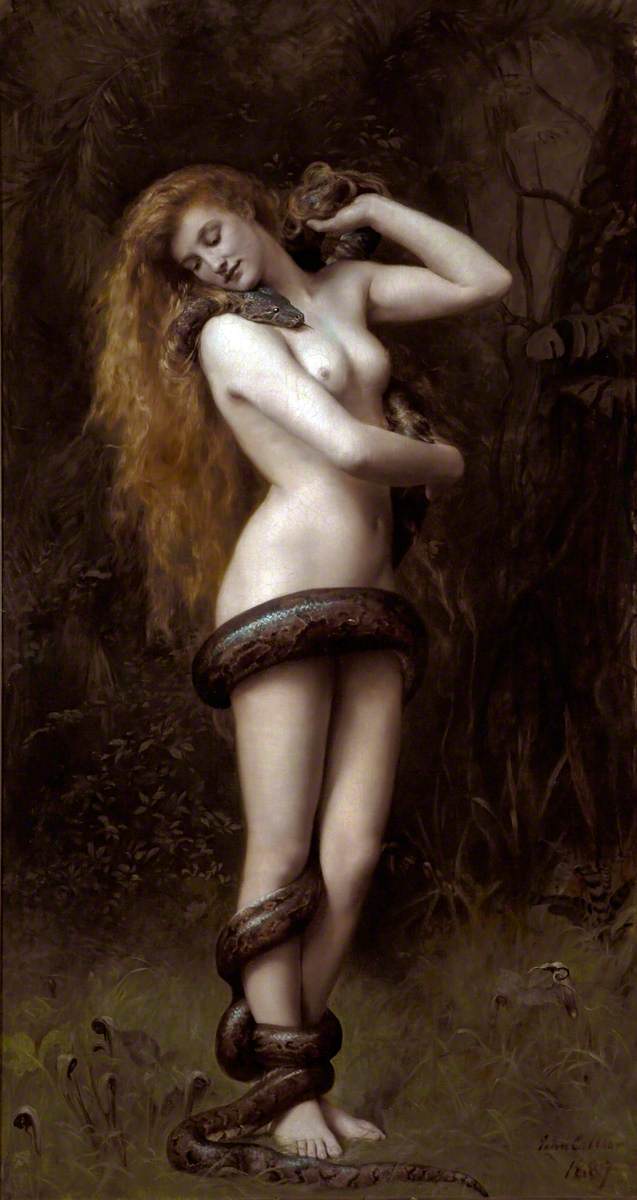
In Mesopotamian mythology
Kiskil-lilla
The mention of a she-demon that is usually identified with Lilith is ki-sikil-lil-la-ke4, a female being in the Sumerian prologue to the Gilgamesh epic. Ki-sikil-lil-la-ke is sometimes translated as Lila's maiden, companion, his beloved or maid. Akin to this, Ki-sikil-ud-da-ka-ra means "the maiden who has stolen the light" or " the maiden who has seized the light". Texts describe Lillake as the "gladdener of all hearts" and "maiden who screeches constantly".
The name of the male companion Lila, is likewise known from this period. The father of Gilgamesh was named as Lilu (= Lila) on the Sumerian king's list. Lila (Lilu, Lillu) is one of four storm demons of the incubi-succubae class. Little is known about the nature of Lila. It is said of him that he attempts to disturb or seduce women in their sleep by night, while Lilitu appears to men in their erotic dreams.
Kramer translates:
a dragon had built its nest at the foot of the treeWolkenstein translates the same passage:
the Zu-bird was raising its young in the crown,
and the demon Lilith had built her house in the middle.
[…]
Then the Zu-bird flew into the mountains with its young,
while Lilith, petrified with fear, tore down her house and fled into the wilderness
a serpent who could not be charmed made its nest in the roots of the tree,Some scholars dispute identification with Lilith. However, most sources consider it definitive. The Anchor Bible Dictionary (Lowell K. Handy) states the following on the subject:
The Anzu bird set his young in the branches of the tree,
And the dark maid Lilith built her home in the trunk.
"Two sources of information previously used to define Lilith are both suspect. Kramer translated ki-sikil-lil-la-ke4 as 'Lilith', in a Sumerian Gilgamesh fragment. The text relates an incident where this female takes up lodging in a tree trunk which has a Zu-bird perched in the branches and a snake living in the roots. This text was used to interpret a sculpture of a woman with bird talons for feet as being a depiction of Lilith. From the beginning this interpretation was questioned so that after some debate neither the female in the story, nor the figure are assumed to be Lilith." (Vol. 4, p. 324)The Burney relief
The Gilgamesh passage quoted above has in turn been applied by some to the Burney relief (Norman Colville collection), which dates to roughly 1950 BC and is a sculpture of a woman who has bird talons and is flanked by owls.
The key to this identification lies in the bird talons and the owls. While the relief may depict the demon Kisikil-lilla-ke of the Gilgamesh passage or a goddess, identification with Lilitu is more tenuous and likely influenced by the "screech owl" translation of the KJV. Most scholars accept it to actually be Inanna or her underworld sister Ereshkigal. However, the real identity of this figure remains inconclusive. A very similar relief dating to roughly the same period is preserved in the Louvre (AO 6501).
Mesopotamian Lilitu
Around 3000 BC, Lilitu/Lilith's first appearance was that in a class of spirits called Lilitu. Here, Lilith was not thought of as a central figure. The Lilitu were said to prey upon children, women in childbirth, and women and were winged spirits with bird feet. Early incantations against the Lilitu associates them with Zu birds (An eagle or type of bird of prey.), lions, storms, and disease. This begins the figure known as Lilith, a disease bearing spirit whose presence was feared to bring illness, death, and terrors by night. Early portrayals of lilitu are known as having Zu bird talons for feet and wings. The name Lilitu/Lilith stood for multiple spirits as well as a single being.
Lilith's epithet was "the beautiful maiden". She had no milk in her breasts and was unable to bear children. She was believed to be a harlot and vampire that would chose lovers and never let them go, but without giving them any real satisfaction.
Lilu, a similar male demon, was one of the four demons that belonged a vampire or incubus-succubi class. The other three were Lilitu, the she-demon, Ardat lili (Lilith's handmaid), who visited men by night and bore them children, and Irdu lili, who was the male counterpart to Ardat lili and would visit women by night and beget children by them. These demons were orginally storm demons. However, because of popular mistaken etymology they became to be regarded as night demons.
Sumerian accounts began to depict Lilitu as the handmaiden of Inanna, particularly presiding over fertility rites. "In older Sumerian texts...it says that Inanna — who corresponds to the Babylonian Ishtar — has sent the beautiful, seductive, and unmarried prostitute Lilitu out into the streets and fields in order to lead men astray". Furthermore, she governs a class of succubi and is called "strangler," a common title in later Lilith stories.
Identical to the Babylo-Sumerian Lilitu, the Akkadian Ardat-Lili presided over temple prostitution. Ardat is derived from "ardatu", a title of prostitutes and young unmarried women, meaning "Maiden". Like Lilith, Ardat Lili was a figure of disease and uncleanliness. One magical text tells of how Ardat Lili had come to 'seize' a sick man.
Akin to the Sumerian and Akkadian accounts, the Babylonians' texts depict Lilitu as the servant of the mother goddess Ishtar. Presiding over sexuality, prostitution, and fertility. However, like her counterparts she is still quite vicious and devouring. Some Babylonian texts mention her as the chief prostitute to Ishtar's temple. While others state that La-bar-tu, the Assyrian counterpart, Lamashtu, as the handmaiden to Inanna/Ishtar.
A similar related Mesopotamian demon, Lamashtu, also contributed to the evolution of the Lilitu myth. Lamashtu was a demon thought to harm children and women during childbirth. This demon was described as having bird talons for feet, having a lioness head and is often depicted as a fearsome creature with wild animals. In further fashion of Lilith, she also had statues, amulets, and incantations against her.
From Arslan Tash (Aleppo National Museum), a site in modern day Syria, comes the "Lilith Prophylactic". Lilith is pictured as a sphinx like creature devouring a child. Similar to the medieval period's amulets to ward off the demon Lilith, this inscribed plaque features an Phoenician-Canaanite dialect incantation against winged night demons called "Lili".
O, Flyer in a dark chamber, Go away at once, O Lili!These lines are part of a incantation to protect women in childbirth. T.H. Gaster's translation wields Lilith as the demon mentioned in this incantation.
Related myths
A figure often compared to Lilith is the Greek Lamia. Said to be a daughter of the goddess Hecate or turned into a monster by the jealous Hera, she has a cannibalistic appetite for children, and is often blamed for kidnapping them. Lamia has a role akin to Lilith in that, she too, is said to have a powerful, dangerous, sexual appetite for men.
Lamia is described as appearing from the torso up as a woman and serpentine from the torso down. She presides over vampiric, blood-sucking Lamiai, (similar to succubi in Medieval myths) and is said to give birth to the horrible demoness Empusae, a creature compared to lilim.
Lilith in the Bible
The Book of Isaiah 34:14, describing the desolation of Edom, is the only occurrence of Lilith in the Hebrew Bible:
Hebrew (ISO 259): pagšu ṣiyyim et-ʾiyyim w-saʿir ʿal-rēʿhu yiqra ʾakšam hirgiʿah lilit u-maṣʾah lah manoḫSchrader (Jahrbuch für Protestantische Theologie, 1. 128) and Levy (ZDMG 9. 470, 484) suggest that Lilith was a goddess of the night, known also by the Jewish exiles in Babylon. Evidence for Lilith being a goddess rather than a demon is lacking. Isaiah dates to the 6th century BC, and the presence of Jews in Babylon would coincide with the attested references to the Līlītu in Babylonian demonology.
morpho-syntactic analysis: "yelpers meet-[perfect] howlers; hairy-ones cry-[imperfect] to fellow. liyliyth reposes-[perfect], acquires-[perfect] resting-place."
KJV: "The wild beasts of the desert shall also meet with the wild beasts of the island, and the satyr shall cry to his fellow; the screech owl also shall rest there, and find for herself a place of rest."
The Septuagint translates onokentauros, apparently for lack of a better word, since also the saʿir "satyrs" earlier in the verse are translated with daimon onokentauros. The "wild beasts of the island and the desert" are omitted altogether, and the "crying to his fellow" is also done by the daimon onokentauros.
In Horace (De Arte Poetica liber, 340), Hieronymus of Cardia translated Lilith as Lamia, a witch who steals children, similar to the Breton Korrigan, in Greek mythology described as a Libyan queen who mated with Zeus. After Zeus abandoned Lamia, Hera stole Lamia's children, and Lamia took revenge by stealing other women's children.
The screech owl translation of the KJV is without precedent, and apparently together with the "owl" (yanšup, probably a water bird) in 34:11, and the "great owl" (qippoz, properly a snake,) of 34:15 an attempt to render the eerie atmosphere of the passage by choosing suitable animals for difficult to translate Hebrew words. It should be noted that this particular species of owl is associated with the vampiric Strix of Roman legend.
Later translations include:
- night-owl (Young, 1898)
- night monster (ASV 1901, NASB 1995)
- night hag (RSV 1947)
- night creature (NIV 1978, NKJV 1982, NLT 1996)
- nightjar (New World Translation, 1984)
- vampires (Moffatt Translation, 1922).
A Hebrew tradition exists in which an amulet is inscribed with the names of three angels (Senoy, Sansenoy, and Semangelof) and placed around the neck of newborn boys in order to protect them from the lilin until their circumcision. There is also a Hebrew tradition to wait three years before a boy's hair is cut so as to attempt to trick Lilith into thinking the child is a girl so that the boy's life may be spared.
Dead Sea scrolls
The appearance of Lilith in the Dead Sea Scrolls is somewhat more contentious, with one indisputable reference in the Song for a Sage (4Q510-511), and a promising additional allusion found by A. Baumgarten in The Seductress (4Q184). The first and irrefutable Lilith reference in the Song occurs in 4Q510, fragment 1:
"And I, the Instructor, proclaim His glorious splendour so as to frighten and to te[rrify] all the spirits of the destroying angels, spirits of the bastards, demons, Lilith, howlers, and [desert dwellers…] and those which fall upon men without warning to lead them astray from a spirit of understanding and to make their heart and their […] desolate during the present dominion of wickedness and predetermined time of humiliations for the sons of lig[ht], by the guilt of the ages of [those] smitten by iniquity – not for eternal destruction, [bu]t for an era of humiliation for transgression."Akin to Isaiah 34:14, this liturgical text both cautions against the presence of supernatural malevolence and assumes familiarity with Lilith; distinct from the biblical text, however, this passage does not function under any socio-political agenda, but instead serves in the same capacity as An Exorcism (4Q560) and Songs to Disperse Demons (11Q11) insomuch that it comprises incantations – comparable to the Arslan Tash relief examined above – used to "help protect the faithful against the power of these spirits." The text is thus, to a community "deeply involved in the realm of demonology," an exorcism hymn.
Another text discovered at Qumran, conventionally associated with the Book of Proverbs, credibly also appropriates the Lilith tradition in its description of a precarious, winsome woman – The Seductress (4Q184). The ancient poem – dated to the first century BCE but plausibly much older – describes a dangerous woman and consequently warns against encounters with her. Customarily, the woman depicted in this text is equated to the "strange woman" of Proverbs 2 and 5, and for good reason; the parallels are instantly recognizable:
"Her house sinks down to death, And her course leads to the shades. All who go to her cannot return And find again the paths of life." (Proverbs 2:18-19)
"Her gates are gates of death, and from the entrance of the house she sets out towards Sheol. None of those who enter there will ever return, and all who possess her will descend to the Pit." (4Q184)However, what this association does not take into account are additional descriptions of the "Seductress" from Qumran that cannot be found attributed to the "strange woman" of Proverbs; namely, her horns and her wings: "a multitude of sins is in her wings." The woman illustrated in Proverbs is without question a prostitute, or at the very least the representation of one, and the sort of individual with whom that text’s community would have been familiar. The "Seductress" of the Qumran text, conversely, could not possibly have represented an existent social threat given the constraints of this particular ascetic community. Instead, the Qumran text utilizes the imagery of Proverbs to explicate a much broader, supernatural threat – the threat of the demoness Lilith.
Folk tradition
The Alphabet of Ben Sira is considered to be the oldest form of the story of Lilith as Adam's first wife. Whether or not this certain tradition is older is not known. Scholars tend to date Ben Sira between 8th and 10th centuries. Its real author is anonymous, but it is falsely attributed to the sage Ben Sira. The amulets used against Lilith that were thought to derive from this tradition are in fact, dated as being much older. While the concept of Eve having a predecessor is not exclusive to Ben Sira or new and can be found in Genesis Rabbah, the idea that this predecessor was Lilith is. According to Gershom Scholem the author of the Zohar, R. Moses de Leon, was aware of the the folk tradition of Lilith, as well another story, possibly older, that may be conflicting.
The idea that Adam had a wife prior to Eve may have developed from an interpretation of the Book of Genesis and its dual creation accounts; while Genesis 2:22 describes God's creation of Eve from Adam's rib, an earlier passage, 1:27, already indicates that a woman had been made: "So God created man in his own image, in the image of God created he him; male and female created he them." The text places Lilith's creation after God's words in Genesis 2:18 that "it is not good for man to be alone". He forms Lilith out of the clay from which he made Adam, but the two bicker. Lilith claims that since she and Adam were created in the same way, they were equal, and she refuses to "lie below" him:
After God created Adam, who was alone, He said, 'It is not good for man to be alone.' He then created a woman for Adam, from the earth, as He had created Adam himself, and called her Lilith. Adam and Lilith immediately began to fight. She said, 'I will not lie below,' and he said, 'I will not lie beneath you, but only on top. For you are fit only to be in the bottom position, while I am to be the superior one.' Lilith responded, 'We are equal to each other inasmuch as we were both created from the earth.' But they would not listen to one another. When Lilith saw this, she pronounced the Ineffable Name and flew away into the air. (In this act, Lilith becomes unique in that she is not touched by "original sin", having left the garden before Eve came into existence. Lilith also reveals herself to be powerful in her own right by knowing the name of God).
Adam stood in prayer before his Creator: 'Sovereign of the universe!' he said, 'the woman you gave me has run away.' At once, the Holy One, blessed be He, sent these three angels Senoy, Sansenoy, and Semangelof, to bring her back."Said the Holy One to Adam, 'If she agrees to come back, what is made is good. If not, she must permit one hundred of her children to die every day.' The angels left God and pursued Lilith, whom they overtook in the midst of the sea, in the mighty waters wherein the Egyptians were destined to drown. They told her God's word, but she did not wish to return. The angels said, 'We shall drown you in the sea.'
"'Leave me!' she said. 'I was created only to cause sickness to infants. If the infant is male, I have dominion over him for eight days after his birth, and if female, for twenty days.'
"When the angels heard Lilith's words, they insisted she go back. But she swore to them by the name of the living and eternal God: 'Whenever I see you or your names or your forms in an amulet, I will have no power over that infant.' She also agreed to have one hundred of her children die every day. Accordingly, every day one hundred demons perish, and for the same reason, we write the angels names on the amulets of young children. When Lilith sees their names, she remembers her oath, and the child recovers."The background and purpose of The Alphabet of Ben-Sira is unclear. It is a collection of stories about heroes of the Bible and Talmud, it may have been a collection of folk-tales, a refutation of Christian, Karaite, or other separatist movements; its content seems so offensive to contemporary Jews that it was even suggested that it could be an anti-Jewish satire, although, in any case, the text was accepted by the Jewish mystics of medieval Germany.
The Alphabet of Ben-Sira is the earliest surviving source of the story, and the conception that Lilith was Adam's first wife became only widely known with the 17th century Lexicon Talmudicum of Johannes Buxtorf.
An Armenian writer Avetik Isahakyan describes Lilit (not Lilith) as Adam's first wife. But here God created Lilit from fire and Adam from soil. Lilit didn't like how Adam smells like soil. In the end she escapes with the Satan in the shape of snake. And only after that God created Eva from Adam's bone, so that she would always be with him. "But though Adam's lips said Eve, but his soul always echoed Lilith."
In the folk tradition that arose in the early middle ages Lilith, a dominate female demon, became identified with Asmodeus, King of Demons, as his queen. Asmodeus was already well known by this time because of the legends about him in the Talmud. Thus, the merging of Lilith and Asmodeus was inevitable. The fecund myth of Lilith grew to include legends about another world and by some accounts this other world existed side by side with this one, Yenne Velt is Yiddish for this described "Other World". In this case Asmodeus and Lilith were believed to procreate demonic offspring endlessly and spread chaos at every turn. Many disasters were blamed on both of them, causing wine to turn into vineger, men to be impotent, women unable to give birth, and it was Lilith who was blamed for the loss of infant life. The presence of Lilith and her cohorts were considered very real at this time.
Two primary characteristics are seen in these legends about Lilith: Lilith as the incarnation of lust, causing men to be led astray, and Lilith as a child killing witch, who stangles helpless neonates. These two aspects of the Lilith legend seemed to have evolved separately, in there is hardly a tale were Lilith emcompasses both roles. But the aspect of the witchlike role that Lilith plays broadens her archetype of the destructive side of witchcraft. Such stories are commonly found among Jewish folklore.
One story tells of how a daughter of Lilith dwelling in a mirror came to possess a narcissistic young girl. (Schwartz) A wife had bought a mirror and hung it in a room of her daughter. The mirror had been hung in a den of demons and a daughter of Lilith resided in it. Whenever the mirror was moved from the haunted house the demoness within went with it. The girl spent a lot of time gazing at herself in the mirror, each time drawing closer and closer into Lilith's web. The daughter of Lilith watched the young girl's every movement. Biding her time, one day Lilith's daughter slipped out and possessed the girl, through the eyes. Seizing control of the girl, Lilith's daughter dominated the girl's every move. Driven by the evil of Lilith's daughter's wishes and desires, the girl became promiscuous and ran around with many men. (Schwartz)
It is said that every mirror is a passage into the Otherworld and leads to Lilith's cave. The cave that Lilith went to after she had abandoned Adam and Eden for all time and the same cave that Lilith took up demon lovers in. From these unholy unions, Lilith birthed multitudes of demons, who flocked from that cave and infested the world. When these demons want to return they simply enter the nearest mirror, that is why Lilith makes her home in every mirror.(ibid)
Lilith in the Romantic period
During the Romantic period (1789 - 1832) Lilith's image began to change dramatically. Goethe and John Keats are two early Romantic authors that were credited to being the first to be influential in the shifting of the image of Lilith and to bring her legend into a larger, more mainstream audience. Later, during the Pre-Raphaelites period, Dante Gabriel Rossetti was famously responsible for bringing a new interpretation of Lilith's identity, image, and myth, where she was adapted by feminists as a modern heroine. A primary consideration for Romantics was the favouring of innovation against traditional forms and styles.
Lilith in Faust
In the earliest Romantic work, Johann Wolfgang von Goethe's 1808 work Faust Part I, Lilith makes another literary appearance, one that has been seen in nearly 600 years since the Zohar. This appearance is quite significant when compared to the ancient works, as Lilith begins to take on a new dimension and a more positive role.
The legends about Dr. Faustus may have begun about 1540. In most versions are his quests for forbidden and often hidden knowledge. During a "Walpurgis" Night scene of Faust by Goethe, Lilith makes one appearance:
Faust:With her "ensnaring" sexuality, Goethe draws upon ancient legends of Lilith which associate her with Adam. Perhaps, more importantly, is the identifying marker of Lilith, her long, ensnaring hair, an image recounted in more familiar ancient tales. This image is the first "modern" literary mention of Lilith and continues to dominate throughout the nineteenth century.
Who's that there?
Mephistopheles:
Take a good look.
Lilith.
Faust:
Lilith? Who is that?
Mephistopheles:
Adam's wife, his first. Beware of her.
Her beauty's one boast is her dangerous hair.
When Lilith winds it tight around young men
She doesn't soon let go of them again.
(1992 Greenberg translation, lines 4206–4211)
After Mephistopheles offers this warning to Faust, he then, quite ironically, encourages Faust to dance with "the Pretty Witch". Lilith and Faust engage in a short conversation, where Lilith recounts the days spent in Eden.
Faust: [dancing with the young witch]Here Goethe chooses to elaborate on the Eden scene, focusing on the popular Lilith's identity as the first wife of Adam rather than a child-killing and disease-bearing demon.
A lovely dream I dreamt one day
I saw a green-leaved apple tree,
Two apples swayed upon a stem,
So tempting! I climbed up for them.
The Pretty Witch:
Ever since the days of Eden
Apples have been man's desire.
How overjoyed I am to think, sir,
Apples grow, too, in my garden.
(1992 Greenberg translation, lines 4216 – 4223)
This brief mention is important, as it marks Lilith's debut in modern literature. Additionally, her character being for the most part is unnecessary, this establishes that Goethe's intentions and reason in invoking her image and associations may differ. It also suggests familiarity with the figure of Lilith. This text heavily influenced the later Romantic art and literature of Lilith and how she is often portrayed and continues to dominate representations throughout the 19th century.
Keats, Lilith, and "Lamia"
In Keats's poem: "Lamia" (1819), the two tales of Lamia and Lilith begin to assimilate and forge a connection.
The title female character is never referred to as Lilith, but the similarities between the two are too prominent to be overlooked. An enchantress and she-demon, Lamia is the archetypal Romantic representation of what Lilith will become. She is never branded as "immoral" or "evil" by Keats. The reader is invited to feel Lamia's pain under her unfortunate circumstances. This sparks the beginning of the transformation of Lilith and Lamia. While both are associated with wickedness, these inherently negative aspects are redefined in a way to make it look unimportant.
The poem begins with Lamia stuck in a serpent's body. It never states how she became that way, but the poem hints that she had a previous human existence. She appeals to Hermes: I was a woman, let me have once more / A woman's shape, and charming as before. / I love a youth of Corinth - O the bliss! / Give me my woman's form, and place me where he is" (I.117-120). The poem continues with Lamia's falling in love with a traveller named Menippus Lycius (whose name is an epithet of the god Apollo.)
"Lamia" introduces the dual sexual nature of Lilith: virgin but also seductress. The paradox is first introduced in these lines: "A virgin purest lipp'd, yet in the lore / Of love deep learned to the red heart's core" (I.189-190). This contradiction is also present in founding texts, some of which that claim Lilith gives birth to children in the hundreds each day, while she, likewise, murders hundreds of children.
The most important aspect of Keats's Lilith-themed poem is that of her association with excess. Her words are spoken as if "through bubbling honey," her song is "too sweet," and she herself is described as "bitter-sweet" (I.64, 299, 59). Within the poem, Lycius himself is driven to comment on this excess, professing that Lamia's mere presence invokes "a hundred thirsts." Lycius further proclaims that he will die without Lamia and that her memory alone is enough to kill (ln. 269-270).
The characterization of Lamia bears great similarities to the figure of Lilith; many other facets are omitted on purpose, such as the night terror aspect. Although she remains a seductress, her intentions are not considered immoral nor condemned. As the Norton Anthology introduction to the poem states: "Lamia is an enchantress, a liar, and a calculating expert in amour; but she apparently intends no harm, is genuinely in love, and is very beautiful" (797).
Goethe simply ignores her negative aspects, Keats altogether rewrites Lilith's original identity. Even the serpent, a symbol in popular Western lore denoted with evil and a cult animal of Lilith's, is shed in the body of the poem. From this "evil" evolves a beautiful and sensuous womanly figure. Many scholars of Romantic literature further associate the unnamed figure in another Keats poem, "La Belle Dame Sans Merci", to that of Lilith. Akin to Lamia, the figure of the poem is a beautiful seductress associated with death.
Lilith in literature
- Lilith is a book containing the character Lilith by the author George Macdonald, who in turn heavily influenced C.S. Lewis.
- George Bernard Shaw has Lilith make a grand speech expressing some of his philosophy at the end of his play As Far as Thought Can Reach, part of his five-part series Back to Methuselah (1921). C.S. Lewis referred to this as "nonsense" in his essay "The Weight of Glory".
- In C.S. Lewis's The Lion, the Witch and the Wardrobe, the central antagonist, the White Witch, is said to be a descendant of Lilith.
- In Piers Anthony's Incarnations of Immortality series Lilith is a demon of Hell.
- Lilith is the main antagonist in the book Resurrection by Steve Alten.
- Lilith is a character in the novel Coldheart Canyon: A Hollywood Ghost Story by Clive Barker, published in 2001.
- Lilith is the name of a main character in Octavia E. Butler's trilogy, Xenogenesis. The trilogy draws upon much of the Lilith mythology.
- In his 1924 novel The Magic Mountain, German author Thomas Mann makes antagonist Lodovico Settembrini refer to main character Hans Castorp's romantic interest, Clawdia Chauchat as Lilith.
- The reference in the above-mentioned literary work is again a quote from Johann Wolfgang von Goethe's Faust I, in which Lilith appears among the witches on Walpurgisnacht.
- Lilith is an antagonistic character in the play "The Love Song of J. Robert Oppenheimer." In this play the character of Lilith exists in Oppenheimer's mind and never touches the ground.
- Song of Lilith is a published poem written by Joy Kogawa as an interpertation of Lilith's flight from the Garden of Eden and the aftermath.
- Lilith is also a prominant figure in the book series "The Nightside" by Simon Green. Once again she is displayed as Adam's first wife, who laid with the devil and created demons. Her character is hinted at for the first three books, but her character does not show up until book four, "Hex and the City".
- Lilith is the name of the vampire queen in the Nora Roberts "Circle" trilogy, released in 2006.
- Lilith in World of Darkness is said to have had a hand in the creation of Daemons, Werewolfs, and Fae's. As well as being a supernatural 'Ascended' human or mage herself. She is also believed to be a second generation Vampire granting her immortality after her romance with Caine, the original Vampire. These things would make her the most powerful being in existence in the World of Darkness Universe, Book of Nod.
Subscribe to:
Posts (Atom)


 Posts
Posts


