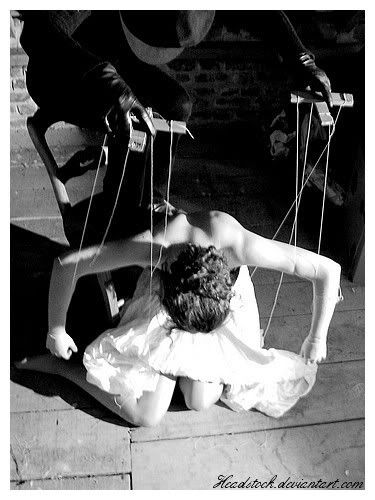
The puppet master is always dusted with a little darkness. In direct relation to his skill he propagates the most bewildering enigmas for, the more lifelike his marionettes, the more godlike his manipulations and the more radical the symbiosis between inarticulate doll and articulating fingers. The puppeteer speculates in a no-man's-limbo between the real and that which, although we know very well it is not, nevertheless seems to be real. He is the intermediary between us, his audience, the living, and they, the dolls, the undead, who cannot live at all and yet who mimic the living in every detail since, though they cannot speak or weep, still they project those signals of signification we instantly recognise as language.
The master of marionettes vitalises inert stuff with the dynamics of his self. The sticks dance, make love, pretend to speak and, finally, personate death; yet, so many Lazaruses out of their graves they spring again in time for the next performance and no worms drip from their noses nor dust clogs their eyes. All complete, they once again offer their brief imitations of men and women with an exquisite precision which is all the more disturbing because we know it to be false; and so this art, if viewed theologically, may, perhaps, be blasphemous.
excerpt from Angela Carter's short story, The Loves of Lady Purple.
photo: deviantart.com
Sunday, March 30, 2008
The Puppeteer
Αναρτήθηκε από
Melian
στις
7:58:00 PM
0
comments
Tags Angela Carter, literature
She and Her Darkness - Diary of Dreams
My heart weights minimum a tone
An army's feet pounding on my head
Maybe I'll wake up one day to notice
that all my life was just a dream...
And maybe I'll be better off without you
You left me here with all my thoughts
I'd write a zillion words or walk a million miles
I'd sleep on broken glass just not to lose your smiles
I travel for you around the world
Collecting moments, o how absurd
To bring you beauty, to bring you joy
I wish I'd be a little boy
Where is that silence you promised me?
Why is that distance so close to me?
Why is your violence still hurting me?
Why are your eyes avoiding me?
Let me say thank you for all that you have given me.
Thank you for everything you've done.
Forgive me for saying one last thing:
I miss you and I hope you hear this song!
I travel for you around the world
Collecting moments, o how absurd
To bring you beauty, to bring you joy
I wish I'd be a little boy
I'm dying for you, can't you see?
I'm lying for you to be free!
I hunger for you, 'cause I can't eat!
I'd vanish for you in defeat!
Αναρτήθηκε από
Melian
στις
5:52:00 PM
0
comments
Friday, March 28, 2008
Ode to Psyche - John Keats
Source: Wikipedia O GODDESS! hear these tuneless numbers, wrung
By sweet enforcement and remembrance dear,
And pardon that thy secrets should be sung
Even into thine own soft-conched ear:
Surely I dreamt to-day, or did I see
The winged Psyche with awaken’d eyes?
I wander’d in a forest thoughtlessly,
And, on the sudden, fainting with surprise,
Saw two fair creatures, couched side by side
In deepest grass, beneath the whisp’ring roof
Of leaves and trembled blossoms, where there ran
A brooklet, scarce espied:
’Mid hush’d, cool-rooted flowers, fragrant-eyed,
Blue, silver-white, and budded Tyrian,
They lay calm-breathing on the bedded grass;
Their arms embraced, and their pinions too;
Their lips touch’d not, but had not bade adieu,
As if disjoined by soft-handed slumber,
And ready still past kisses to outnumber
At tender eye-dawn of aurorean love:
The winged boy I knew;
But who wast thou, O happy, happy dove?
His Psyche true!
O latest born and loveliest vision far
Of all Olympus’ faded hierarchy!
Fairer than Phoebe’s sapphire-region’d star,
Or Vesper, amorous glow-worm of the sky;
Fairer than these, though temple thou hast none,
Nor altar heap’d with flowers;
Nor virgin-choir to make delicious moan
Upon the midnight hours;
No voice, no lute, no pipe, no incense sweet
From chain-swung censer teeming;
No shrine, no grove, no oracle, no heat
Of pale-mouth’d prophet dreaming.
O brightest! though too late for antique vows,
Too, too late for the fond believing lyre,
When holy were the haunted forest boughs,
Holy the air, the water, and the fire;
Yet even in these days so far retir’d
From happy pieties, thy lucent fans,
Fluttering among the faint Olympians,
I see, and sing, by my own eyes inspired.
So let me be thy choir, and make a moan
Upon the midnight hours;
Thy voice, thy lute, thy pipe, thy incense sweet
From swinged censer teeming;
Thy shrine, thy grove, thy oracle, thy heat
Of pale-mouth’d prophet dreaming.
Yes, I will be thy priest, and build a fane
In some untrodden region of my mind,
Where branched thoughts, new grown with pleasant pain,
Instead of pines shall murmur in the wind:
Far, far around shall those dark-cluster’d trees
Fledge the wild-ridged mountains steep by steep;
And there by zephyrs, streams, and birds, and bees,
The moss-lain Dryads shall be lull’d to sleep;
And in the midst of this wide quietness
A rosy sanctuary will I dress
With the wreath’d trellis of a working brain,
With buds, and bells, and stars without a name,
With all the gardener Fancy e’er could feign,
Who breeding flowers, will never breed the same:
And there shall be for thee all soft delight
That shadowy thought can win,
A bright torch, and a casement ope at night,
To let the warm Love in!
Αναρτήθηκε από
Melian
στις
4:40:00 PM
0
comments
Tags John Keats, poetry, romanticism
Friday, March 14, 2008
Reviewing Tom Holland's The Vampyre

When I first encountered this particular book on the shelves of an English bookstore I was instantly attracted by its main title and even more by the subtitle: The Secret History of Lord Byron. Of course this is a pretty well known myth which has been made famous and proliferated by Polidori's Vampyre and relates Lord Byron with vampirism. And that is because Polidori's Vampyre based on a fragment of novel that Lord Byron himself attempted to write maintains a lot of characteristics with the Byronic Hero, which is not the real Byron but the caricature that has been created after his name. So attracted by this background and a lover of Lord Byron, I bought the book without any hesitation. I wanted to see how the writer managed to blend history with fantasy and to check if such an attempt was really possible and successful.
I have to admit that while I was reading the book I had a strange feeling that I couldn't help. I was refusing to connect the fictional Byron with the real Byron which was rather difficult since the novel had him as a protagonist. I refused to make the connection because I firmly believe that Holland's fantasy had nothing to do with the poet himself. Just taking a lot of biographical elements of a person's life and blending them with reality is like abusing in a way his true life, his true memory. And this is a thing in question, at least in my point of view. Why for example didn't the author choose to write about a completely fictional vampyre and why did he choose Lord Byron as the medium of his story? Was such a choice rather pure on its intention or was it a "catchy" idea? These thoughts preoccupied all the time, from the first till the last page of reading the book.
But let's discuss the more technical details. As far as the the plot is concerned I found a lot of flaws in it. There were many elements that didn't seem to fit, many things were kept unsaid and unexplained and I was left with a rather chaotic feeling. The ending itself was rather abrupt and very superficial. Although the writer tried through the novel to justify and explain the protagonist's choices and way of life, it left me with a vague feeling in the end. Nothing made sense. There was a gothic atmosphere but it didn't manage to take me with it.
Another thing that disappointed me in this particular novel was the thing that it had nothing to offer to the gothic genre in particular. It wasn't worthy of the pre-existent gothic novels and it wasn't either worthy of the present gothic needs. What I mean is that the Vampyres of Holland had similar characteristics to the main characters of the other gothic novels like Stoker's Dracula and Anne Rice's Lestat and it didn't make any new suggestions on what a vampire is or could be. On this respect, it was a rather boring reading. I have read many gothic-vampire fiction and what I really want each time is an author who will make some interesting suggestions and he will not repeat the same old stories.
Lastly, I have to say that the only thing that made me read the book till the end was that I wanted to see how the author mixed Lord Byron's biography and work with the figments of his imagination. I wouldn't say that he was successful in this part as well. When you decide to write such a novel and to talk fictionally about personalities strong and elegant like Lord Byron's you have too be at least worthy of their powerfullness. And this is a high-fetched challenge. Either you succeed or you fail. Your work cannot be mediocre. And I think that Tom Holland failed for all the above reasons. And that is a pity because we need good contemporary gothic literature.
Yes, it is a rather interesting story for those who do not have high expectations and want to read something with a quick plot but I wouldn't suggest it to a gothic lover or scholar who expects to find something worth reading, something innovative. But this is just my own opinion for all that matters. If anyone has read the novel it would be my pleasure to hear his comments on it.
Αναρτήθηκε από
Melian
στις
11:48:00 AM
3
comments
Tags English Gothic, literature, Lord Byron, my reviews, vampires
Sunday, March 9, 2008
Tarot - The World
Basic Card Symbols
Woman or hermaphrodite dancing, a wreath in the shape of a Yoni (almond shaped circle), two wands, a cherub, an eagle, a lion, a bull.
Basic Tarot Story
The Fool turns to take that final step along his final path, and finds, to his bemusement that he is right back where he started, at the edge of that very same cliff he almost stepped over when he was young and too foolish to look where he was going. But now he sees his position very differently. He thought he could separate body and mind, learn all about one, then leave it to learn about the other. But in the end, it is all about self, mind and body, past and future, the individual, and the world. All one. As above, so below, and all opposites are each other, including the Fool and the Mystic who are both doorways to the secrets of the universe. With a knowing smile, the Fool takes that final step right off the cliff...and soars. Higher and higher, until the whole of the world is his to see. And there he dances, surrounded by a yoni of stars, one with the universe. Ending, in a sense, where he began, beginning again at the end. The world turns, and the Fool journey is complete.
Basic Tarot Meaning
The World card pictures a dancer in a Yoni (sometimes made of laurel leaves). The Yoni symbolizes the great Mother, the cervix through which everything is born, and also the doorway to the next life after death. It is indicative of a complete circle. The Dancer has one leg crossed over the other, just like the Hanged man. She is, in a sense, his opposite, the hanged man right-side-up. As the Hanged Man saw infinitely inward, the Dancer sees infinitely outward. Which brings us to the Lion, Bull, Cherub and Eagle standing for Leo, Taurus, Aquarius and Scorpio, the fixed signs of the Zodiac (these link the ever turning World card to the ever turning Wheel of Fortune), and so symbolic of the four elements, four compass points and the four corners of the universe. All within the Dancer's sight and power.
Thus, the World card, very aptly, represents a successful conclusion, all aspects accounted for and taken in. Simply put, this card tells the Querent that the end to a long-term project is in sight, and that it will be accompanied by well-earned praise, celebration and success. With Saturn as its ruling planet, this card can also indicate that the Querent, now an expert in their subject, is likely to become a teacher or sought-after lecturer. And, finally, on a more mundane level, the World card indicates travel, not short business trips, but long, fantastic trips. Maybe a lecture tour, book signing, or just a trip around the world. This is a wonderful card of wholeness, perfection, satisfaction and happiness.
Thirteen's Observations
There are three possible things I usually see in this card when it comes up, sometimes combined, sometimes not:
(1) Everything finally coming together, successfully and at last. The Querent will get that Ph.D. they've been working for years to complete, they'll graduate at long last, marry after a long engagement, finish that huge project. This card is not for little ends, but for big ones, important ones, ones that come with well earned cheers and acknowledgements. The Querent's hard work, knowledge, wisdom, patience, etc, will absolutely pay-off; they've done everything right.
(2) Maybe because of their success, the Querent is about to become a teacher, a Sensei, if you will. Revered for their expertise.
(3) And maybe, because of this, they're going to be offered a job or trip to some amazing place. They're asked to lecture in a remote city in India, spend a month at the North Pole, teach on board a boat sailing round the globe. No boring little trip for this person, no sir! Luckily for them, the World card indicates that they'll feel comfortable and welcome no matter where they go. The World card indicates a person who owns nothing, because everything is theirs. No place is their home because every place is their home. It's all one, all complete.
Αναρτήθηκε από
Melian
στις
9:44:00 PM
0
comments
Tags tarot
Saturday, February 16, 2008
Rapunzel - Brothers Grimm
There were once a man and a woman who had long in vain wished for a child. At length the woman hoped that God was about to grant her desire. These people had a little window at the back of their house from which a splendid garden could be seen, which was full of the most beautiful flowers and herbs. It was, however, surrounded by a high wall, and no one dared to go into it because it belonged to an enchantress, who had great power and was dreaded by all the world.
One day the woman was standing by this window and looking down into the garden, when she saw a bed which was planted with the most beautiful rampion - Rapunzel, and it looked so fresh and green that she longed for it, and had the greatest desire to eat some. This desire increased every day, and as she knew that she could not get any of it, she quite pined away, and began to look pale and miserable.
Then her husband was alarmed, and asked, "What ails you, dear wife?"
"Ah," she replied, "if I can't eat some of the rampion, which is in the garden behind our house, I shall die."
The man, who loved her, thought, sooner than let your wife die, bring her some of the rampion yourself, let it cost what it will. At twilight, he clambered down over the wall into the garden of the enchantress, hastily clutched a handful of rampion, and took it to his wife. She at once made herself a salad of it, and ate it greedily. It tasted so good to her - so very good, that the next day she longed for it three times as much as before. If he was to have any rest, her husband must once more descend into the garden. In the gloom of evening, therefore, he let himself down again. But when he had clambered down the wall he was terribly afraid, for he saw the enchantress standing before him.
"How can you dare," said she with angry look, "descend into my garden and steal my rampion like a thief? You shall suffer for it."
"Ah," answered he, "let mercy take the place of justice, I only made up my mind to do it out of necessity. My wife saw your rampion from the window, and felt such a longing for it that she would have died if she had not got some to eat."
Then the enchantress allowed her anger to be softened, and said to him, "If the case be as you say, I will allow you to take away with you as much rampion as you will, only I make one condition, you must give me the child which your wife will bring into the world. It shall be well treated, and I will care for it like a mother."
The man in his terror consented to everything, and when the woman was brought to bed, the enchantress appeared at once, gave the child the name of Rapunzel, and took it away with her.
Rapunzel grew into the most beautiful child under the sun. When she was twelve years old, the enchantress shut her into a tower, which lay in a forest, and had neither stairs nor door, but quite at the top was a little window. When the enchantress wanted to go in, she placed herself beneath it and cried,
"Rapunzel, Rapunzel,
Let down your hair!"Rapunzel had magnificent long hair, fine as spun gold, and when she heard the voice of the enchantress she unfastened her braided tresses, wound them round one of the hooks of the window above, and then the hair fell twenty ells down, and the enchantress climbed up by it.
After a year or two, it came to pass that the king's son rode through the forest and passed by the tower. Then he heard a song, which was so charming that he stood still and listened. This was Rapunzel, who in her solitude passed her time in letting her sweet voice resound. The king's son wanted to climb up to her, and looked for the door of the tower, but none was to be found. He rode home, but the singing had so deeply touched his heart, that every day he went out into the forest and listened to it. Once when he was thus standing behind a tree, he saw that an enchantress came there, and he heard how she cried,
"Rapunzel, Rapunzel,
Let down your hair!"Then Rapunzel let down the braids of her hair, and the enchantress climbed up to her. "If that is the ladder by which one mounts, I too will try my fortune," said he, and the next day when it began to grow dark, he went to the tower and cried,
"Rapunzel, Rapunzel,
Let down your hair!"Immediately the hair fell down and the king's son climbed up. At first Rapunzel was terribly frightened when a man, such as her eyes had never yet beheld, came to her. But the king's son began to talk to her quite like a friend, and told her that his heart had been so stirred that it had let him have no rest, and he had been forced to see her. Then Rapunzel lost her fear, and when he asked her if she would take him for her husband, and she saw that he was young and handsome, she thought, he will love me more than old dame gothel does. And she said yes, and laid her hand in his.
She said, "I will willingly go away with you, but I do not know how to get down. Bring with you a skein of silk every time that you come, and I will weave a ladder with it, and when that is ready I will descend, and you will take me on your horse."
They agreed that until that time he should come to her every evening, for the old woman came by day.
The enchantress remarked nothing of this, until once Rapunzel said to her, "Tell me, Dame Gothel, how it happens that you are so much heavier for me to draw up than the young king's son - he is with me in a moment."
"Ah! You wicked child," cried the enchantress. "What do I hear you say. I thought I had separated you from all the world, and yet you have deceived me."
In her anger she clutched Rapunzel's beautiful tresses, wrapped them twice round her left hand, seized a pair of scissors with the right, and snip, snap, they were cut off, and the lovely braids lay on the ground. And she was so pitiless that she took poor Rapunzel into a desert where she had to live in great grief and misery.
On the same day that she cast out Rapunzel, however, the enchantress fastened the braids of hair, which she had cut off, to the hook of the window, and when the king's son came and cried,
"Rapunzel, Rapunzel,
Let down your hair!"she let the hair down. The king's son ascended, but instead of finding his dearest Rapunzel, he found the enchantress, who gazed at him with wicked and venomous looks.
"Aha," she cried mockingly, "you would fetch your dearest, but the beautiful bird sits no longer singing in the nest. The cat has got it, and will scratch out your eyes as well. Rapunzel is lost to you. You will never see her again."
The king's son was beside himself with pain, and in his despair he leapt down from the tower. He escaped with his life, but the thorns into which he fell pierced his eyes. Then he wandered quite blind about the forest, ate nothing but roots and berries, and did naught but lament and weep over the loss of his dearest wife.
Thus he roamed about in misery for some years, and at length came to the desert where Rapunzel, with the twins to which she had given birth, a boy and a girl, lived in wretchedness. He heard a voice, and it seemed so familiar to him that he went towards it, and when he approached, Rapunzel knew him and fell on his neck and wept. Two of her tears wetted his eyes and they grew clear again, and he could see with them as before. He led her to his kingdom where he was joyfully received, and they lived for a long time afterwards, happy and contented.
Αναρτήθηκε από
Melian
στις
1:29:00 AM
0
comments
Tags Brothers Grimm, fairy-tales