Friday, May 4, 2007

Chance and Carl Jung

The Mystery of Chance

by Peter A. Jordan

At some time or another it's happened to all of us. There's that certain number that pops up wherever you go. Hotel rooms, airline terminals, street addresses -- its haunting presence cannot be escaped. Or, you're in your car, absently humming a song. You turn on the radio. A sudden chill prickles your spine. That same song is now pouring from the speaker.

Coincidence, you tell yourself. Or is it?

For most mainstream scientists, experiences like this, however strange and recurrent, are nothing but lawful expressions of chance, a creation -- not of the divine or mystical -- but of simply that which is possible. Ignorance of natural law, they argue, causes us to fall prey to superstitious thinking, inventing supernatural causes where none exist. In fact, say these statistical law-abiding rationalists, the occasional manifestation of the rare and improbable in daily life is not only permissible, but inevitable.

Consider this: from a well-shuffled deck of fifty-two playing cards, the mathematical odds of dealing a hand of thirteen specified cards are about 635,000,000,000 to one. (This means that, in dealing the hand, there exist as many as 635,000,000,000 different hands that may possibly appear.) What statisticians tell us, though, is that these billions of hands are all equally likely to occur, and that one of them is absolutely certain to occur each time the hand is dealt. Thus, any hand that is dealt, including the most rare and improbable hand is, in terms of probability, merely one of a number of equally likely events, one of which was bound to happen.

Such sobering assurances don't necessarily satisfy everyone, however: many see coincidence as embedded in a higher, transcendental force, a cosmic "glue," as it were, which binds random events together in a meaningful and coherent pattern. The question has always been: could such a harmonizing principle actually exist? Or are skeptics right in regarding this as a product of wishful thinking, a consoling myth spawned by the intellectual discomfort and capriciousness of chance?

Mathematician Warren Weaver, in his book, Lady Luck: The Theory of Probability, recounts a fascinating tale of coincidence that stretches our traditional notions of chance to their breaking point. The story originally appeared in Life magazine. Weaver writes:

All fifteen members of a church choir in Beatrice, Nebraska, due at practice at 7:20, were late on the evening of March 1, 1950. The minister and his wife and daughter had one reason (his wife delayed to iron the daughter's dress) one girl waited to finish a geometry problem; one couldn't start her car; two lingered to hear the end of an especially exciting radio program; one mother and daughter were late because the mother had to call the daughter twice to wake her from a nap; and so on. The reasons seemed rather ordinary. But there were ten separate and quite unconnected reasons for the lateness of the fifteen persons. It was rather fortunate that none of the fifteen arrived on time at 7:20, for at 7:25 the church building was destroyed in an explosion. The members of the choir, Life reported, wondered if their delay was "an act of God."

Weaver calculates the staggering odds against chance for this uncanny event as about one chance in a million.

Coincidences such as these, some say, are almost too purposeful, too orderly, to be a product of random chance, which strains somewhat to accommodate them. But then how do we explain them?

Psychologist Carl Jung believed the traditional notions of causality were incapable of explaining some of the more improbable forms of coincidence. Where it is plain, felt Jung, that no causal connection can be demonstrated between two events, but where a meaningful relationship nevertheless exists between them, a wholly different type of principle is likely to be operating. Jung called this principle "synchronicity."

In The Structure and Dynamics of the Psyche, Jung describes how, during his research into the phenomenon of the collective unconscious, he began to observe coincidences that were connected in such a meaningful way that their occurrence seemed to defy the calculations of probability. He provided numerous examples culled from his own psychiatric case-studies, many now legendary.

A young woman I was treating had, at a critical moment, a dream in which she was given a golden scarab. While she was telling me his dream I sat with my back to the closed window. Suddenly I heard a noise behind me, like a gentle tapping. I turned round and saw a flying insect knocking against the window-pane from outside. I opened the window and caught the creature in the air as it flew in. It was the nearest analogy to the golden scarab that one finds in our latitudes, a scarabaeid beetle, the common rose-chafer (Cetoaia urata) which contrary to its usual habits had evidently felt an urge to get into a dark room at this particular moment. I must admit that nothing like it ever happened to me before or since, and that the dream of the patient has remained unique in my experience.

Who then, might we say, was responsible for the synchronous arrival of the beetle -- Jung or the patient? While on the surface reasonable, such a question presupposes a chain of causality Jung claimed was absent from such experience. As psychoanalyst Nandor Fodor has observed, the scarab, by Jung's view, had no determinable cause, but instead complemented the "impossibility" of the analysis. The disturbance also (as synchronicities often do) prefigured a profound transformation. For, as Fodor observes, Jung's patient had -- until the appearance of the beetle -- shown excessive rationality, remaining psychologically inaccessible. Once presented with the scarab, however, her demeanor improved and their sessions together grew more profitable.

Because Jung believed the phenomenon of synchronicity was primarily connected with psychic conditions, he felt that such couplings of inner (subjective) and outer (objective) reality evolved through the influence of the archetypes, patterns inherent in the human psyche and shared by all of mankind. These patterns, or "primordial images," as Jung sometimes refers to them, comprise man's collective unconscious, representing the dynamic source of all human confrontation with death, conflict, love, sex, rebirth and mystical experience. When an archetype is activated by an emotionally charged event (such as a tragedy), says Jung, other related events tend to draw near. In this way the archetypes become a doorway that provide us access to the experience of meaningful (and often insightful) coincidence.

Implicit in Jung's concept of synchronicity is the belief in the ultimate "oneness" of the universe. As Jung expressed it, such phenomenon betrays a "peculiar interdependence of objective elements among themselves as well as with the subjective (psychic) states of the observer or observers." Jung claimed to have found evidence of this interdependence, not only in his psychiatric studies, but in his research of esoteric practices as well. Of the I Ching, a Chinese method of divination which Jung regarded as the clearest expression of the synchronicity principle, he wrote: "The Chinese mind, as I see it at work in the I Ching, seems to be exclusively preoccupied with the chance aspect of events. What we call coincidence seems to be the chief concern of this peculiar mind, and what we worship as causality passes almost unnoticed...While the Western mind carefully sifts, weighs, selects, classifies, isolates, the Chinese picture of the moment encompasses everything down to the minutest nonsensical detail, because all of the ingredients make up the observed moment."

Similarly, Jung discovered the synchronicity within the I Ching also extended to astrology. In a letter to Freud dated June 12, 1911, he wrote: "My evenings are taken up largely with astrology. I make horoscopic calculations in order to find a clue to the core of psychological truth. Some remarkable things have turned up which will certainly appear incredible to you...I dare say that we shall one day discover in astrology a good deal of knowledge that has been intuitively projected into the heavens."

Freud was alarmed by Jung's letter. Jung's interest in synchronicity and the paranormal rankled the strict materialist; he condemned Jung for wallowing in what he called the "black tide of the mud of occultism." Just two years earlier, during a visit to Freud in Vienna, Jung had attempted to defend his beliefs and sparked a heated debate. Freud's skepticism remained calcified as ever, causing him to dismiss Jung's paranormal leanings, "in terms of so shallow a positivism," recalls Jung, "that I had difficulty in checking the sharp retort on the tip of my tongue." A shocking synchronistic event followed. Jung writes in his memoirs:

While Freud was going on this way, I had a curious sensation. It was as if my diaphragm were made of iron and were becoming red-hot -- a glowing vault. And at that moment there was such a loud report in the bookcase, which stood right next to us, that we both started up in alarm, fearing the thing was going to topple over on us. I said to Freud: 'There, that is an example of a so-called catalytic exteriorization phenomenon.' 'Oh come,' he exclaimed. 'That is sheer bosh.' 'It is not,' I replied. 'You are mistaken, Herr Professor. And to prove my point I now predict that in a moment there will be another such loud report! 'Sure enough, no sooner had I said the words that the same detonation went off in the bookcase. To this day I do not know what gave me this certainty. But I knew beyond all doubt that the report would come again. Freud only stared aghast at me. I do not know what was in his mind, or what his look meant. In any case, this incident aroused his distrust of me, and I had the feeling that I had done something against him. I never afterward discussed the incident with him.

In formulating his synchronicity principle, Jung was influenced to a profound degree by the "new" physics of the twentieth century, which had begun to explore the possible role of consciousness in the physical world. "Physics," wrote Jung in 1946, "has demonstrated...that in the realm of atomic magnitudes objective reality presupposes an observer, and that only on this condition is a satisfactory scheme of explanation possible." "This means," he added, "that a subjective element attaches to the physicist's world picture, and secondly that a connection necessarily exists between the psyche to be explained and the objective space-time continuum." These discoveries not only helped loosen physics from the iron grip of its materialistic world-view, but confirmed what Jung recognized intuitively: that matter and consciousness -- far from operating independently of each other -- are, in fact, interconnected in an essential way, functioning as complementary aspects of a unified reality.

The belief -- suggested by quantum theory and by reports of synchronous events -- that matter and consciousness interpenetrate is, of course, far from new. What historian Arthur Koestler refers to as the capacity of the human psyche to "act as a cosmic resonator" faithfully echoes the thinking of Kepler and Pico. Leibnitz's "monad," a spiritual microcosm said to mirror the patterns of the universe, was based on the premise that individual and universe "imprint" each other, acting by virtue of a "pre-established harmony." And for Schopenhauer who, like Jung, questioned the exclusive status of causality, everything was "interrelated and mutually attuned."

Common among these various historical sources, as Koestler observes in his book, The Roots of Coincidence, is the presumption of a "fundamental unity of all things," which transcends mechanical causality, and which relates coincidence to the "universal scheme of things."

In exploring the parallels between modern science and the mystical concept of a universal scheme or oneness, Koestler compares the evolution of science during the past one-hundred-and-fifty years to a vast river system, in which each tributary is "swallowed up" by the mainstream, until all unified in a single river-delta. The science of electricity, he points out, merged, during the nineteenth century, with the science of magnetism. Electromagnetic waves were then discovered to be responsible for light, color, radiant heat and Hertzian waves, while chemistry was embraced by atomic physics. The control of the body by nerves and glands was linked to electrochemical processes, and atoms were broken down into the "building blocks" of protons, electrons and neutrons. Soon, however, even these fundamental parts were reduced by scientists to mere "parcels of compressed energy, packed and patterned according to certain mathematical formulae."

What all this reveals, then, is that there may be what Koestler refers to as "the universal hanging-together of things, their embeddedness in a universal matrix." Many ecologists already subscribe to this sense of interrelation in the world, what the ancients called the "sympathy" of life, and the numbers of scientists now converting to this world-view are beginning to multiply. Nobel Prize winner Ilya Prigione of the University of Texas at Austin is studying the "spontaneous formation of coherent structures," how chemical and other kinds of structures evolve patterns out of chaos. Karl Pribram, a neuroscientist at Stanford University, has proposed that the brain may be a type of "hologram," a pattern and frequency analyzer which creates "hard" reality by interpreting frequencies from a dimension beyond space and time. On the basis of such a model, the physical world "out there," is, in Pribram's words, "isomorphic with" -- that, the same as, the processes of the brain.

So, if the modern alliance evolving between quantum physicists, neuroscientists, parapsychologists and mystics is not just a short-fused phase in scientific understanding, a paradigm shift may well be imminent. We may soon not only embrace a new image of the universe as non-causal and "sympathetic," but uncover conclusive evidence that the universe functions not as some great machine, but as a great thought -- unifying matter, energy, and consciousness. Synchronous events, perhaps even the broader spectrum of paranormal phenomena, will be then liberated from the stigma of "occultism," and no longer seen as disturbing. At that point, our perceptions, and hence our world, will be changed forever.

source: strangemag.com

Haunted English landscapes

Devil's Field

What happens to those places which have a reputation for being 'haunted', and which may have a record of disturbances' going back many years, once their topography changes beyond recognition? Remembrances of previous buildings may be preserved to retain 'character' in the new planning scheme, but what happens to the 'haunted' field, or wood, once lost beneath the bypass, or housing development? In our late 20th Century, we are so used to the continuous upheaval of building and roadworks, that we hold very short-term memories of our surroundings. Villages drowned beneath reservoirs, or cleared for the park of some Palladio-inspired country Squire, remain in the folk memory: fields lost to the relentless ribbon-development from town centres do not.

People are no longer tied to the same small town where their parents and grandparents lived before them. New housing estates are not necessarily settled by families from the immediate surrounding area. The closer we live together, the more insular we become.

Some places do strive to hold on to their recent, and distant past - if only for the tourists! York, for example, revels in its railway heritage, its wealth of medieval buildings, and its ancient Viking past. Those devotees of the city's ghost-lore delight in the Roman legion which reputedly marches knee-deep through the cellars of the Treasurer's House, conveniently forgetting that the Treasurer's House itself is a fortunate relic of a bygone age - in anywhere but York, it might not have survived. These spectacular and picturesque events are happily recorded in the local psyche, and will no doubt survive for centuries to come. It is the more mundane happenings that we lose. Whilst dining in an unassuming (and unlicensed) fish 'n' chip cafe in the middle of the old town, we were once treated to the remarkable peregrinations of a stainless steel teapot. Psychokinesis, perhaps? A poltergeist troubled by the flagrant disregard for the traditional mushy pea? Who knows, but it certainly won't make a stopping point on the York Ghost Walk.

Joking apart, it is just these peculiar, unsubstantiated incidents which skip the 'official' record, existing only in personal history. If we recorded these 'events' as our ancestors did, handed down through the generations, adding to the local mind-map, or sacred landscape, we would surely be closer to understanding the processes behind them. We have largely replaced the superstitious fear of past ages, with an inquiring mind determined to root out 'the Truth' - it is ironic, then, that we are losing this almost unseen - and certainly unappreciated - mass of peripheral data - on which we could test our (numerous) theories.

We would therefore like to place on record the superstitious local history of an unassuming place, which has in a year been transformed from gorses ringed scrubland to a coloured-brick Legoland of identikit houses. That which was known as Devil's Field is now the bijou suburbia of Adel Meadows. (We presume Beelzebub Gardens was rejected at an early stage of planning...)

The one-time village of Adel is now roughly described as that area which is pierced through by the A660 Leeds Skipton road, shortly after the treacherous Lawnswood roundabout. A succession of pre-war villas, 1950s flats, and later council houses cover the ancient wilderness of Farrar Moor as far as Holt Park top, the highest point in Leeds. Those with OS pathfinder 672 will find the 'officially' unnamed Devil's Field at SE265405. A few months ago, the gardens of Kingsley Avenue opened onto this rough grassland. A trackway took you through the copse and the little beck to Holt Farm. Those with courage, and bicycles, could go further to the looming Cookridge Hall and wander through the ruins of neglected kitchen gardens. Grass grew to the height of a child. All year long, wood was collected there for the bonfire feast, and zealously protected from Wreckers. This was a sacred place for children, but all knew of its unlucky reputation. Nothing prospered there.

Further up the hill, Holt Park Village had been built during the early seventies; on all sides new buildings were insinuated into narrow plots of land, yet the field remained untouched. Devil's Field. Nothing prospered there. They had tried to put buildings there in the past, it was said, but none would stand. Something wrong with the foundations. There was an underground lake at Devil's Field. Tunnels beneath a certain gorse-ring were sought each Summer, and never found. A variant on the lake story, told that something had 'gone wrong' with the drainage at Holt Park - instead of linking to the System, it ran downhill and collected beneath the field. You could not build on Devil's Field - no deep foundations stand there.

You couldn't build on Devil's Field but you could certainly dump there. It became a builder's spoil heap - glassy accretions of concrete formed strange lunar landscapes amongst the grass. Householders threw their garden leavings there. Others came to hide their night's work in the concrete dens. Broken bottles, used condoms, a tramp's fireplace, children's toys part-buried in stone. The Village-builders were not the first to leave their refuse on the site. Underneath the grass were cracked and broken grave-stones.

Devil's Field was haunted, but none could say by what. A man had disappeared there, it was said. Set off to reach the other side, and never made it to the fence. Still others would tell you of the tramp that died in the gorse-ring, whose body had lain there all the long hot Summer. Completely desiccated, they said. Each year the gorse-rings moved. Successive waves of children pushed their way through in annual trepidation.

One explanation for the unlucky nature of the place went back to its first owner. All this land had once belonged to Kirkstall Abbey. Following the dissolution, it was said to have been bought by a defrocked monk. At Cookridge Hall had lived Thomas Kirke, 17th Century composer, collector, astronomer, mason, and alchemist. In nearby Moseley Wood, he constructed interconnecting geometric pathways, and in the Norman church at Adel, he commissioned a heraldic window for the vestry. Those devotees of Kirke and his close friend, the antiquarian Ralph Thoresby, praise them as Yorkshire worthies: there is a local hinting that he felt some need for divine intercession.

The Hall passed through many owners, eventually becoming an institute for epileptics, and now a carefully manicured golf club in landscaped grounds. But a few years ago, it formed part of a peculiar landscape of fear for the local children. Always, somehow 'not right'.

After dark, Devil's Field was a place for gangs, riding over childish terrors with teenage bravado. One of these gangs organised a late summer ritual of hedge-hopping and apple-scrumping. On a particular evening, shortly before nearly killing themselves with the cider they had brewed in a tin bath, those gang members who lived at the bottom of the hill agreed to meet with those who lived at the top. As the story goes, the bottom-enders could hear the top-enders singing and shouting a few streets away, eventually catching sight of them about a hundred yards away, just crossing into the field. Moments later, the three boys came running at breakneck speed straight past their friends, with no intention of stopping: one yelling at the top of his voice. Shrugging their shoulders (as only 14 year-old boys can) and assuming some stupid trick, the latter party continued to the appointed meeting place, climbing up a grassy rise that covered the builders' rubble. As they crested the rise and looked towards the tall trees of the copse, a vast and luminous shape seemed suspended in the air. It was white, shining. One of the party described it as a 'ten foot tall Chrysanthemum Fountain' - only a firework could capture his impression of glistening, cold flames. No braver than their predecessors, they turned and ran - 'bricking it', in the vernacular.

This curious event was carefully omitted from all gang records. Both parties maintained a discreet silence over the matter.

Nothing more might ever have been thought of the whole affair had not, a few years later, a group of lads in a pub turned to discussing Devil's Field. One related the tale of how he, and two companions, had gone into the field one night. They had gone over to the copse, and suddenly before their shocked gaze a white and luminous light had risen from the ground. He was surprised to find that one of those present had been in the second party that night, and could more than corroborate his story.

This event thus entered the dubious record of Devil's Field. What was it? A ten foot will o' the wisp? Marsh gas, or methane effluvia from the buried waste? Who knows. Even if perfectly explainable by science, it is unlikely to be expunged from the local catalogue of 'hauntings'. Or is it? Now that the name, Devil's Field, is erased from the mind-map, have its terrors also ceased to exist?

Perhaps those new residents of Adel Meadows, with their elegant gabling and matched garages, carefully arranged forecourt shrubberies where the gorse-rings used to gather, perhaps they would care to tell us?

A Yorkshire tale of presences and mysteries, related for us by Jo Hirons from Northern Earth 86

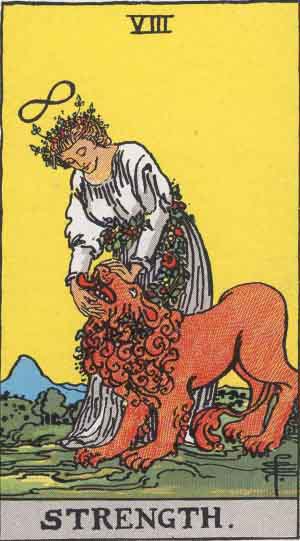
Tarot - Strength

Basic Card Symbols

A woman with a lemniscate hovering over her head, a lion.

Basic Tarot Story

The Fool, victorious over his enemies, is feeling arrogant, powerful, even vengeful. There is a hot passion in him that he can barely control. It is in this state that he comes across a maiden struggling with a lion. Running to help, he arrives in time to see her gently but firmly shut the lion's mouth! In fact, the beast, which seemed so wild and fierce a moment ago, is now completely at her command.

Amazed, the Fool asks her, "How did you do that?" One hand on the lion's mane, she answers, "Will power. Any beast, no matter how wild, will back down before a superior will." At that moment, the Maiden meets the Fool's eyes; though saintly and young, her look is knowing and filled with great power. "Likewise," she says to him, "there are many unworthy impulses inside us. It is not wrong to have them. But it is wrong to let them control us. We are human, not beast, and we can command such energy, use them for higher purposes." His rage quieted, the Fool nods, enlightened, and walks away knowing that it wasn't only the lion who was tamed this day by a Maiden's pure and innocent strength.

Basic Tarot Meaning

Like its ruling sign Leo, this is a card of courage and energy. It represents both the Lion's hot, roaring energy, and the Maiden's steadfast will. The innocent Maiden is unafraid, undaunted, and indomitable. In some cards she opens the lion's mouth, in others she shuts it. Either way, she proves that inner strength is more powerful than raw physical strength. That forces can be controlled and used to score a victory is very close to the message of the Chariot, which might be why, in some decks, it is Justice that is card 8 instead of Strength. This card assures the Querent that they can control not only the situation, but themselves. It is a card about anger and impulse management, about creative answers, leadership and maintaining one's personal honor. It can also stand for a steadfast friend.

Thirteen's Opinion

Wang in the 'Qabbalistic Tarot' likens to the Strength card, at one point, to a Vestal Virgin tending a sacred flame. And this, I think, is one of the best interpretations. Fire is a fearful thing, hot, burning, all too easily able to spark out of control. But somewhere along the way, we lost our fear - but not our respect - for fire. And with will and intelligence, we made it our tool. And I think it worth understanding and saying to the Querent, that as with fire or taming a lion, you might get burned or scratched a few time by that which you're trying to control, be it a situation, a person or your own unworthy impulses. The important message of the strength card is not to give up. To have the courage to keep at it till you succeed and to have the faith and optimism that you will succeed.

source: http://www.aeclectic.net/tarot/

Thursday, May 3, 2007

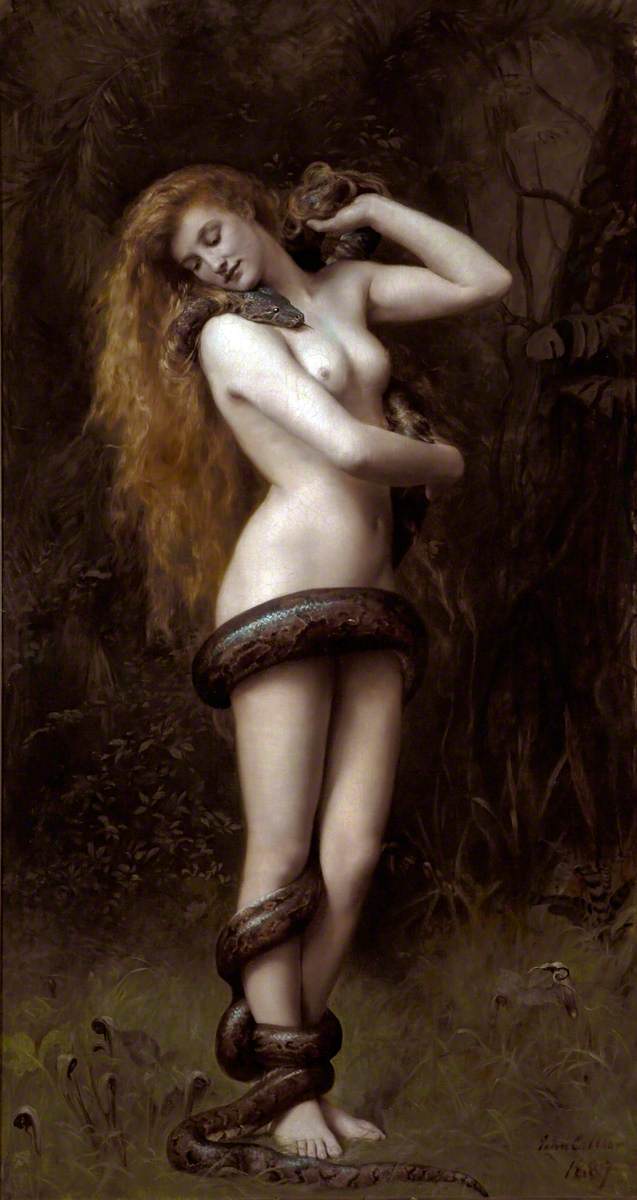
Lilith - the Vampire Mother

Lilith (Hebrew לילית) is a female Mesopotamian demon associated with wind and was thought to be a bearer of disease, illness, and death. The figure of Lilith first appeared in a class of wind and storm demons or spirits as Lilitu, in Sumeria, circe 3000 B.C. Many scholars place the origin of the phonetic name "Lilith" at somewhere around 700 B.C. Lilith appears as a night demon in the Talmud and Midrash and as a screech owl in the King James version of the Bible.

In Mesopotamian mythology

Kiskil-lilla

The mention of a she-demon that is usually identified with Lilith is ki-sikil-lil-la-ke4, a female being in the Sumerian prologue to the Gilgamesh epic. Ki-sikil-lil-la-ke is sometimes translated as Lila's maiden, companion, his beloved or maid. Akin to this, Ki-sikil-ud-da-ka-ra means "the maiden who has stolen the light" or " the maiden who has seized the light". Texts describe Lillake as the "gladdener of all hearts" and "maiden who screeches constantly".

The name of the male companion Lila, is likewise known from this period. The father of Gilgamesh was named as Lilu (= Lila) on the Sumerian king's list. Lila (Lilu, Lillu) is one of four storm demons of the incubi-succubae class. Little is known about the nature of Lila. It is said of him that he attempts to disturb or seduce women in their sleep by night, while Lilitu appears to men in their erotic dreams.

Kramer translates:

a dragon had built its nest at the foot of the tree
the Zu-bird was raising its young in the crown,
and the demon Lilith had built her house in the middle.
[…]
Then the Zu-bird flew into the mountains with its young,
while Lilith, petrified with fear, tore down her house and fled into the wilderness
Wolkenstein translates the same passage:
a serpent who could not be charmed made its nest in the roots of the tree,
The Anzu bird set his young in the branches of the tree,
And the dark maid Lilith built her home in the trunk.
Some scholars dispute identification with Lilith. However, most sources consider it definitive. The Anchor Bible Dictionary (Lowell K. Handy) states the following on the subject:
"Two sources of information previously used to define Lilith are both suspect. Kramer translated ki-sikil-lil-la-ke4 as 'Lilith', in a Sumerian Gilgamesh fragment. The text relates an incident where this female takes up lodging in a tree trunk which has a Zu-bird perched in the branches and a snake living in the roots. This text was used to interpret a sculpture of a woman with bird talons for feet as being a depiction of Lilith. From the beginning this interpretation was questioned so that after some debate neither the female in the story, nor the figure are assumed to be Lilith." (Vol. 4, p. 324)
The Burney relief

The Gilgamesh passage quoted above has in turn been applied by some to the Burney relief (Norman Colville collection), which dates to roughly 1950 BC and is a sculpture of a woman who has bird talons and is flanked by owls.

The key to this identification lies in the bird talons and the owls. While the relief may depict the demon Kisikil-lilla-ke of the Gilgamesh passage or a goddess, identification with Lilitu is more tenuous and likely influenced by the "screech owl" translation of the KJV. Most scholars accept it to actually be Inanna or her underworld sister Ereshkigal. However, the real identity of this figure remains inconclusive. A very similar relief dating to roughly the same period is preserved in the Louvre (AO 6501).

Mesopotamian Lilitu

Around 3000 BC, Lilitu/Lilith's first appearance was that in a class of spirits called Lilitu. Here, Lilith was not thought of as a central figure. The Lilitu were said to prey upon children, women in childbirth, and women and were winged spirits with bird feet. Early incantations against the Lilitu associates them with Zu birds (An eagle or type of bird of prey.), lions, storms, and disease. This begins the figure known as Lilith, a disease bearing spirit whose presence was feared to bring illness, death, and terrors by night. Early portrayals of lilitu are known as having Zu bird talons for feet and wings. The name Lilitu/Lilith stood for multiple spirits as well as a single being.

Lilith's epithet was "the beautiful maiden". She had no milk in her breasts and was unable to bear children. She was believed to be a harlot and vampire that would chose lovers and never let them go, but without giving them any real satisfaction.

Lilu, a similar male demon, was one of the four demons that belonged a vampire or incubus-succubi class. The other three were Lilitu, the she-demon, Ardat lili (Lilith's handmaid), who visited men by night and bore them children, and Irdu lili, who was the male counterpart to Ardat lili and would visit women by night and beget children by them. These demons were orginally storm demons. However, because of popular mistaken etymology they became to be regarded as night demons.

Sumerian accounts began to depict Lilitu as the handmaiden of Inanna, particularly presiding over fertility rites. "In older Sumerian texts...it says that Inanna — who corresponds to the Babylonian Ishtar — has sent the beautiful, seductive, and unmarried prostitute Lilitu out into the streets and fields in order to lead men astray". Furthermore, she governs a class of succubi and is called "strangler," a common title in later Lilith stories.

Identical to the Babylo-Sumerian Lilitu, the Akkadian Ardat-Lili presided over temple prostitution. Ardat is derived from "ardatu", a title of prostitutes and young unmarried women, meaning "Maiden". Like Lilith, Ardat Lili was a figure of disease and uncleanliness. One magical text tells of how Ardat Lili had come to 'seize' a sick man.

Akin to the Sumerian and Akkadian accounts, the Babylonians' texts depict Lilitu as the servant of the mother goddess Ishtar. Presiding over sexuality, prostitution, and fertility. However, like her counterparts she is still quite vicious and devouring. Some Babylonian texts mention her as the chief prostitute to Ishtar's temple. While others state that La-bar-tu, the Assyrian counterpart, Lamashtu, as the handmaiden to Inanna/Ishtar.

A similar related Mesopotamian demon, Lamashtu, also contributed to the evolution of the Lilitu myth. Lamashtu was a demon thought to harm children and women during childbirth. This demon was described as having bird talons for feet, having a lioness head and is often depicted as a fearsome creature with wild animals. In further fashion of Lilith, she also had statues, amulets, and incantations against her.

From Arslan Tash (Aleppo National Museum), a site in modern day Syria, comes the "Lilith Prophylactic". Lilith is pictured as a sphinx like creature devouring a child. Similar to the medieval period's amulets to ward off the demon Lilith, this inscribed plaque features an Phoenician-Canaanite dialect incantation against winged night demons called "Lili".
O, Flyer in a dark chamber, Go away at once, O Lili!
These lines are part of a incantation to protect women in childbirth. T.H. Gaster's translation wields Lilith as the demon mentioned in this incantation.

Related myths

A figure often compared to Lilith is the Greek Lamia. Said to be a daughter of the goddess Hecate or turned into a monster by the jealous Hera, she has a cannibalistic appetite for children, and is often blamed for kidnapping them. Lamia has a role akin to Lilith in that, she too, is said to have a powerful, dangerous, sexual appetite for men.

Lamia is described as appearing from the torso up as a woman and serpentine from the torso down. She presides over vampiric, blood-sucking Lamiai, (similar to succubi in Medieval myths) and is said to give birth to the horrible demoness Empusae, a creature compared to lilim.

Lilith in the Bible

The Book of Isaiah 34:14, describing the desolation of Edom, is the only occurrence of Lilith in the Hebrew Bible:
Hebrew (ISO 259): pagšu ṣiyyim et-ʾiyyim w-saʿir ʿal-rēʿhu yiqra ʾakšam hirgiʿah lilit u-maṣʾah lah manoḫ
morpho-syntactic analysis: "yelpers meet-[perfect] howlers; hairy-ones cry-[imperfect] to fellow. liyliyth reposes-[perfect], acquires-[perfect] resting-place."
KJV: "The wild beasts of the desert shall also meet with the wild beasts of the island, and the satyr shall cry to his fellow; the screech owl also shall rest there, and find for herself a place of rest."
Schrader (Jahrbuch für Protestantische Theologie, 1. 128) and Levy (ZDMG 9. 470, 484) suggest that Lilith was a goddess of the night, known also by the Jewish exiles in Babylon. Evidence for Lilith being a goddess rather than a demon is lacking. Isaiah dates to the 6th century BC, and the presence of Jews in Babylon would coincide with the attested references to the Līlītu in Babylonian demonology.

The Septuagint translates onokentauros, apparently for lack of a better word, since also the saʿir "satyrs" earlier in the verse are translated with daimon onokentauros. The "wild beasts of the island and the desert" are omitted altogether, and the "crying to his fellow" is also done by the daimon onokentauros.

In Horace (De Arte Poetica liber, 340), Hieronymus of Cardia translated Lilith as Lamia, a witch who steals children, similar to the Breton Korrigan, in Greek mythology described as a Libyan queen who mated with Zeus. After Zeus abandoned Lamia, Hera stole Lamia's children, and Lamia took revenge by stealing other women's children.

The screech owl translation of the KJV is without precedent, and apparently together with the "owl" (yanšup, probably a water bird) in 34:11, and the "great owl" (qippoz, properly a snake,) of 34:15 an attempt to render the eerie atmosphere of the passage by choosing suitable animals for difficult to translate Hebrew words. It should be noted that this particular species of owl is associated with the vampiric Strix of Roman legend.

Later translations include:
  • night-owl (Young, 1898)
  • night monster (ASV 1901, NASB 1995)
  • night hag (RSV 1947)
  • night creature (NIV 1978, NKJV 1982, NLT 1996)
  • nightjar (New World Translation, 1984)
  • vampires (Moffatt Translation, 1922).
Jewish tradition

A Hebrew tradition exists in which an amulet is inscribed with the names of three angels (Senoy, Sansenoy, and Semangelof) and placed around the neck of newborn boys in order to protect them from the lilin until their circumcision. There is also a Hebrew tradition to wait three years before a boy's hair is cut so as to attempt to trick Lilith into thinking the child is a girl so that the boy's life may be spared.

Dead Sea scrolls

The appearance of Lilith in the Dead Sea Scrolls is somewhat more contentious, with one indisputable reference in the Song for a Sage (4Q510-511), and a promising additional allusion found by A. Baumgarten in The Seductress (4Q184). The first and irrefutable Lilith reference in the Song occurs in 4Q510, fragment 1:
"And I, the Instructor, proclaim His glorious splendour so as to frighten and to te[rrify] all the spirits of the destroying angels, spirits of the bastards, demons, Lilith, howlers, and [desert dwellers…] and those which fall upon men without warning to lead them astray from a spirit of understanding and to make their heart and their […] desolate during the present dominion of wickedness and predetermined time of humiliations for the sons of lig[ht], by the guilt of the ages of [those] smitten by iniquity – not for eternal destruction, [bu]t for an era of humiliation for transgression."
Akin to Isaiah 34:14, this liturgical text both cautions against the presence of supernatural malevolence and assumes familiarity with Lilith; distinct from the biblical text, however, this passage does not function under any socio-political agenda, but instead serves in the same capacity as An Exorcism (4Q560) and Songs to Disperse Demons (11Q11) insomuch that it comprises incantations – comparable to the Arslan Tash relief examined above – used to "help protect the faithful against the power of these spirits." The text is thus, to a community "deeply involved in the realm of demonology," an exorcism hymn.

Another text discovered at Qumran, conventionally associated with the Book of Proverbs, credibly also appropriates the Lilith tradition in its description of a precarious, winsome woman – The Seductress (4Q184). The ancient poem – dated to the first century BCE but plausibly much older – describes a dangerous woman and consequently warns against encounters with her. Customarily, the woman depicted in this text is equated to the "strange woman" of Proverbs 2 and 5, and for good reason; the parallels are instantly recognizable:
"Her house sinks down to death, And her course leads to the shades. All who go to her cannot return And find again the paths of life." (Proverbs 2:18-19)
"Her gates are gates of death, and from the entrance of the house she sets out towards Sheol. None of those who enter there will ever return, and all who possess her will descend to the Pit." (4Q184)
However, what this association does not take into account are additional descriptions of the "Seductress" from Qumran that cannot be found attributed to the "strange woman" of Proverbs; namely, her horns and her wings: "a multitude of sins is in her wings." The woman illustrated in Proverbs is without question a prostitute, or at the very least the representation of one, and the sort of individual with whom that text’s community would have been familiar. The "Seductress" of the Qumran text, conversely, could not possibly have represented an existent social threat given the constraints of this particular ascetic community. Instead, the Qumran text utilizes the imagery of Proverbs to explicate a much broader, supernatural threat – the threat of the demoness Lilith.

Folk tradition

The Alphabet of Ben Sira is considered to be the oldest form of the story of Lilith as Adam's first wife. Whether or not this certain tradition is older is not known. Scholars tend to date Ben Sira between 8th and 10th centuries. Its real author is anonymous, but it is falsely attributed to the sage Ben Sira. The amulets used against Lilith that were thought to derive from this tradition are in fact, dated as being much older. While the concept of Eve having a predecessor is not exclusive to Ben Sira or new and can be found in Genesis Rabbah, the idea that this predecessor was Lilith is. According to Gershom Scholem the author of the Zohar, R. Moses de Leon, was aware of the the folk tradition of Lilith, as well another story, possibly older, that may be conflicting.

The idea that Adam had a wife prior to Eve may have developed from an interpretation of the Book of Genesis and its dual creation accounts; while Genesis 2:22 describes God's creation of Eve from Adam's rib, an earlier passage, 1:27, already indicates that a woman had been made: "So God created man in his own image, in the image of God created he him; male and female created he them." The text places Lilith's creation after God's words in Genesis 2:18 that "it is not good for man to be alone". He forms Lilith out of the clay from which he made Adam, but the two bicker. Lilith claims that since she and Adam were created in the same way, they were equal, and she refuses to "lie below" him:
After God created Adam, who was alone, He said, 'It is not good for man to be alone.' He then created a woman for Adam, from the earth, as He had created Adam himself, and called her Lilith. Adam and Lilith immediately began to fight. She said, 'I will not lie below,' and he said, 'I will not lie beneath you, but only on top. For you are fit only to be in the bottom position, while I am to be the superior one.' Lilith responded, 'We are equal to each other inasmuch as we were both created from the earth.' But they would not listen to one another. When Lilith saw this, she pronounced the Ineffable Name and flew away into the air. (In this act, Lilith becomes unique in that she is not touched by "original sin", having left the garden before Eve came into existence. Lilith also reveals herself to be powerful in her own right by knowing the name of God).
Adam stood in prayer before his Creator: 'Sovereign of the universe!' he said, 'the woman you gave me has run away.' At once, the Holy One, blessed be He, sent these three angels Senoy, Sansenoy, and Semangelof, to bring her back.
"Said the Holy One to Adam, 'If she agrees to come back, what is made is good. If not, she must permit one hundred of her children to die every day.' The angels left God and pursued Lilith, whom they overtook in the midst of the sea, in the mighty waters wherein the Egyptians were destined to drown. They told her God's word, but she did not wish to return. The angels said, 'We shall drown you in the sea.'
"'Leave me!' she said. 'I was created only to cause sickness to infants. If the infant is male, I have dominion over him for eight days after his birth, and if female, for twenty days.'
"When the angels heard Lilith's words, they insisted she go back. But she swore to them by the name of the living and eternal God: 'Whenever I see you or your names or your forms in an amulet, I will have no power over that infant.' She also agreed to have one hundred of her children die every day. Accordingly, every day one hundred demons perish, and for the same reason, we write the angels names on the amulets of young children. When Lilith sees their names, she remembers her oath, and the child recovers."
The background and purpose of The Alphabet of Ben-Sira is unclear. It is a collection of stories about heroes of the Bible and Talmud, it may have been a collection of folk-tales, a refutation of Christian, Karaite, or other separatist movements; its content seems so offensive to contemporary Jews that it was even suggested that it could be an anti-Jewish satire, although, in any case, the text was accepted by the Jewish mystics of medieval Germany.

The Alphabet of Ben-Sira is the earliest surviving source of the story, and the conception that Lilith was Adam's first wife became only widely known with the 17th century Lexicon Talmudicum of Johannes Buxtorf.

An Armenian writer Avetik Isahakyan describes Lilit (not Lilith) as Adam's first wife. But here God created Lilit from fire and Adam from soil. Lilit didn't like how Adam smells like soil. In the end she escapes with the Satan in the shape of snake. And only after that God created Eva from Adam's bone, so that she would always be with him. "But though Adam's lips said Eve, but his soul always echoed Lilith."

In the folk tradition that arose in the early middle ages Lilith, a dominate female demon, became identified with Asmodeus, King of Demons, as his queen. Asmodeus was already well known by this time because of the legends about him in the Talmud. Thus, the merging of Lilith and Asmodeus was inevitable. The fecund myth of Lilith grew to include legends about another world and by some accounts this other world existed side by side with this one, Yenne Velt is Yiddish for this described "Other World". In this case Asmodeus and Lilith were believed to procreate demonic offspring endlessly and spread chaos at every turn. Many disasters were blamed on both of them, causing wine to turn into vineger, men to be impotent, women unable to give birth, and it was Lilith who was blamed for the loss of infant life. The presence of Lilith and her cohorts were considered very real at this time.

Two primary characteristics are seen in these legends about Lilith: Lilith as the incarnation of lust, causing men to be led astray, and Lilith as a child killing witch, who stangles helpless neonates. These two aspects of the Lilith legend seemed to have evolved separately, in there is hardly a tale were Lilith emcompasses both roles. But the aspect of the witchlike role that Lilith plays broadens her archetype of the destructive side of witchcraft. Such stories are commonly found among Jewish folklore.

One story tells of how a daughter of Lilith dwelling in a mirror came to possess a narcissistic young girl. (Schwartz) A wife had bought a mirror and hung it in a room of her daughter. The mirror had been hung in a den of demons and a daughter of Lilith resided in it. Whenever the mirror was moved from the haunted house the demoness within went with it. The girl spent a lot of time gazing at herself in the mirror, each time drawing closer and closer into Lilith's web. The daughter of Lilith watched the young girl's every movement. Biding her time, one day Lilith's daughter slipped out and possessed the girl, through the eyes. Seizing control of the girl, Lilith's daughter dominated the girl's every move. Driven by the evil of Lilith's daughter's wishes and desires, the girl became promiscuous and ran around with many men. (Schwartz)

It is said that every mirror is a passage into the Otherworld and leads to Lilith's cave. The cave that Lilith went to after she had abandoned Adam and Eden for all time and the same cave that Lilith took up demon lovers in. From these unholy unions, Lilith birthed multitudes of demons, who flocked from that cave and infested the world. When these demons want to return they simply enter the nearest mirror, that is why Lilith makes her home in every mirror.(ibid)

Lilith in the Romantic period

During the Romantic period (1789 - 1832) Lilith's image began to change dramatically. Goethe and John Keats are two early Romantic authors that were credited to being the first to be influential in the shifting of the image of Lilith and to bring her legend into a larger, more mainstream audience. Later, during the Pre-Raphaelites period, Dante Gabriel Rossetti was famously responsible for bringing a new interpretation of Lilith's identity, image, and myth, where she was adapted by feminists as a modern heroine. A primary consideration for Romantics was the favouring of innovation against traditional forms and styles.

Lilith in Faust

In the earliest Romantic work, Johann Wolfgang von Goethe's 1808 work Faust Part I, Lilith makes another literary appearance, one that has been seen in nearly 600 years since the Zohar. This appearance is quite significant when compared to the ancient works, as Lilith begins to take on a new dimension and a more positive role.

The legends about Dr. Faustus may have begun about 1540. In most versions are his quests for forbidden and often hidden knowledge. During a "Walpurgis" Night scene of Faust by Goethe, Lilith makes one appearance:
Faust:
Who's that there?

Mephistopheles:
Take a good look.
Lilith.

Faust:
Lilith? Who is that?

Mephistopheles:
Adam's wife, his first. Beware of her.
Her beauty's one boast is her dangerous hair.
When Lilith winds it tight around young men
She doesn't soon let go of them again.

(1992 Greenberg translation, lines 4206–4211)
With her "ensnaring" sexuality, Goethe draws upon ancient legends of Lilith which associate her with Adam. Perhaps, more importantly, is the identifying marker of Lilith, her long, ensnaring hair, an image recounted in more familiar ancient tales. This image is the first "modern" literary mention of Lilith and continues to dominate throughout the nineteenth century.

After Mephistopheles offers this warning to Faust, he then, quite ironically, encourages Faust to dance with "the Pretty Witch". Lilith and Faust engage in a short conversation, where Lilith recounts the days spent in Eden.
Faust: [dancing with the young witch]
A lovely dream I dreamt one day
I saw a green-leaved apple tree,
Two apples swayed upon a stem,
So tempting! I climbed up for them.

The Pretty Witch:
Ever since the days of Eden
Apples have been man's desire.
How overjoyed I am to think, sir,
Apples grow, too, in my garden.

(1992 Greenberg translation, lines 4216 – 4223)
Here Goethe chooses to elaborate on the Eden scene, focusing on the popular Lilith's identity as the first wife of Adam rather than a child-killing and disease-bearing demon.

This brief mention is important, as it marks Lilith's debut in modern literature. Additionally, her character being for the most part is unnecessary, this establishes that Goethe's intentions and reason in invoking her image and associations may differ. It also suggests familiarity with the figure of Lilith. This text heavily influenced the later Romantic art and literature of Lilith and how she is often portrayed and continues to dominate representations throughout the 19th century.

Keats, Lilith, and "Lamia"

In Keats's poem: "Lamia" (1819), the two tales of Lamia and Lilith begin to assimilate and forge a connection.

The title female character is never referred to as Lilith, but the similarities between the two are too prominent to be overlooked. An enchantress and she-demon, Lamia is the archetypal Romantic representation of what Lilith will become. She is never branded as "immoral" or "evil" by Keats. The reader is invited to feel Lamia's pain under her unfortunate circumstances. This sparks the beginning of the transformation of Lilith and Lamia. While both are associated with wickedness, these inherently negative aspects are redefined in a way to make it look unimportant.

The poem begins with Lamia stuck in a serpent's body. It never states how she became that way, but the poem hints that she had a previous human existence. She appeals to Hermes: I was a woman, let me have once more / A woman's shape, and charming as before. / I love a youth of Corinth - O the bliss! / Give me my woman's form, and place me where he is" (I.117-120). The poem continues with Lamia's falling in love with a traveller named Menippus Lycius (whose name is an epithet of the god Apollo.)

"Lamia" introduces the dual sexual nature of Lilith: virgin but also seductress. The paradox is first introduced in these lines: "A virgin purest lipp'd, yet in the lore / Of love deep learned to the red heart's core" (I.189-190). This contradiction is also present in founding texts, some of which that claim Lilith gives birth to children in the hundreds each day, while she, likewise, murders hundreds of children.

The most important aspect of Keats's Lilith-themed poem is that of her association with excess. Her words are spoken as if "through bubbling honey," her song is "too sweet," and she herself is described as "bitter-sweet" (I.64, 299, 59). Within the poem, Lycius himself is driven to comment on this excess, professing that Lamia's mere presence invokes "a hundred thirsts." Lycius further proclaims that he will die without Lamia and that her memory alone is enough to kill (ln. 269-270).

The characterization of Lamia bears great similarities to the figure of Lilith; many other facets are omitted on purpose, such as the night terror aspect. Although she remains a seductress, her intentions are not considered immoral nor condemned. As the Norton Anthology introduction to the poem states: "Lamia is an enchantress, a liar, and a calculating expert in amour; but she apparently intends no harm, is genuinely in love, and is very beautiful" (797).

Goethe simply ignores her negative aspects, Keats altogether rewrites Lilith's original identity. Even the serpent, a symbol in popular Western lore denoted with evil and a cult animal of Lilith's, is shed in the body of the poem. From this "evil" evolves a beautiful and sensuous womanly figure. Many scholars of Romantic literature further associate the unnamed figure in another Keats poem, "La Belle Dame Sans Merci", to that of Lilith. Akin to Lamia, the figure of the poem is a beautiful seductress associated with death.

Lilith in literature

  • Lilith is a book containing the character Lilith by the author George Macdonald, who in turn heavily influenced C.S. Lewis.
  • George Bernard Shaw has Lilith make a grand speech expressing some of his philosophy at the end of his play As Far as Thought Can Reach, part of his five-part series Back to Methuselah (1921). C.S. Lewis referred to this as "nonsense" in his essay "The Weight of Glory".
  • In C.S. Lewis's The Lion, the Witch and the Wardrobe, the central antagonist, the White Witch, is said to be a descendant of Lilith.
  • In Piers Anthony's Incarnations of Immortality series Lilith is a demon of Hell.
  • Lilith is the main antagonist in the book Resurrection by Steve Alten.
  • Lilith is a character in the novel Coldheart Canyon: A Hollywood Ghost Story by Clive Barker, published in 2001.
  • Lilith is the name of a main character in Octavia E. Butler's trilogy, Xenogenesis. The trilogy draws upon much of the Lilith mythology.
  • In his 1924 novel The Magic Mountain, German author Thomas Mann makes antagonist Lodovico Settembrini refer to main character Hans Castorp's romantic interest, Clawdia Chauchat as Lilith.
  • The reference in the above-mentioned literary work is again a quote from Johann Wolfgang von Goethe's Faust I, in which Lilith appears among the witches on Walpurgisnacht.
  • Lilith is an antagonistic character in the play "The Love Song of J. Robert Oppenheimer." In this play the character of Lilith exists in Oppenheimer's mind and never touches the ground.
  • Song of Lilith is a published poem written by Joy Kogawa as an interpertation of Lilith's flight from the Garden of Eden and the aftermath.
  • Lilith is also a prominant figure in the book series "The Nightside" by Simon Green. Once again she is displayed as Adam's first wife, who laid with the devil and created demons. Her character is hinted at for the first three books, but her character does not show up until book four, "Hex and the City".
  • Lilith is the name of the vampire queen in the Nora Roberts "Circle" trilogy, released in 2006.
  • Lilith in World of Darkness is said to have had a hand in the creation of Daemons, Werewolfs, and Fae's. As well as being a supernatural 'Ascended' human or mage herself. She is also believed to be a second generation Vampire granting her immortality after her romance with Caine, the original Vampire. These things would make her the most powerful being in existence in the World of Darkness Universe, Book of Nod.
source: Wikipedia

Tuesday, May 1, 2007

The Immortal Count of St. Germain

The Count of St. Germain (allegedly died February 27, 1784) was a courtier, adventurer, inventor, amateur scientist, violinist, amateur composer, and a mysterious gentleman; he also displayed some skills with the practice of alchemy. He was known as 'Der Wundermann' -- 'The Wonderman'. He was a man whose origin was unknown and who disappeared without leaving a trace.

Since his death, various occult organizations have adopted him as a model figure or even as a powerful deity. In recent years several people have claimed to be the Count of St. Germain. (Note that St Germain was never regarded as a saint by the Roman Catholic Church - the "st." before his name refers to his alleged home).

St. Germain never revealed his actual background and identity, leading to many speculations about him and his origin and ancestry. Some of these include the possibility that he was the son of Francis II Rakoczi, the Prince of Transylvania (who was in exile), or that he was the illegitimate son of Maria Anna of Pfalz-Neuburg, the widow of Charles II of Spain.

While he may have studied in Italy at Siena University, possibly as a protιgι of Grand Duke Gian Gastone (the last of the Medici line), St. Germain's first chronicled appearances were in London in 1743 and in Edinburgh in 1745, where he was apparently arrested for spying. He was released and soon acquired a reputation as a great violinist. He was ascetic and apparently celibate. During this time he met Jean-Jacques Rousseau.

In 1746 he disappeared. Horace Walpole, who knew him from about 1745 in London, described him thus: "He sings, plays the violin wonderfully, composes, is mad and not very sensible".

He reappeared in Versailles in 1758. He claimed to have had recipes for dyes and acquired quarters in the Chateau de Chambord. During this time in Paris he gave diamonds as gifts and reputedly hinted that he was centuries old. The old portrait of him dates from these years. He was an acquaintance of Louis XV and his mistress Madame de Pompadour. At the time a mime, Gower, began to mimic his mannerism in salons, joking that he would have advised Jesus.

In 1760 he left for England through Holland when the minister of State, Duke of Choiseul, tried to have him arrested.

After that the Count passed through the Netherlands into Russia and apparently was in St Petersburg when the Russian army put Catherine the Great on the throne. Later conspiracy theories credit him for causing it. The next year he turned up in Belgium, bought land and took the name Surmount. He tried to offer his processes ­ treatments of wood, leather, oil paint ­ to the state.

During his negotiations ­ that came to nothing ­ with Belgian minister Karl Cobenzl he hinted at a royal birth and turned iron into something resembling gold. He then disappeared for 11 years.

In 1774 he resurfaced, and apparently tried to present himself to a count in Bavaria as Freiherr Reinhard Gemmingen-Guttenberg, the count Tsarogy.

In 1776 the Count was in Germany, calling himself Count Welldone, and again offered recipes ­ cosmetics, wines, liqueurs, treatments of bone, paper and ivory. He alienated King Frederick's emissaries by his claims of transmutation of gold and reputedly compared himself to God. To Frederick he claimed to have been a Freemason. He settled in a house of Prince Karl of Hesse-Kassel, governor of Schleswig-Holstein and studied herbal remedies and chemistry to give to the poor. To him he claimed he was a Francis Rakoczy II, Prince of Transylvania.

1784 is when the Count supposedly died, probably of pneumonia. He left very little behind.

There were rumors of him alive in Paris in 1835, in Milan in 1867 and in Egypt during Napoleon's campaign. Napoleon III kept a dossier on him. Annie Besant said that she met the Count in 1896.

Theosophist C. W. Leadbeater claimed to have met him in Rome in 1926, and said that St. Germain showed him a robe that had been previously owned by a Roman Emperor and that St. Germain told him that one of his residences was a castle in Transylvania.

Theosophist Guy Ballard claimed that the Count had introduced him to visitors from Venus and published a book series about his channelings; Ballard founded the "I Am" Activity.In January 28, 1972, ex-convict and lover of singing star Dalida, Richard Chanfray claimed to be the Count of St. Germain on French television. He also claimed that Louis XV was still alive.

There are several "authoritative" biographers who usually do not agree with one another. His ancestry is a matter of much speculation. Theosophists consider him to be an Ascended Master or adept. Aleister Crowley identified with him. Helena Blavatsky said he was one of her Masters of Wisdom and hinted at secret documents. Several books on palmistry and astrology have been published in his name.

During the centuries after his death, numerous myths, legends and speculations have surfaced. He has been attributed with occult practices like snake charming and ventriloquism. There are stories about an affair between him and Madame de Pompadour. Other legends report that he was immortal, the Wandering Jew, an alchemist with the elixir of life, a Rosicrucian or an ousted king, a bastard of Queen Anna Maria of Spain, that he prophesied the French Revolution. Casanova called him the violinist Catlini. Count Cagliostro was rumored to be his pupil. The fact that the name "St. Germain" was not exactly uncommon confuses the matters even more.

Many groups in occultism honor St. Germain as an Ascended Master. As such, he is believed to have many magical powers such as the ability to teleport, levitate, walk through walls, influence people telepathically, etc.

Some esoteric groups credit him with inspiring the Founding Fathers to draft the Declaration of Independence and the United States Constitution.

In the New Age beliefs regarding him, St. Germain is always associated with the color violet and the jewel amethyst; he is also regarded as the "Master of the Seventh (violet) Ray".

According to Theosophy, the Seven Rays are seven metaphysical principles that govern both individual souls and the unfolding of each 2,158 year long Astrological Age. Since according to Theosophy the next Astrological Age, the Age of Aquarius, will be governed by the Seventh (violet) Ray (the Ray of Ceremonial Order), St. Germain is sometimes called "The Cosmic Master of the Age of Aquarius."

In Rosicrucian Max Heindel's writings, the Count of St Germain (18th century) is described as one of the later incarnations of Christian Rosenkreuz, an enigmatic individual born in the 13th century and the Head of the Rosicrucian Order. According to this author, Rosenkreuz had been Lazarus in his previous previous physical life, a biblical character in the New Testament (this would contradict the idea that he was Joseph, since they both lived at the same time) and Hiram Abiff, the Widow's Son of Freemasonry, in an earlier existence.

In the 1925 book The Masters and the Path by C.W. Leadbeater, an adherent of Theosophy, St. Germain is called both the "Comte de St. Germain" and the "Master Rakoczi." His previous incarnations are enumerated (the same ones as noted below in the paragraph about Guy Ballard). On page 240 of The Masters and the Path it is stated that when performing magical rituals in his castle in Transylvania, St. Germain wears "a suit of golden chain-mail which once belonged to a Roman Emperor; over it is thrown a magnificent cloak of crimson, with on its clasp a seven-pointed star in diamond and amethyst, and sometimes he wears a glorious robe of violet."

In the Alice Bailey's books, St. Germain is also known as the "Master Rakoczi". Alice A. Bailey's book The Externalisation of the Hierarchy (1934) gives the most information about his reputed role as an Ascended Master. His title is said to be the "Lord of Civilization". He is said to telepathically influence people who are seen by him as being instrumental in bringing about the new civilization of the Age of Aquarius. It was said by Alice A. Bailey that "sometime after AD 2025" Jesus Christ, St. Germain, Kuthumi and the others in the Ascended Master hierarchy (except Gautama Buddha) would "externalisze" i.e., descend from the etheric plane, and live physically on Earth in ashrams surrounded by their disciples.

In the Godfre Ray King books, and Law of Life books is said that St. Germain was Joseph the foster-father of Jesus, Merlin the magician of King Arthur's Court, Roger Bacon, Christian Rosenkreuz of Germany, Christopher Columbus, Francis Bacon and Prince Rakoczy of Transylvania, in previous reincarnations. These beliefs about his previous incarnations are also promulgated by the Church Universal and Triumphant, with the addition that he was also incarnated as the ancient Jewish Prophet Samuel, as Saint Alban, and as a high priest of the white magicians in Atlantis. Guy Ballard claimed his book The Magic Presence was channeled to him from St. Germain (The official I Am edition of The Magic Presence, regarded as a sacred scripture, is printed in a violet colored typeface on lavender paper.).

According to Elizabeth Clare Prophet, St. Germain ascended on May 1st 1684. Although Sir Francis Bacon is said to have died in 1626, Prophet claims that the body in the coffin at Sir Francis Bacon's funeral was not his own and that he attended his own funeral. Supposedly, he continued living until his ascension in 1684. Thus, according to Prophet, the historical St. Germain was already an ascended master.In the Church Universal and Triumphant St Germain is regarded as a deity outranked only in importance by Jesus Christ, Gautama Buddha, and Sanat Kumara (the "Lord of the World"), and in that church, he is the deity towards whom the most intense devotion is given. Guy Ballard, the founder of I Am, originated the meditation practice of invoking the "Violet Flame" from St. Germain in order to contact one's "I Am Presence" and revivify one's etheric body. This practice has been continued by the Church Universal and Triumphant.

Conspiracy theorists who believe in NESARA, a purported secret law that the US government denies the existence of (such as controversial evangelist Sherry Shriner), believe that St. Germain is still alive and is actively working with Jesus Christ and with benevolent space aliens to get the law enacted.

The commonest hypothesis about his birth is that Saint-Germain was the natural son of the widow of Charles II of Spain and a certain Comte (Count) Adanero, whom she knew at Bayonne. This Spanish queen was Marie de Neubourg, whom Victor Hugo took as the heroine of his Ruy Blas. Those who disliked Saint-Germain said that he was the son of a Portuguese Jew named Aymar, while those who hated him said, in the effort to add to his discredit, that he was the son of an Alsatian Jew named Wolff.

Fairly recently a new genealogy of Saint-Germain has been put forward which seems the most probable of all. It is the work of the theosophists and Annie Besant, who has frequently made the statement that the Comte de Saint-Germain was one of the sons of Francis Racoczi II, Prince of Transylvania. The children of Francis Racoczi were brought up by the Emperor of Austria, but one of them was withdrawn from his guardianship.

Saint Germain never seemed to age. For an entire century he maintined the physical appearance of a man between forty and fifty years old.

He could do just about anything. He was almost too good to be true. He was a magician, a musician, artistry as a violinist, talent as a painter, skill in alchemy and chemistry, a seer who read for and socialized with the rich and famous, had great wealth, and was one of the most mysterious men on the Europe continent. He knew nearly all the European languages. His knowledge of history was comprehensive, and his accomplishments as a chemist, on which he based his reputation, were in many ways considerable.

By far the greatest obvious talents of the Comte de Saint-Germain were connected with his knowledge of alchemy. Yet if Saint-Germain he knew how to make gold, he was wise enough to say nothing about it. Nothing but the possession of this secret could perhaps account for the enormous wealth at his command, though he was not known to have money on deposit at any banks.

He was one of the of the most celebrated mystics and adventurers of modern times. He was a confidant of two kings of France, a dazzlingly rich and gifted social figure, the subject of a thousand rumors.

He enjoyed and sought the company of the pretty women of his day. It appears from the memoirs of Baron von Gleichen that when Saint-Germain was in Paris he became the lover of Mademoiselle Lambert, daughter of the Chevalier Lambert, who lived in the house in which he lodged. And it appears from Grosley's memoirs that in Holland he became the lover of a woman as rich and mysterious as himself.

Though he never ate any food in public, he liked dining out because of the people he met and the conversations he heard. They say he lived on oatmeal. He had an immense stock of amusing stories with which he regaled society.

He was an aristocrat who lived with princes and even with kings almost on a footing of an equal.

He gave recipes for removing wrinkles and dyeing hair.

His activity and the diversity of his occupations were very great. He was interested in the preparation of dyes and even started a factory in Germany for the manufacture of felt hats.

One of his principal roles was that of a secret agent in international politics in the service of France. He became Louis XV's confidential and intimate counselor and was entrusted by him with various secret missions.

He had a love of jewels in an extreme form, and he ostentatiously showed off those he possessed. He kept a great quantity of them in a casket, which he carried about everywhere with him. The importance he attached to jewels was so great that in the pictures painted by him, which were in themselves remarkable, the figures were covered with jewels; and his colors were so vivid and strange that faces looked pale and insignificant by contrast. Jewels cast their reflection on him and threw a distorting light on the whole of his life.

He was also known to carry jewels sewn into his clothing . He was said to have presented a cross ornamented with gems to a woman he scarcely knew, because she had idly admired it.

The count claimed that he had learned how to turn several small diamonds into one large one and to make pearls grow to spectacular size. He said he could remove flaws from diamonds. He could make a big diamond out of several small stones. The diamonds that he wore in his shoes and garters were believed to be worth more than 200,000 francs.

It was widely suspected that he also knew the secret for making gold out of base metal.

Tradition has related that he said he had known Jesus and been present at the Council of Nicea. But he did not go so far as this in his contempt for the men with whom he associated and in his derision of their credulity.

He seems to have become a celebrity in the 1750's as a friend of Louis XV and his mistress Madame de Pompadour, who together spent evenings with him simply for the pleasure of his conversation. Louis XV must have known who he was, for he extended to him a friendship that aroused the jealousy of his court. He allotted him rooms in the Chateau of Chambord. He shut himself up with Saint-Germain and Madam de Pompadour for whole evenings; and the pleasure he derived from his conversation and the admiration he no doubt felt for the range of his knowledge cannot explain the consideration, almost the deference, he had for him. Madam du Housset says in her memoirs that the king spoke of Saint-Germain as a personage of illustrious birth.

Count Charles of Hesse Cassel, with whom he lived during the last years in which history is able to follow his career, must also have possessed the secret of his birth. They worked with alchemy together. Saint-Germain treated him as an equal. It was to him that Saint-Germain entrusted his paper just before his supposed death in 1784.

However, neither Louis XV nor the Count of Hesse Cassel ever revealed anything about the birth of Saint-Germain. The count even went so far as invariably to withhold the smallest detail bearing on the life of his mysterious friend. This is a very remarkable fact, since Saint-Germain was an extremely well known figure.

Whether he was a genius or a charlatan, Saint-Germain had the talent to make himself noticed and the subject of gossip. But in Versailles and Paris he was embraced as the confidential adviser of Louis XV. The position earned him the envy and enmity of the king's ministers, who denounced him as an adventurer with a smooth line of talk.

Matters came to a head in 1760, when the count at the behest of the king involved himself in foreign affairs, going behind the back of ministry. Threatened with arrest, he was obliged to flee to England, where he stayed for a while; possibly for a period of two years.

From England Count Saint-Germain apparently went to Russia, where it is claimed he took part in a conspiracy that put Catherine the Great upon the throne in 1762.

After that nothing much is known of the count until 1774, when Louis XVI and Marie Antoinette came to the throne. Saint-Germain then returned to France. It is said that he warned the royal couple of the revolution 15 years in the future, saying, "There will be a blood-thirsty republic, whose scepter will be the executioner's knife."

Secret Societies

Secret societies were the fashion in pre-revolutionary France, and some of them recognized Saint-Germain as an 'adept' one who knew the ancient wisdoms hinted at in the rites of the Freemasons, Rosicrucians and Knights Templars.

He influenced Freemasonry and the secret societies, though many modern masons have denied this and have even omitted to mention him as a great source of inspiration.

In Vienna he took part in the foundation of the Society of Asiatic Brothers and of the Knights of Light, who studied alchemy; and it was he who gave Mesmer his fundamental ideas on personal magnetism and hypnotism. It is said that he initiated Cagliostro, who visited him on several occasions in Holstein to receive directions from him, though there is no direct evidence for this. The two men were to be far separated from one another by opposite currents and a different fate.

All over the country secret societies sprang up. The new spirit manifested itself in the form of associations. Neither the nobility nor the clergy escaped what had become a fashion.

There were lodges for women, and the Princesse de Lamballe became grand mistress of one of them.

In Germany there were the Illuminati and the Knights of Strict Observance, and Frederick II, when he came to the throne, founded the sect of the Architects of Africa.

In France, the Order of the Templars was reconstituted, and Freemasonry, whose grand master was the Duke de Chartres, increased the number of its lodges in every town. Martinez de Pasqually taught his philosophy at Marseilles, Bordeaux and Toulouse; and Savalette de Lange, with mystics such as Court de Gebelin and Saint-Martin, founded the lodge of the Friends Assembled.

The initiates of these sects understood that they were the depositories of a heritage that they did not know, but whose boundless value they guessed; it was to be found somewhere, perhaps in traditions, perhaps in a book written by a master, perhaps in themselves. They spoke of this revealing word, this hidden treasure it was said to be in the hands of "unknown superiors of these sects, who would one day disclose the wealth which gives freedom and immortality."

It was this immortality of the spirit that Saint-Germain tried to bring to a small group of chosen initiates. He believed that this minority, once it was developed itself, would, in its turn, help to develop another small number, and that a vast spiritual radiation would gradually descend, in beneficent waves, towards the more ignorant masses. It was a sage's dream, which was never to be realized.

With the co-operation of Savalette de Lange, who was the nominal head, he founded the group of Philalethes, or truth-lovers, which was recruited from the cream of the Friends Assembled. The Prince of Hesse, Condorcet, and Cagliostro were all members of this group. Saint-Germain expounded his philosophy at Ermenonville and in Paris, in the rue Platriere. It was a Platonic Christianity, which combined Swedenborg's visions with Martinez de Pasqually's theory of reintegration. There were to be found in it Plotinus' emanations and the hierarchy of successive planes described by Hermeticists and modem theosophists. He taught that man has in him infinite possibilities and that, from the practical point of view, he must strive unceasingly to free himself of matter in order to enter into communication with the world of higher intelligences.

He was understood by some. In two great successive assemblies, at which every Masonic lodge in France was represented, the Philalethes attempted the reform of Freemasonry. If they had attained their aim, if they had succeeded in directing the great force of Freemasonry by the prestige of their philosophy, which was sublime and disinterested, it may be that the course of events would have been altered, that the old dream of a world guided by philosopher-initiates would have been realized.

But matters were to turn out differently. Old causes, created by accumulated injustices had paved the way for terrible effects. These effects were in their turn to create the causes of future evil. The chain of evil, linked firmly together by men's egoism and hatred, was not to be broken. The light kindled by a few wise visionaries, a few faithful watchers over the well being of their brothers, was extinguished almost as soon as it was kindled.

Saint-Germain's Death

Secluded at Eckenforn in the count's castle, Saint-Germain announced that he was tired of fife. He seemed careworn and melancholy. He said he felt feeble, but he refused to see a doctor and was tended only by women. No details exist of his death, or rather of his supposed death. No tombstone at Eckenforn bore his name. It was known that he had left all his papers and certain documents relating to Freemasonry to the Count of Hesse Cassel.

The count for his part asserted that he had lost a very dear friend. But his attitude was highly equivocal. He refused to give any information about his friend or his last moments, and turned the conversation if anyone spoke of him. His whole behavior gives color to the supposition that he was the accomplice of a pretended death.

Although, on the evidence of reliable witnesses, he must have been at least a hundred years old in 1784, his death in that year cannot have been genuine. The official documents of Freemasonry say that in 1785 the French masons chose him as their representative at the great convention that took place in that year, with Mesmer, Saint-Martin, and Cagliostro present. In the following year Saint-Germain was received by the Empress of Russia. Finally, the Comtesse d'Adhemar reports at great length a conversation she had with him in 1789 in the Church of the Recollets, after the taking of the Bastille.

His face looked no older than it had looked thirty years earlier. He said he had come from China and Japan. "There is nothing so strange out there," he said, "as that which is happening here. But I can do nothing. My hands are tied by someone who is stronger than I. There are times when it is possible to draw back; others at which the decree must be carried out as soon as he has pronounced it."

And he told her in broad outlines all the events, not excepting the death of the queen, that were to take place in the years that followed. "The French will play with titles and honors and ribbons like children. They will regard everything as a plaything, even the equipment of the Garde Nationale. There is today a deficit of some forty millions, which is the nominal cause of the Revolution. Well, under the dictatorship of philanthropists and orators the national debt will reach thousands of millions."

"I have seen Saint-Germain again," wrote Comtesse d'Adhemar in 1821, "each time to my amazement. I saw him when the queen was murdered, on the 18th of Brumaire, on the day following the death of the Duke d'Enghien, in January, 1815, and on the eve of the murder of the Duke de Berry."

Mademoiselle de Genlis asserts that she met the Comte de Saint-Germain in 1821 during the negotiations for the Treaty of Vienna; and the Comte de Chalons, who was ambassador in Venice, said he spoke to him there soon afterwards in the Piazza di San Marco. There is other evidence, though less conclusive, of his survival. The Englishman Grosley said he saw him in 1798 in a revolutionary prison; and someone else wrote that he was one of the crowd surrounding the tribunal at which the Princess de Lamballe appeared before her execution.

It seems quite certain that the Comte de Saint-Germain did not die at the place and on the date that history has fixed. He continued an unknown career, of whose end we are ignorant and whose duration seems so long that one's imagination hesitates to admit it.

What happened to the Comte de Saint-Germain after 1821, in which year there is evidence that he was still alive? An Englishman, Albert Vandam, in his memoirs, which he calls An Englishman in Paris, speaks of a certain person whom he knew towards the end of Louis Philippe's reign and whose way of life bore a curious resemblance to that of the Comte de Saint-Germain.

"He called himself Major Fraser, wrote Vandam, "lived alone and never alluded to his family. Moreover he was lavish with money, though the source of his fortune remained a mystery to everyone. He possessed a marvelous knowledge of all the countries in Europe at all periods. His memory was absolutely incredible and, curiously enough, he often gave his hearers to understand that he had acquired his learning elsewhere than from books. Many is the time he has told me, with a strange smile, that he was certain he had known Nero, had spoken with Dante, and so on."

Like Saint-Germain, Major Fraser had the appearance of a man of between forty and fifty, of middle height and strongly built. The rumor was current that he was the illegitimate son of a Spanish prince. After having been, also like Saint-Germain, a cause of astonishment to Parisian society for a considerable time, he disappeared without leaving a trace. Was it the same Major Fraser who, in 1820, published an account of his journey in the Himalayas, in which he said he had reached Gangotri, the source of the most sacred branch of the Ganges River, and bathed in the source of the Jumna River?

It was at the end of the nineteenth century that the legend of Saint-Germain grew so inordinately. By reason of his knowledge, of the integrity of his life, of his wealth and of the mystery that surrounded him, he might reasonably have been taken for an heir of the first Rosicrucians, for a possessor of the Philosopher's Stone. But the theosophists and a great many occultists regarded him as a master of the great White Lodge of the Himalayas. The legend of these masters is well known. According to it there live in inaccessible lamaseries in Tibet certain wise men who possess the ancient secrets of the lost civilization of Atlantis. Sometimes they send to their imperfect brothers, who are blinded by passions and ignorance, sublime messengers to teach and guide them. Krishna, the Buddha, and Jesus were the greatest of these. But there were many other more obscure messengers, of whom Saint-Germain has been considered to be one.

"This pupil of Hindu and Egyptian hierophants, this holder of the secret knowledge of the East," theosophist Madam Blavatsky says of him, "was not appreciated for who he was. The stupid world has always treated in this way men who, like Saint-Germain, have returned to it after long years of seclusion devoted to study with their hands full of the treasure of esoteric wisdom and with the hope of making the world better, wiser and happier." Between 1880 and 1900 it was admitted among all theosophists, who at that time had become very numerous, particularly in England and America, that the Comte de Saint-Germain was still alive, that he was still engaged in the spiritual development of the West, and that those who sincerely took part in this development had the possibility of meeting him.

The brotherhood of Khe-lan was famous throughout Tibet, and one of their most famous brothers was an Englishman who had arrived one day during the early part of the twentieth century from the West. He spoke every language, including the Tibetan, and knew every art and science, says the tradition. His sanctity and the phenomena produced by him caused him to be proclaimed a Shaberon Master after a residence of but a few years. His memory lives to the present day among the Tibetans, but his real name is a secret with the Shaberons alone. Might not this mysterious traveler be the Comte de Saint-Germain?

But even if he has never come back, even if he is no longer alive and we must relegate to legend the idea that the great Hermetic nobleman is still wandering about the world with his sparkling jewels, his senna tea, and his taste for princesses and queens even so it can be said that he has gained the immortality he sought. For a great number of imaginative and sincere men the Comte de Saint-Germain is more alive than he has ever been. There are men who, when they hear a step on the staircase, think it may perhaps be he, coming to give them advice, to bring them some unexpected philosophical idea. They do not jump up to open the door to their guest, for material barriers do not exist for him. There are men who, when they go to sleep, are pervaded by genuine happiness because they are certain that their spirit, when freed from the body, will be able to hold converse with the master in the luminous haze of the astral world.

Suggested literary or not texts

sources:
wikipedia
crystalinks.com

Doppelganger (bilocation)

Doppelganger: a ghostly double of a living person, especially one that haunts its fleshly counterpart.

Do you have an exact double somewhere in the world? Can a person be in two places at once? There are many intriguing accounts throughout history of people who claim to have either encountered apparitions of themselves - their doppelgangers - or have experienced the phenomenon of bilocation, being in two separate locations at the very same time.

"Doppelganger" is German for "double walker" - a shadow self that is thought to accompany every person. Traditionally, it is said that only the owner of the doppelganger can see this phantom self, and that it can be a harbinger of death. Occasionally, however, a doppelganger can be seen by a person's friends or family, resulting in quite a bit of confusion.

In instances of bilocation, a person can either spontaneously or willingly project his or her double, known as a "wraith," to a remote location. This double is indistinguishable from the real person and can interact with others just as the real person would.

Famous Deaths Attributed to the Doppelganger

Percy Bysshe Shelley
On 8 July 1822, Percy Bysshe Shelley, poet, drowned in the Bay of Spezia near Lerici. On 15 August, while staying at Pisa, Mary Shelley wrote a letter to Maria Gisborne in which she relayed Percy's claims to her that he had met his own doppelgänger. A week after Mary's nearly fatal miscarriage, in the early hours of 23 June, Percy had had a nightmare about the house collapsing in a flood, and
... talking it over the next morning he told me that he had had many visions lately — he had seen the figure of himself which met him as he walked on the terrace & said to him — "How long do you mean to be content" — No very terrific words & certainly not prophetic of what has occurred. But Shelley had often seen these figures when ill; but the strangest thing is that Mrs W[illiams] saw him. Now Jane though a woman of sensibility, has not much imagination & is not in the slightest degree nervous — neither in dreams or otherwise. She was standing one day, the day before I was taken ill, [15 June] at a window that looked on the Terrace with Trelawny — it was day — she saw as she thought Shelley pass by the window, as he often was then, without a coat or jacket — he passed again — now as he passed both times the same way — and as from the side towards which he went each time there was no way to get back except past the window again (except over a wall twenty feet from the ground) she was struck at seeing him pass twice thus & looked out & seeing him no more she cried — "Good God can Shelley have leapt from the wall? Where can he be gone?" Shelley, said Trelawny — "No Shelley has past — What do you mean?" Trelawny says that she trembled exceedingly when she heard this & it proved indeed that Shelley had never been on the terrace & was far off at the time she saw him.
Percy Shelley's drama Prometheus Unbound (1820) contains the following passage in Act I: "Ere Babylon was dust, / The Magus Zoroaster, my dear child, / Met his own image walking in the garden. / That apparition, sole of men, he saw. / For know there are two worlds of life and death: / One that which thou beholdest; but the other / Is underneath the grave, where do inhabit / The shadows of all forms that think and live / Till death unite them and they part no more...."
John Donne
Izaak Walton claimed that John Donne, the English metaphysical poet, saw his wife's doppelgänger in 1612 in Paris, on the same night as the stillbirth of his daughter.
Two days after their arrival there, Mr. Donne was left alone, in that room in which Sir Robert, and he, and some other friends had dined together. To this place Sir Robert return'd within half an hour; and, as he left, so he found Mr. Donne alone; but, in such Extasie, and so alter'd as to his looks, as amaz'd Sir Robert to behold him: insomuch that he earnestly desired Mr. Donne to declare what had befaln him in the short time of his absence? to which, Mr. Donne was not able to make a present answer: but, after a long and perplext pause, did at last say, I have seen a dreadful Vision since I saw you: I have seen my dear wife pass twice by me through this room, with her hair hanging about her shoulders, and a dead child in her arms: this, I have seen since I saw you. To which, Sir Robert reply'd; Sure Sir, you have slept since I saw you; and, this is the result of some melancholy dream, which I desire you to forget, for you are now awake. To which Mr. Donnes reply was: I cannot be surer that I now live, then that I have not slept since I saw you: and am, as sure, that at her second appearing, she stopt, and look'd me in the face, and vanisht.
This account first appears in the edition of Life of Dr John Donne published in 1675, and is attributed to "a Person of Honour... told with such circumstances, and such asseveration, that... I verily believe he that told it me, did himself believe it to be true." At the time Donne was indeed extremely worried about his pregnant wife, and was going through severe illness himself. However, R. C. Bald points out that Walton's account "is riddled with inaccuracies. He says that Donne crossed from London to Paris with the Drurys in twelve days, and that the vision occurred two days later; the servant sent to London to make inquiries found Mrs Donne still confined to her bed in Drury House. Actually, of course, Donne did not arrive in Paris until more than three months after he left England, and his wife was not in London but in the Isle of Wight. The still-born child was buried on 24 January.... Yet as late as 14 April Donne in Paris was still ignorant of his wife's ordeal." In January, Donne was still at Amiens. His letters do not support the story as given.
Abraham Lincoln
Carl Sandburg's biography contains the following:
A queer dream or illusion had haunted Lincoln at times through the winter. On the evening of his election he had thrown himself on one of the haircloth sofas at home, just after the first telegrams of November 6 had told him he was elected President, and looking into a bureau mirror across the room he saw himself full length, but with two faces.
It bothered him; he got up; the illusion vanished; but when he lay down again there in the glass again were two faces, one paler than the other. He got up again, mixed in the election excitement, forgot about it; but it came back, and haunted him. He told his wife about it; she worried too.
A few days later he tried it once more and the illusion of the two faces again registered to his eyes. But that was the last; the ghost since then wouldn't come back, he told his wife, who said it was a sign he would be elected to a second term, and the death pallor of one face meant he wouldn't live through his second term.
This is adapted from Washington in Lincoln's Time (1895) by Noah Brooks, who claimed that he had heard it from Lincoln himself on 9 November 1864, at the time of his re-election, and that he had printed an account "directly after." He also claimed that the story was confirmed by Mary Todd Lincoln, and partially confirmed by Private Secretary John Hay (who thought it dated from Lincoln's nomination, not his election). Brooks's version is as follows (in Lincoln's own words):
It was just after my election in 1860, when the news had been coming in thick and fast all day and there had been a great "hurrah, boys," so that I was well tired out, and went home to rest, throwing myself down on a lounge in my chamber. Opposite where I lay was a bureau with a swinging glass upon it (and here he got up and placed furniture to illustrate the position), and looking in that glass I saw myself reflected nearly at full length; but my face, I noticed had two separate and distinct images, the tip of the nose of one being about three inches from the tip of the other. I was a little bothered, perhaps startled, and got up and looked in the glass, but the illusion vanished. On lying down again, I saw it a second time, plainer, if possible, than before; and then I noticed that one of the faces was a little paler — say five shades — than the other. I got up, and the thing melted away, and I went off, and in the excitement of the hour forgot all about it — nearly, but not quite, for the thing would once in a while come up, and give me a little pang as if something uncomfortable had happened. When I went home again that night I told my wife about it, and a few days afterward I made the experiment again, when (with a laugh), sure enough! the thing came back again; but I never succeeded in bringing the ghost back after that, though I once tried very industriously to show it to my wife, who was somewhat worried about it. She thought it was a "sign" that I was to be elected to a second term of office, and that the paleness of one of the faces was an omen that I should not see life through the last term.
Lincoln was known to be superstitious, and old mirrors will occasionally produce double images; whether this Janus illusion can be counted as a doppelgänger is perhaps debatable, though probably no more than other such claims of doppelgängers.
Emilie Sagée
Robert Dale Owen was responsible for writing down the singular case of Emilie Sagée. He was told this anecdote by Julie von Güldenstubbe, a Latvian aristocrat. Von Güldenstubbe reported that in the year 1845–46, at the age of 13, she witnessed, along with audiences of between 13 and 42 children, her 32-year-old French teacher Sagée bilocate, in broad daylight, inside her school, Pensionat von Neuwelcke. The actions of Sagée's doppelgänger included:
  • Mimicking writing and eating, but with nothing in its hands.
  • Moving independently of Sagée, and remaining motionless while she moved.
  • Appearing to be in full health at a time when Sagée was badly ill.
Apparently, the doppelgänger also exerted resistance to the touch, but was non-physical (one girl passed through the doppelgänger's body).

Suggested literary texts
  • The Dark Half - Stephen King
  • William Wilson - Edgar Allan Poe
  • Dr. Jekyll and Mr. Hyde - Robert Luis Stevenson
sources:
paranormal.about.com
wikipedia
answers.com
Zemanta Pixie